
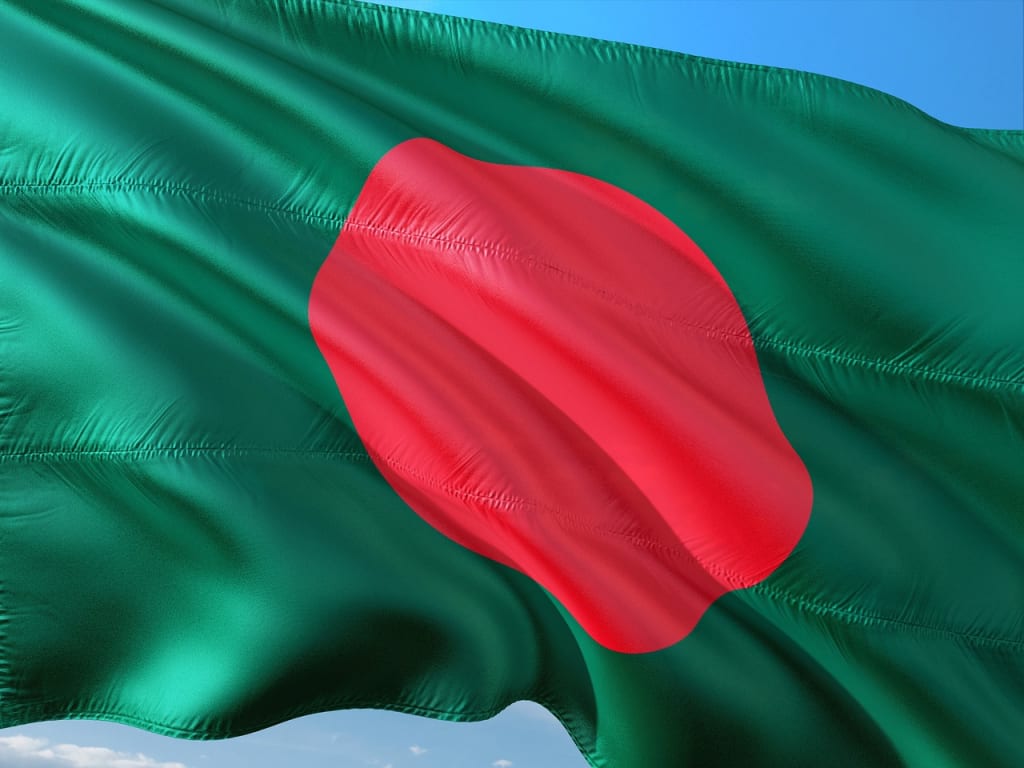
A Nation of Promise, Struggle, and Heritage is Bangladesh. Introduction
Bangladesh, a nation in South Asia, exemplifies perseverance, a diverse cultural heritage, and resilience. This vibrant nation, which is located next to the Bay of Bengal and is largely surrounded by India, has developed a distinct identity through a web of history, tradition, and development. Bangladesh is a land of stories, strength, and lofty goals, from the golden fields of Bengal to the sacrifices its people made during the Liberation War.
1. Landscape and Geography Bangladesh is surrounded by India to the west, north, and east, Myanmar to the southeast, and the Bay of Bengal to the south on its total surface area of approximately 147,570 square kilometers. More than 700 rivers, including Padma (Ganges), Meghna, and Jamuna, traverse the country's mostly flat and fertile topography. Not only are these rivers essential for agriculture and transportation, but they have also had a profound impact on the people's culture and way of life. The Chittagong Hill Tracts, in the southeast, offer hilly terrain and scenic beauty to break up the monotony of the plains.
2. A Trip Through History The land that is now Bangladesh has a long and illustrious history. This area was formerly known as Banga or Gangaridai and was a part of ancient empires like the Maurya, Gupta, Pala, and Sena. Dhaka became an important administrative and commercial center after Islam was introduced around the 13th century, followed by centuries of Muslim rule, including the influential Mughal Empire. British colonial rule began in 1757, following the Battle of Plassey, and continued until 1947. Bangladesh became East Pakistan following the British India partition, separated from West Pakistan by more than 1,600 kilometers. However, widespread unrest was brought about by economic disparity, cultural suppression, and political discrimination.
3. The 1971 Liberation War In 1971, the struggle for independence reached its zenith. Bangabandhu Sheikh Mujibur Rahman ignited the spirit of freedom in Dhaka with a historic speech on March 7. The Pakistani army unleashed brutal attacks on civilians on March 25 with Operation Searchlight. For nine months, the people of East Pakistan engaged in a bloody war that resulted in the displacement of millions and the deaths of three million people. Bangladesh gained independence on December 16, 1971, heralding a fresh start as a sovereign nation.
4. Traditions and customs Bangladesh is a cultural mosaic that reflects a mix of traditional practices, folklore, and contemporary expressions. During the Language Movement of 1952, which ultimately resulted in the country's independence, the Bengali language, which is integral to the nation's identity, was defended. All communities celebrate festivals like Christmas, Pohela Boishakh, Eid ul Fitr, Durga Puja, Buddha Purnima, and the Bengali New Year. In addition, the nation is well-known for its Baul music, Lalon songs, Nakshi Kantha embroidery, and traditional crafts like Jamdani weaving, which UNESCO has designated as part of its intangible cultural heritage.
5. The Economy: Diversifying and Growing Bangladesh has transitioned to a mixed economy, despite its agrarian past. Although agriculture continues to play a role, Bangladesh's Ready-Made Garment (RMG) industry is now Bangladesh's largest exporter of apparel and the largest contributor to GDP. Other important industries include: Workers' remittances from abroad Technology for Information and Communication Pharmaceuticals
Fishing and shipbuilding The Padma Bridge, the Dhaka Metro Rail, the Karnaphuli Tunnel, and the Rooppur Nuclear Power Plant are massive projects that are strengthening the nation's infrastructure and attracting investment from around the world.
6. Health and learning In education, Bangladesh has made significant progress, particularly in female literacy and primary enrollment. Access and outcomes have been improved by community-based education initiatives, stipends for female students, and free textbooks for students. Access to maternal healthcare has increased and child mortality has significantly decreased in the health sector. In addition, Bangladesh produces medicines largely on its own and is emerging as a low-cost exporter in the pharmaceutical sector.
7. Society and Religion Despite its Muslim majority, Bangladesh is home to Christians, Hindus, Buddhists, and other minorities who coexist in a society rooted in tradition and tolerance. The constitution guarantees religious liberty and generally upholds religious harmony. Hospitality, mutual respect, and cultural rites are strong values in Bangladesh's social fabric, which is family- and community-centered.
8. Environment-related Issues Bangladesh is one of the nations that is most vulnerable to climate change because: escalating sea levels Erosion of rivers Flooding
Cyclones
Intrusion of salinity Millions of people's livelihoods, water supplies, and agriculture are at risk from these issues. Bangladesh has been a global voice for climate action and has implemented large-scale adaptation programs with international support despite its limited resources.
9. Bangladesh's Place in the World Bangladesh actively participates in a number of international organizations, including the OIC, SAARC, and the United Nations. It has received worldwide praise for its contributions to UN peacekeeping operations. Over a million Rohingya refugees from Myanmar have been hosted by the nation, which has taken humanitarian leadership and plays a crucial role in regional diplomacy. Influenced by Bangabandhu's principle of "Friendship to all, malice toward none," Bangladesh's foreign policy places an emphasis on peaceful cooperation.
10. Perspective for the Future Bangladesh aspires to become a developed nation with a high income through programs like Vision 2041. The foundation for a society that looks to the future is being laid by the government's focus on digitalization, women's empowerment, youth entrepreneurship, green energy, and smart governance. A "Smart Bangladesh" is being constructed in which innovation, education, artificial intelligence, and e-governance will lead social and economic progress. Conclusion
Bangladesh is a nation that was established through perseverance, sacrifice, and hope. Bangladesh continues to rise with dignity and strength from its ancient heritage and vibrant culture to its modern development and international outreach. Bangladesh is a shining example of possibility not only in South Asia but also globally thanks to its young population, rich traditions, and unwavering spirit. Its journey serves as a reminder that unity, vision, and bravery can lead even the smallest nations to greatness.
About the Creator
Dolphins and Orcas Can’t Evolve Back to Land, Scientists Say
For decades, scientists and enthusiasts have speculated about the possibility of dolphins, orcas, and other cetaceans evolving back onto land. After all, these marine mammals originated from land-dwelling ancestors millions of years ago. However, recent research confirms what many evolutionary biologists suspected: dolphins and orcas cannot evolve back to live on land.
By Aarif Lashariabout 17 hours ago in Earth
Nature’s Hidden Gems: Discovering the Rarest Flowers on Earth
Introduction: When Beauty Meets Rarity Nature is filled with wonders, but few are as captivating—and as elusive—as the rarest flowers on Earth. From enormous parasitic blooms to delicate orchids that appear only under precise conditions, these plants challenge our understanding of survival, evolution, and beauty.
By Ahmed aldeabella6 days ago in Earth




Comments (1)
Bangladesh sounds like a fascinating place. The geography with all those rivers is really something. It's amazing how they've shaped the culture and way of life. And the history is quite a journey, from ancient empires to colonial rule and then the fight for independence. I wonder how much of that rich heritage is still very much alive and celebrated in Bangladesh today? Do people there feel a strong connection to those past empires and the liberation struggle?