
Bagram Revisited: A Historic Afghan Hub at the Center of Global Tension
A concise history of Bagram — its role from antiquity to the Cold War and the U.S. era — and the geopolitical fallout after recent U.S. moves, Taliban pushback, and China’s response.

By Real contentPublished 5 months ago • 5 min read
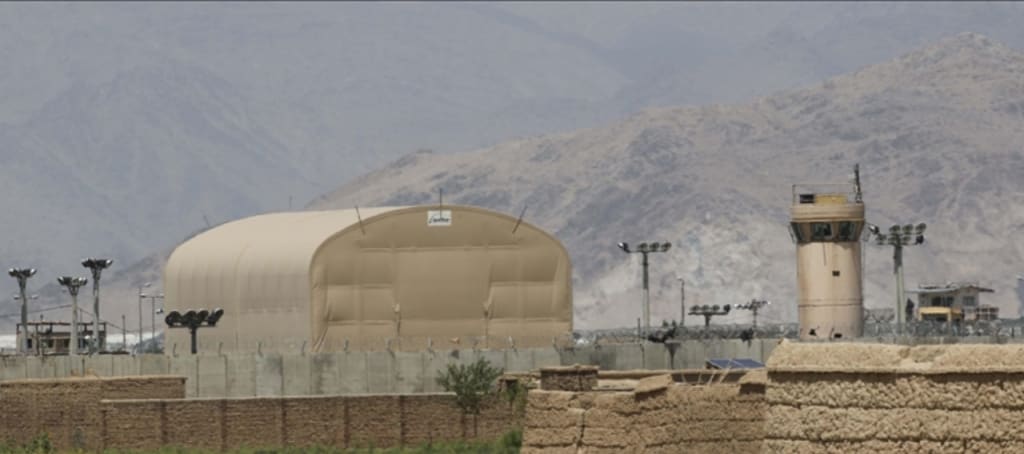
- Bagram is once again the focal point of power narratives. Built in the 1950s by the Soviet Union at the foot of Afghanistan’s snow-covered mountains, this airbase became the military hub for two global powers — the Soviet Union and the United States. Today, it is under the administration of the Afghan Ministry of Defense. Yet, the history of this site in Parwan province in northern Afghanistan is centuries old.
It should be recalled that the Taliban government in Afghanistan has rejected the U.S. announcement of regaining control of the Bagram airbase, saying that those with such ambitions “should look at the history of Afghanistan.”
Following the U.S. announcement, not only did the Taliban respond, but China also issued a strong reaction.
At the crossroads of Central Asia, South Asia, and the Middle East, about 60 kilometers north of the Afghan capital Kabul, Bagram lies on a high plateau at the foot of the Hindu Kush mountains. It has at different times served as the headquarters of Alexander the Great’s armies, and later, as the summer capital of Kushan kings.
Buddhist monasteries once echoed here with the ringing of bells, and in the 7th century Arabs transformed the spiritual character of this region. As a key junction on the ancient Silk Road, caravans from Rome, Iran, India, and China passed through this trading hub.
The Encyclopedia Britannica notes that the city of Alexandria-Capisa, founded by Alexander the Great, gradually became the most important center for India’s western trade.
According to Britannica:
“Not only goods but also ideas and beliefs passed through here. India’s religious concepts, particularly Buddhism, along with literary and artistic styles flourishing in Gandhara (present-day northwestern Pakistan, between the Kabul River’s lower valley, the Kunduz River, and the Indus River) and Mathura (Punjab, northwestern India), reached Bactria through these routes — from where they spread to Kashmir, Tibet, China, and sometimes as far as the remote oasis towns of Xinjiang.”
In Archaeological Gazetteer of Afghanistan, Warwick Ball and Jørgen Glædgaard write:
“The Buddhist and Hindu statuary from this city indicates that it was initially ruled by people of Indian origin — either migrants who came here, or those who mingled with Iranian peoples such as the Kamboja from Bactria who entered the region.”
When Alexander’s successors were fighting among themselves, the Mauryan Empire was rising in northern India. Its founder, Chandragupta Maurya, confronted an invading army led by Seleucus I, Alexander’s general, in 305 BCE. A brief war ended in a treaty under which Seleucus ceded Gandhara, Arachosia (centered on ancient Kandahar), and the regions south of Bagram (modern southeastern Afghanistan) to the Mauryan Empire.
During the nearly 120-year Mauryan era, Buddhism was introduced to southern Afghanistan, where it grew alongside Zoroastrianism and local ancient religions. Coins from the Mauryan period have been discovered in Bagram and Mir Zakah, pointing to either trade or administrative presence in the region.
Later Called “Kapisa”
Today, one of Afghanistan’s provinces still bears the name Kapisa. References to the city of Kapisa appear as early as the 5th century BCE in the writings of the Indian scholar Panini, who also mentioned the locally produced Kapisiana wine. The name Kapisa appears on the coins of Indo-Greek rulers Apollodotus and Eucratides, as well as on those of the Nezak Huns.
Archaeological remains of ancient Kapisa (today’s Bagram) are found in the surrounding areas.
Historian Tristan Hughes notes:
“This city witnessed several invasions by ancient superpowers: the Persians, Alexander and his successors. But it was during the Kushan Empire that the prosperous, ancient Bagram saw its golden age.”
According to Abdul Wahid Alikozai in A Concise History of Afghanistan:
“Between the 1st and 4th centuries CE, the Kushan Empire — stretching from northern Afghanistan to northwestern India — established its summer capital here. It played a key role in the defense of the Greco-Bactrian kingdom.”
“The city had high walls and towers. Along its main avenue stood the magnificent Kushan palace, housing workshops and shops filled with Indian ivory carvings, Indian lacquer chests, Egyptian and Roman glass, plastered panels, and goods brought along the Silk Road.”
This famed “Bagram Treasure” testifies to the vibrant trade during the Kushan era. Even after Kapisa’s decline, goods brought via the Silk Road were found stored here in the Sassanian period.
Later Periods
After the Kushan Empire, Kapisa remained part of a kingdom ruled by a Buddhist Kshatriya monarch.
The Chinese pilgrim Xuanzang visited here in 644 CE and wrote that the local king ruled over ten neighboring states. Xuanzang also mentioned the region’s famous horses, its grains, fruits, and an aromatic root grown here.
The book Mughal India: Art, Culture and Empire (edited by J.P. Losty and Malini) notes that Islamic conquests in Afghanistan and adjacent Pashtun regions began in the 7th century, shortly after the conquest of Iran.
According to Richard Nelson Frye in Encyclopaedia of Islam, in 1221 the province of Parwan, where Bagram lies, was the site of a historic battle in which invading Mongol forces led by Genghis Khan were defeated by the Khwarazmian ruler Jalal al-Din Mangburni.
Mughal India also records that Afghanistan’s fully Islamic identity was established under the Ghaznavids. The region later came under Timurid and Mughal control.
It is believed that the present-day town was built on the ruins of the ancient city by Zahiruddin Babur. In his memoir Baburnama, he described his 1519 journey, noting a settlement of Hindu ascetics that fascinated him.
Frye writes that in 1747, Ahmad Shah Durrani incorporated Parwan into his Durrani Empire. Later, in 1840, during the First Anglo-Afghan War, Parwan again became the site of a major battle in which British forces were defeated.
A Great Crossroads
According to Hughes, this city was once a great hub linking China, India, and the Mediterranean. Goods produced across Eurasia arrived here through trade and diplomacy. One particular collection symbolizes this connection: the Bagram Hoard.
French archaeologists discovered this treasure — a stunning assortment of objects from ancient China, India, and the Roman Mediterranean, all gathered in one place.
In 1939, excavations revealed that Kapisa was also a center of wine trade in antiquity. Bottles, fish-shaped jars, and drinking vessels were found — typical paraphernalia of the wine trade. Grapes and wine from this region are also mentioned in several ancient Indian texts.
Under the distribution system of that time, the discoveries were divided between the Musée Guimet (Paris) and the National Museum of Kabul. After the Kabul Museum’s closure in 1978, the whereabouts of ivory artifacts became uncertain, and many were looted in the 1990s.
Robert J. Morgan in On This Day quotes the Times of London headline of October 22, 1996:
“Lost Forever: A Nation’s Heritage Looted by Its Own People.”
The paper wrote:
“Kabul’s National Museum lies in ruins. Once home to one of the greatest collections of multicultural antiquities in the world — Persian, Indian, Chinese, Central Asian, and beyond — it has been destroyed.
The basements were blown apart, showcases smashed, antiquities looted and sold worldwide for quick cash. Rockets pierced the roof, burying ancient bronzes under tons of rubble. Prehistoric pots were stuffed into sacks as though they were cheap porcelain.”
“The Bagram Treasure — one of the greatest archaeological discoveries of the 20th century — disappeared. Nearly 40,000 coins, among the world’s oldest, vanished. A radiant past was wrecked by an unrestrained present. A nation was robbed of its history.”
Peter Beaumont wrote in The Guardian that in 2004, some of these missing objects resurfaced, and 20 more antiquities being sold illegally through dealers were recovered. After restoration at the British Museum, they were exhibited in 2011.
About the Creator
Keep reading
More stories from Real content and writers in Earth and other communities.
Salal Dam Release Sparks Cross-Border Flood Fears Between India and Pakistan
The Salal Dam in India has come under discussion after repeated concerns in Pakistan’s local media and on social platforms that the release of hundreds of thousands of cusecs of water from this dam could once again trigger flooding in Punjab’s Chenab River.
By Real content6 months ago in Earth
Winterthorne
Winterthorne stood alone at the edge of the park. The beautiful snow that had surrounded him was all trampled now, from the feet of all of the children who had built him. He missed the sparkly clean snow blanket, but he was happy that so many children had come out to make him.
By Laura DePace7 days ago in Fiction


Comments
There are no comments for this story
Be the first to respond and start the conversation.