
Australia Fertilizer Market Size and Forecast 2025–2033
Australia’s Fertilizer Industry Grows Steadily as Sustainability and Precision Farming Take Center Stage

Introduction
Australia’s agricultural sector has long been the backbone of the nation’s economy, supplying food and raw materials not only to domestic consumers but also to major export markets worldwide. At the heart of this productivity lies the fertilizer industry, which plays a vital role in maintaining soil fertility, enhancing crop yields, and ensuring food security. As farming practices evolve to address environmental concerns, climate variability, and rising global demand, the fertilizer market in Australia is undergoing a meaningful transformation.
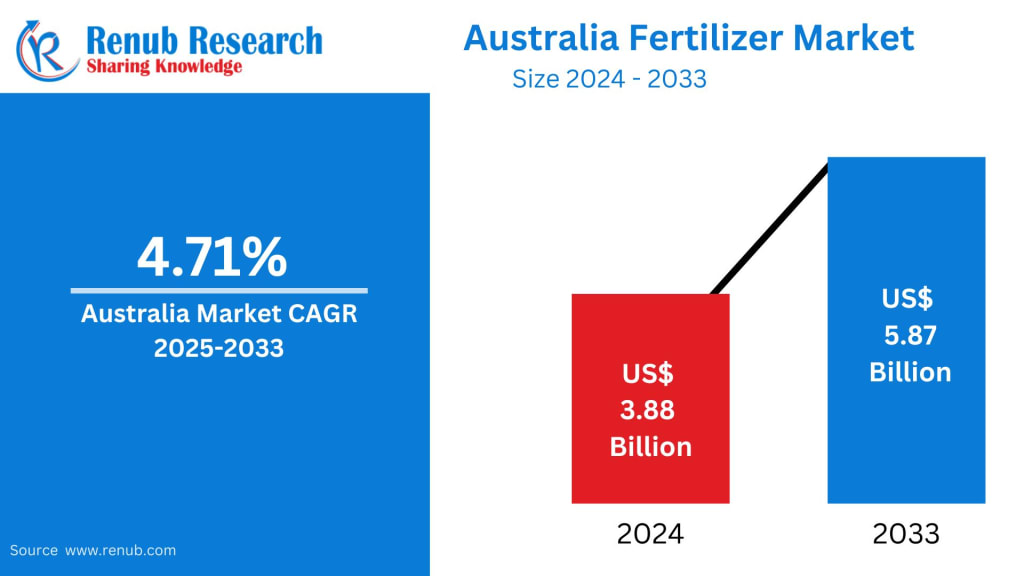
According to Renub Research, the Australia Fertilizer Market was valued at US$ 3.88 billion in 2024 and is projected to reach US$ 5.87 billion by 2033, growing at a compound annual growth rate (CAGR) of 4.71% during 2025–2033. This growth is driven primarily by farmers’ increasing preference for sustainable and organic fertilizer solutions that enhance soil health while reducing environmental impact.
Australia Fertilizer Market Overview
Australia’s fertilizer market is essential to sustaining agricultural productivity across diverse climatic zones, ranging from tropical regions in the north to temperate zones in the south. Fertilizers are widely used to replenish nutrient-deficient soils, support intensive farming, and improve crop quality across cereals, fruits, vegetables, and industrial crops.
The market includes both inorganic fertilizers, such as nitrogen, phosphorus, and potassium products, and organic and bio-fertilizers, which are gaining traction due to environmental and soil health benefits. Strict safety and environmental regulations govern fertilizer production, distribution, and usage, ensuring compliance with sustainability standards while minimizing ecological harm.
Australia relies on a mix of domestic fertilizer production and imports, creating a competitive and well-supplied market environment. Over recent years, innovation, sustainability, and precision farming technologies have emerged as defining themes shaping market development.
Shift Toward Sustainability and Precision Agriculture
Sustainability has become a defining pillar of Australia’s fertilizer industry. Farmers are increasingly adopting precision agriculture techniques to optimize fertilizer use, reduce wastage, and improve nutrient uptake efficiency. These practices are supported by advancements in soil testing, satellite imaging, and digital farm management tools.
Government initiatives have further accelerated this shift. In 2023, the Australian government allocated USD 30 million to support grain growers, helping them manage risks associated with drought, market volatility, and climate change. This funding has encouraged the adoption of modern irrigation systems and advanced fertilizer management practices nationwide.
Australia’s agricultural sector now uses more than 8.1 million megaliters of water annually, supported by improved irrigation infrastructure. While adoption of drip irrigation remains relatively low—around 9% for surface drip and 2% for sub-surface drip systems—there is growing momentum toward water-efficient and nutrient-efficient farming models.
Key Growth Drivers in the Australia Fertilizer Market
Rising Agricultural Demand
Rising agricultural demand is one of the strongest drivers of fertilizer consumption in Australia. Population growth, expanding export markets, and increasing food requirements have placed pressure on farmers to improve productivity and crop yields. Fertilizers play a crucial role in meeting the nutrient needs of crops such as wheat, barley, fruits, vegetables, and pulses.
Australia’s position as a major exporter of agricultural commodities further amplifies fertilizer demand. High-quality crop production requires consistent nutrient management, making fertilizers indispensable to modern farming operations.
Growth in Horticulture and Field Crops
The expansion of horticulture and field crops has significantly boosted fertilizer usage across the country. High-value crops such as fruits, vegetables, and grains require precise nutrient formulations to achieve optimal yield and quality.
Export-oriented horticulture has encouraged year-round production and intensive farming practices, increasing the need for specialized fertilizer solutions. Domestic and international demand for premium-quality produce has also motivated farmers to invest in soil fertility and plant health, further driving fertilizer consumption.
Innovation in Fertilizer Products
Innovation is reshaping the future of Australia’s fertilizer market. Manufacturers are increasingly developing slow-release, water-soluble, and eco-friendly fertilizers that improve nutrient efficiency while minimizing environmental impact.
Slow-release fertilizers provide nutrients gradually, reducing application frequency and nutrient losses. Water-soluble fertilizers, on the other hand, are ideal for modern irrigation systems and allow precise nutrient delivery. These innovations align closely with Australia’s sustainability goals and growing regulatory emphasis on responsible agricultural inputs.
Challenges Facing the Australia Fertilizer Market
High Cost of Specialty Fertilizers
Despite their benefits, specialty fertilizers—such as slow-release and water-soluble formulations—often come with higher costs. For small and medium-sized farmers, these expenses can be prohibitive, especially during periods of tight profit margins or economic uncertainty.
As a result, many farmers continue to rely on traditional fertilizers, even though advanced products may offer better long-term returns. Government subsidies, cooperative purchasing models, and research-driven cost reductions could help bridge this affordability gap and encourage broader adoption.
Stringent Environmental Regulations
Australia’s fertilizer industry operates under strict environmental regulations designed to minimize nutrient runoff, soil degradation, and greenhouse gas emissions. While these rules support long-term sustainability, they also increase compliance costs for manufacturers and distributors.
Companies must invest in cleaner production technologies, monitoring systems, and regulatory reporting, which can limit short-term profitability and slow product launches. However, adherence to environmental standards is increasingly viewed as essential for maintaining public trust and ensuring long-term industry viability.
Regional Insights: Australia Fertilizer Market
Northeast Australia Fertilizer Market
Northeast Australia, particularly North Queensland, plays a crucial role in the national fertilizer landscape. The region hosts major manufacturing facilities, including Incitec Pivot’s ammonium phosphate plant at Phosphate Hill, which supplies both domestic and export markets.
Agricultural activities such as sugarcane, cotton, and horticulture drive fertilizer demand in this region. Due to its proximity to the Great Barrier Reef, fertilizer application is closely regulated to prevent nutrient runoff and protect marine ecosystems. Sustainable farming practices are therefore essential to balancing productivity and environmental conservation.
Midwest Australia Fertilizer Market
The Midwest region, especially Western Australia, is experiencing strong fertilizer market growth driven by extensive grain production, livestock farming, and horticulture. Major investments are strengthening the fertilizer supply chain to meet rising demand.
Nutrien Ag Solutions’ USD 70 million fertilizer distribution center in Rockingham will increase bulk granular fertilizer storage capacity by 20%. Meanwhile, CBH Group is expanding into liquid fertilizers with a new Urea Ammonium Nitrate (UAN) storage facility near Kwinana port. These developments enhance supply efficiency and support the region’s long-term agricultural sustainability.
South Australia Fertilizer Market
South Australia’s fertilizer market reflects the state’s diverse agricultural landscape, ranging from grain and cereal production on the Eyre Peninsula to horticulture in the Riverland region. Variable climate conditions, including frequent droughts, make efficient nutrient management critical.
Local distributors and suppliers play a key role in ensuring timely fertilizer availability. Farmers increasingly prioritize customized fertilizer solutions tailored to specific soil types and crop requirements, reinforcing the importance of innovation and regional expertise.
Australia Fertilizer Market Segmentation Analysis
By Type
Nitrogen Fertilizers: Urea, Ammonium Nitrate, Ammonium Sulfate, Others
Phosphorus Fertilizers: Superphosphates, MAP, DAP
Potassium Fertilizers: Potash, SOP
Bio-Fertilizers: Microbial, Organic Variants
By Category
Organic
Inorganic
By Form
Dry
Liquid
By Application
Agriculture
Horticulture
Gardening
Others
By Crop
Grassland, Vegetables, Fruits/Treenuts, Roots/Tubers, Sugar Crops, Fibre Crops, Other Oil Crops, Oil Palm, Soybeans, Other Cereals, Maize, Rice, Wheat, Others
By Region
Northeast
Midwest
South
West
Competitive Landscape and Company Analysis
The Australia fertilizer market features strong participation from global and regional players focused on innovation, sustainability, and supply chain efficiency. Renub Research covers key companies from four viewpoints—overview, key persons, recent developments, and revenue.
Key Companies Profiled
Yara International ASA
K+S AG
CF Industries Holdings
Grupa Azoty S.A.
ICL Group
OCI NV
Sociedad Química y Minera de Chile SA
BASF SA
PhosAgro
These companies continue to invest in product innovation, sustainable fertilizer solutions, and strategic infrastructure expansion to strengthen their position in the Australian market.
Final Thoughts
The Australia Fertilizer Market is on a steady growth path, supported by rising agricultural demand, expansion in horticulture and field crops, and increasing adoption of sustainable farming practices. With the market projected to grow from US$ 3.88 billion in 2024 to US$ 5.87 billion by 2033, fertilizers will remain a cornerstone of Australia’s agricultural success.
While challenges such as high specialty fertilizer costs and strict environmental regulations persist, innovation and government support are creating new opportunities. As farmers continue to embrace precision agriculture and eco-friendly inputs, the fertilizer industry is well-positioned to support Australia’s food security, export competitiveness, and long-term agricultural sustainability.
About the Creator
Renub Research
Renub Research is a Market Research and Consulting Company. We have more than 15 years of experience especially in international Business-to-Business Researches, Surveys and Consulting. Call Us : +1-478-202-3244
Keep reading
More stories from Renub Research and writers in Earth and other communities.
Global Water Purifier Market Size and Forecast 2025–2033
Introduction: Clean Water at the Center of Global Health and Development Access to clean and safe drinking water has become one of the most pressing global priorities of the 21st century. Rising concerns over water contamination, rapid urbanization, industrial discharge, and increasing awareness of health and wellness have brought water purification solutions into the spotlight. As a result, water purifiers are no longer viewed as luxury appliances but as essential household and commercial utilities across many regions of the world.
By Renub Research26 days ago in Earth
Severe Cold Grips the Country as Hunza Records −21°C: Pakistan Faces a Deep Winter Freeze
A powerful cold wave has swept across Pakistan, plunging temperatures to alarming lows and turning daily life into a test of endurance for millions. The northern region of Hunza has recorded a bone-chilling −21°C, marking one of the coldest temperatures of the season and drawing national attention to the intensity of this winter. As icy winds cut through valleys and plains alike, the country is experiencing a severe cold spell that is affecting health, travel, agriculture, and energy supplies. Hunza at the Center of the Freeze Hunza, known worldwide for its breathtaking landscapes and serene beauty, has transformed into a frozen world. At −21°C, rivers partially freeze, roads become slippery, and even routine activities turn risky. Residents of the valley, though accustomed to harsh winters, describe this cold as unusually intense. Water pipelines have frozen solid, livestock require special care, and heating resources are stretched to their limits. Despite the extreme conditions, life continues. Locals rely on traditional methods of insulation, wood-burning stoves, and community cooperation to survive the cold nights. However, the severity of the temperature has raised concerns about vulnerable groups, including the elderly, children, and those living in remote areas with limited access to fuel and medical facilities. Cold Wave Spreads Across Pakistan While Hunza sits at the epicenter of the cold, the effects are being felt nationwide. Gilgit-Baltistan and parts of Khyber Pakhtunkhwa are experiencing sub-zero temperatures, while major cities like Islamabad, Lahore, and Karachi are facing unusually cold mornings and dense fog. In the plains, nighttime temperatures have dropped sharply, catching many residents off guard. The Pakistan Meteorological Department has warned that the cold wave may persist, driven by continental air systems moving southward. These systems not only lower temperatures but also increase the risk of frost, fog, and icy conditions on highways, disrupting travel and trade. Impact on Daily Life and Health Severe cold brings serious health risks, particularly for those without adequate shelter or heating. Hospitals in colder regions report an increase in patients suffering from hypothermia, respiratory infections, and flu-like illnesses. Doctors advise people to stay warm, avoid unnecessary exposure to cold, and ensure proper ventilation when using indoor heaters to prevent carbon monoxide poisoning. In urban areas, gas shortages and power outages have intensified the struggle. Many households face limited gas supply during peak morning and evening hours, forcing families to rely on electric heaters or alternative fuels. This increased demand places additional pressure on the national power grid, raising the risk of load shedding. Agriculture and Livelihoods Under Threat The cold wave poses a significant threat to agriculture, particularly winter crops and orchards. Frost can damage wheat fields, vegetables, and fruit trees, potentially impacting yields and farmers’ incomes. In northern areas, livestock owners are working hard to protect animals from the cold, as freezing temperatures can lead to illness and even death among cattle and sheep. Tourism, a vital source of income for regions like Hunza, has also been affected. While some tourists are drawn by the snow-covered scenery, many trips have been canceled due to dangerous road conditions and travel advisories. Local businesses, already facing economic challenges, are feeling the strain of reduced visitor numbers. Government Response and Preparedness Authorities across Pakistan have issued cold weather alerts and advisories, urging citizens to take precautionary measures. Disaster management agencies are monitoring the situation, particularly in northern and mountainous regions where access can be cut off due to snow and ice. Emergency services have been placed on high alert, and local administrations are working to ensure the availability of fuel, food supplies, and medical assistance. However, experts stress that long-term planning is essential, as extreme weather events are becoming more frequent due to climate change. Climate Change and Extreme Winters Meteorologists and climate scientists point out that while Pakistan has always experienced cold winters, the increasing intensity and unpredictability of such cold waves may be linked to broader climate patterns. Shifts in jet streams and changing atmospheric circulation can result in extreme cold spells in regions not always prepared for them. These events highlight the need for improved infrastructure, better energy management, and stronger disaster preparedness strategies to protect vulnerable populations. Resilience in the Face of the Cold Despite the freezing temperatures, stories of resilience continue to emerge. Communities in Hunza and other cold-hit areas are supporting one another, sharing firewood, food, and shelter. Volunteers and local organizations are stepping in to help those most in need, proving once again the strength of communal bonds in times of hardship. Conclusion As severe cold grips Pakistan and Hunza records a staggering −21°C, the country faces a challenging winter marked by health risks, energy shortages, and economic strain. Yet, amid the icy conditions, resilience and solidarity shine through. This cold wave serves as a reminder of nature’s power and the importance of preparedness, cooperation, and compassion in overcoming even the harshest winters.
By Fiazahmedbrohi about 8 hours ago in Earth



Comments
There are no comments for this story
Be the first to respond and start the conversation.