
Atomic Force Microscopy: Illuminating the Nanoscale World of Biology
Unveiling the Nanoscale: Atomic Force Microscopy Revolutionizes Biology

Introduction:
The microscopic world has been a realm of fascination and discovery for scientists across generations. However, conventional microscopy methods have their limitations, especially when it comes to exploring nanoscale structures without harming living samples. Fortunately, in the mid-1980s, a breakthrough technology known as Atomic Force Microscopy (AFM) revolutionized the field of nanobiology. This remarkable innovation allows researchers to observe and manipulate tiny biological entities in real-time without causing harm. In this blog, we will delve deeper into the power of AFM and its profound impact on the realm of biology.
The Limit of Diffraction and the Rise of Electron Microscopy:
Conventional visible light microscopes have been instrumental in studying cells and bacteria. However, they encounter a significant challenge: the limit of diffraction. Objects smaller than 200 nanometers appear blurry due to the spreading out of light waves. To overcome this limitation, scientists turned to electron microscopy in 1933. Electron microscopes utilize a beam of electrons to achieve incredible resolution, up to 0.1 nanometers. Unfortunately, this technique requires the samples to be dead, dehydrated, and placed in a vacuum, causing potential damage to delicate biological structures.
Introducing Atomic Force Microscopy (AFM):
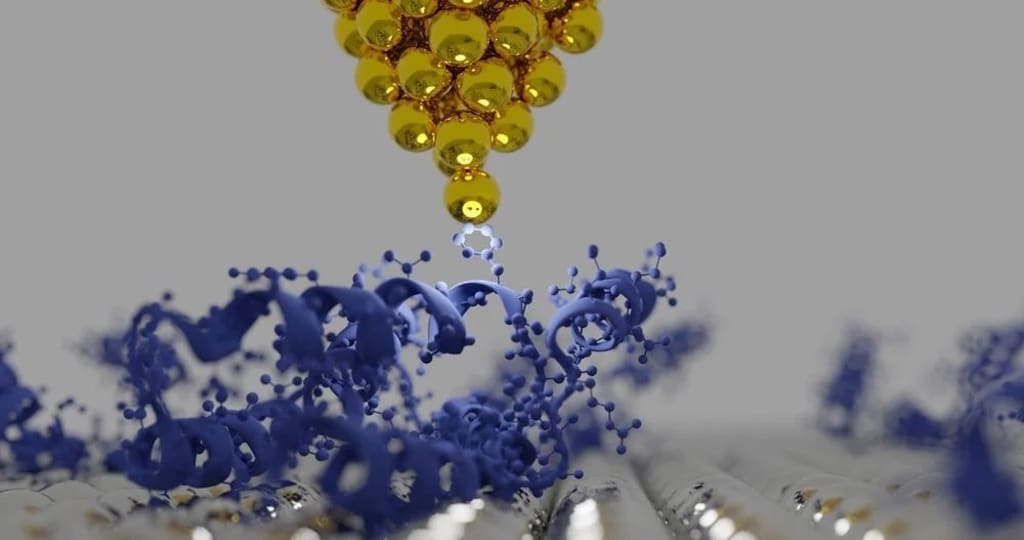
In stark contrast to electron microscopy, AFM offers a non-invasive and real-time approach to observe nanoscale structures. AFMs employ a minuscule probe that hovers just above the sample's surface, sensing the van der Waals forces between the probe and the specimen. This interaction provides valuable information about the topography of the sample down to the atomic level. Additionally, AFMs have the capability to measure mechanical properties such as surface friction and stiffness, offering deeper insights into the behavior of biological entities.
Real-Time Nanobiology:
Unveiling Dynamic Molecular Events One of the most significant advancements brought about by AFM is its ability to capture real-time nanobiological processes. Traditional AFMs were limited by slow imaging speed, potentially missing vital details. However, by 2001, high-speed AFMs were developed, capturing up to 50 frames per second. This technological leap enables scientists to witness dynamic molecular events that were previously hidden from observation. For instance, researchers can now observe the mesmerizing formation of the DNA double helix or the intricate folding of proteins as they occur in living samples.
Implications for Cancer Research:
Decoding the Mechanical Properties of Cells AFM has proven invaluable in cancer research by providing unique insights into the mechanical properties of cells. Cancerous cells often exhibit different mechanical behaviors compared to healthy cells, making AFM a promising tool for cancer diagnostics. By analyzing the stiffness and deformability of cells, researchers can distinguish between cancerous and healthy cells with greater accuracy. This breakthrough offers the potential for early and more precise cancer detection, leading to improved treatment outcomes.
Manipulating Molecular Interactions:
Precision Medicine Takes a Leap Beyond its observational capabilities, AFM empowers scientists to manipulate molecular interactions at the nanoscale. By attaching drug molecules to the AFM's scanning probe and targeting specific cellular receptors, researchers can gain unprecedented insight into how drugs interact at the molecular level. This knowledge opens up new possibilities for designing personalized and highly targeted treatments for various diseases, including cancer.
Conclusion:
Pioneering the Nanoscale Frontier Atomic Force Microscopy has ushered in a new era of exploration in the world of nanobiology. This non-invasive and real-time imaging technique allows scientists to study living samples, paving the way for groundbreaking discoveries in cancer research and molecular interactions. As AFM technology continues to evolve, it holds immense potential to unravel the mysteries of life at its tiniest scale. With every advancement, we come one step closer to understanding the intricate workings of life's building blocks and shaping a healthier future through precision medicine.
About the Creator
Rohit Singh
Software developer, part-time content creator, and tech enthusiast.
Unleashing creativity and embracing tech. Join me on this thrilling journey! 🚀
Keep reading
More stories from Rohit Singh and writers in Earth and other communities.
Transforming Food Waste: The Journey from Farm to Compost
Unveiling the Heart of Food Waste Management In a small town, located 80 miles east of the vibrant city of San Francisco, lies a bustling site that holds a secret to a greener tomorrow - the transformation of food waste into valuable compost. Every day, more than a dozen trucks arrive at this unassuming location, laden with discarded food waste. But this seemingly mundane process of unloading waste holds the key to a remarkable journey orchestrated by some of the tiniest and most underrated workers on the planet - microorganisms!
By Rohit Singh3 years ago in Earth
Nuclear Transmutation: The Accidental Dream of Making Gold
Picture a laboratory humming with quiet intensity, banks of instruments blinking in the low light, and somewhere inside a shielded reactor chamber, something almost magical is happening. An element is changing. One thing is becoming another. What was mercury is now, atom by atom, becoming gold.
By CurlsAndCommas5 days ago in Earth



Comments
There are no comments for this story
Be the first to respond and start the conversation.