
Are We Living in a Cosmic Mirage? The Black Hole Theory of Our Universe
Examining the Intriguing Idea that Our Universe Emerged from the Heart of a Black Hole

Introduction
The universe is a vast and mysterious place that has intrigued scientists, philosophers, and curious people for centuries. While we have made remarkable progress in understanding many aspects of our cosmos, there are still many unanswered questions that continue to fascinate us. One such question is whether our universe is inside a black hole, as proposed by some physicists.
The Black Hole Universe Hypothesis
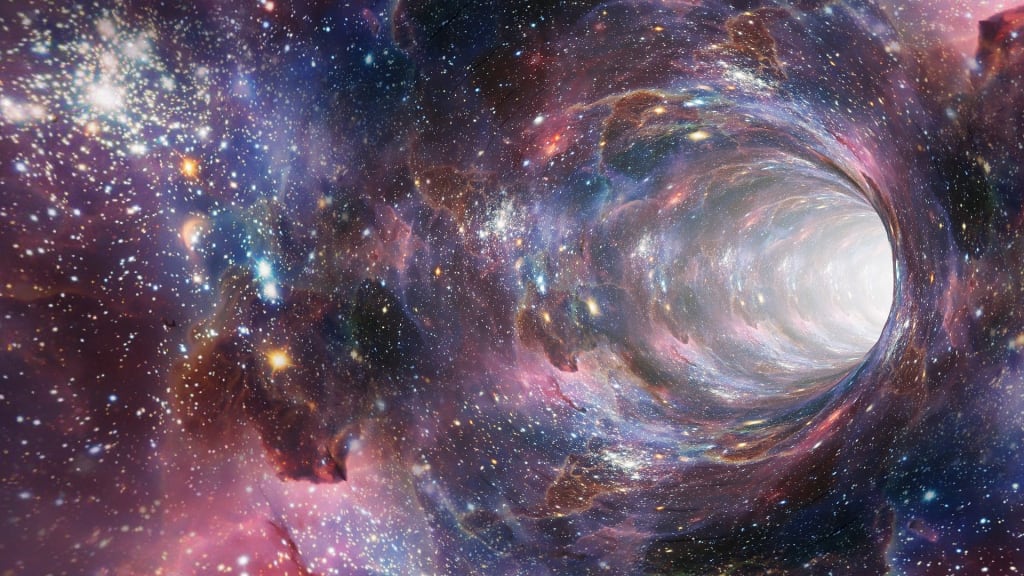
The black hole universe hypothesis is a mind-bending idea that challenges our notions of space and time. It is based on the concept of higher dimensions and the properties of black holes. According to this hypothesis, our universe could be the interior of a black hole that exists in a higher-dimensional universe. In other words, the three-dimensional space that we perceive as the universe is embedded in a four-dimensional space-time.
This hypothesis has been proposed by several physicists, including Juan Maldacena, Leonard Susskind, and Stephen Hawking, among others. It is a speculative idea that has not yet been confirmed by observation or experiment, but it has generated a lot of interest and speculation in the scientific community.
The Properties of Black Holes
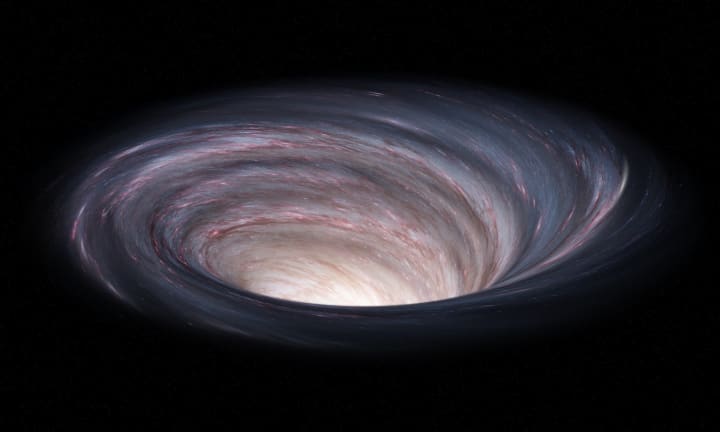
To understand the black hole universe hypothesis, it is important to first understand the properties of black holes. A black hole is a region of space where the gravitational pull is so strong that nothing, not even light, can escape from it. Black holes are formed when massive stars collapse under their own weight, creating a singularity where space and time become infinitely curved.
The singularity at the center of a black hole is a point of infinite density and zero volume, where the laws of physics as we know them break down. This is one of the reasons why black holes are such fascinating objects to study, as they challenge our understanding of the universe and the nature of reality.
The Evidence for the Hypothesis
While the black hole universe hypothesis is still speculative, there are some interesting pieces of evidence that support it. One such piece of evidence is the cosmic microwave background radiation (CMB), which is the afterglow of the Big Bang. According to the hypothesis, the CMB could be the result of the gravitational collapse of a massive star that formed a black hole in a higher-dimensional universe.
The CMB is one of the most important pieces of evidence for the Big Bang theory, which is the prevailing model of the origin and evolution of the universe. The fact that the CMB has a uniform temperature and structure across the entire sky is a strong indication that it was produced by a uniform event, such as the rapid expansion of the universe in its early stages.
Another piece of evidence that supports the black hole universe hypothesis is the existence of dark matter, which is a mysterious substance that is thought to make up a large portion of the mass of the universe. According to the hypothesis, dark matter could be the gravitational influence of the black hole that our universe is inside.
Dark matter is one of the biggest mysteries in modern astrophysics. It does not emit, absorb, or reflect light, so it cannot be detected directly. However, its gravitational influence can be observed in the motions of stars and galaxies, which suggests that it is a real and significant component of the universe.
The Implications of the Hypothesis
If the black hole universe hypothesis is true, it would have profound implications for our understanding of the universe. For one, it would mean that our universe is not a self-contained entity, but rather a part of a larger, higher-dimensional universe. This would raise many questions about the nature of this higher-dimensional universe and our place within it.
It would also mean that the singularity at the center of the black hole that our universe is inside could be the origin of the laws of physics that govern our universe. The black hole singularity is a point where space and time become infinitely curved and quantum effects become dominant. This means that the singularity could be the key to unifying the two biggest theories in physics – general relativity and quantum mechanics.
Moreover, if the black hole universe hypothesis is true, it would also mean that our universe has a finite size and age, as it is embedded in a larger universe that is older and possibly infinite in size. This would challenge the idea that the universe is infinite and eternal, which has been a recurring theme in cosmology throughout history.
The Challenges to the Hypothesis
While the black hole universe hypothesis is an intriguing idea, it is also a speculative one that has not yet been confirmed by observation or experiment. There are several challenges and criticisms to the hypothesis that need to be addressed before it can be taken seriously as a scientific theory.
One challenge is the lack of direct evidence for the existence of higher dimensions and the properties of black holes beyond what we can observe. While there are indirect pieces of evidence that support the hypothesis, such as the CMB and dark matter, they are not conclusive and could be explained by other models.
Another challenge is the mathematical complexity of the hypothesis, which requires the use of advanced theories such as string theory, quantum mechanics, and general relativity. These theories are not yet fully understood and are still being developed and tested.
Moreover, the black hole universe hypothesis is a non-falsifiable theory, which means that it cannot be tested by observation or experiment. This is because the black hole singularity is a point where the laws of physics break down and our current understanding of the universe becomes invalid. This makes it difficult to formulate specific predictions that can be tested.
Conclusion
In conclusion, the black hole universe hypothesis is a fascinating and thought-provoking idea that challenges our notions of the universe and the nature of reality. While it is still a speculative hypothesis that has not yet been confirmed by observation or experiment, it has generated a lot of interest and speculation in the scientific community.
If the hypothesis is true, it would have profound implications for our understanding of the universe and the laws of physics that govern it. It would also raise many questions about the nature of the higher-dimensional universe that our universe is embedded in.
As we continue to explore the mysteries of the universe, it is important to keep an open mind and be willing to consider new and unconventional ideas, even if they challenge our current understanding of the world. The black hole universe hypothesis is a prime example of this, and it will be fascinating to see how it develops and evolves over time.
References
[1] Almheiri, A., Marolf, D., Polchinski, J., & Sully, J. (2013). Black holes: complementarity or firewalls?. Journal of High Energy Physics, 2013(2), 062.
[2] Hawking, S. W. (1971). Gravitational radiation from colliding black
About the Creator
krish
Freelance writer and blogger sharing meaningful stories about universe, nature and humanity. Daring to know more, exploring and sharing insights on a journey of discovery. Join me in this never-ending quest for knowledge.
Pandora’s Burden
“My brother warned me to not accept gifts from the one who commissioned you,” said Epimetheus to the woman clad in silvery raiments standing at the entrance to the temple. Her silver tiara and the silver rings on her fingers and toes glinted in the firelight cast by torches set on either side of the doorway. Lingering in the shadows, beyond the reach of the flames as she was, he could not tell what she held in her hands. At first what appeared to be a box was perhaps a funerary urn, or maybe merely an apple.
By J. Otis Haas3 days ago in Fiction




Comments
There are no comments for this story
Be the first to respond and start the conversation.