
Are eels really the natural enemy of snakes?
The reason why the snake has the upper hand

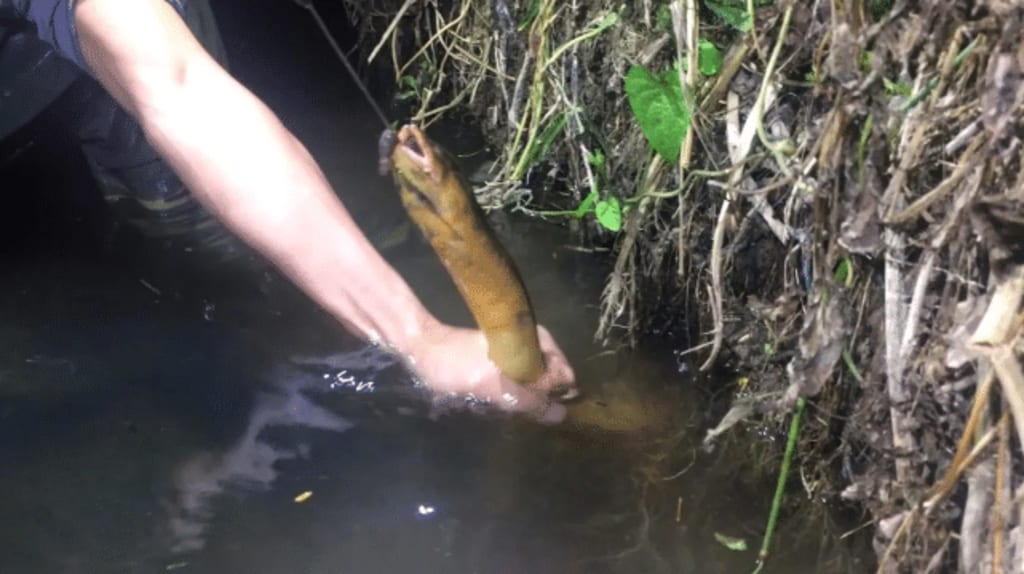
In the midsummer of childhood, my friends spent their time "touching snails and catching crabs during the day, and catching eels by taking pictures of frogs at night".
But my grandfather didn't allow me to catch the eel at night, he said, "Don't look at the eel, it's a bit dumb. It is very fierce and will bite people. Even snakes are afraid of the eel."
Regarding the saying that "snakes are afraid of eels", there are still several versions of the folk saying that snakes eat eels.
But no matter what the next sentence is, it all points to the same meaning, that is: the snake eats the eel, and the ending is tragic.
To sum up, the main reasons why people think snakes have the upper hand are the following:
1. The eel is very ferocious, and ordinary snakes are not its opponents;
2. The eel is poisonous and does not rot when it dies. Many animals do not eat the dead eel, and snakes naturally do not dare to challenge the eel easily;
3. The eel is sticky and elongated. Such a snake is difficult to swallow. Even if it is swallowed carefully, if the eel is not completely dead and moves suddenly, it is very likely that both the snake and the eel will die. Even the eel burst out.
However, from a scientific point of view, the statement that snakes are afraid of eels is not accurate.
Snakes that feed on eels do exist in nature. Many people weaken the snake's ability and exaggerate the eel's combat effectiveness.
First of all, the eel is really strong;
In appearance, it is snake-shaped, but it is smaller than snakes, generally only 20-70cm, and can grow to 1 meter. In the past, the environment was relatively good, and there were many eels. When I was a child, I would catch them almost every day, but most of them were of the thickness of my fingers, and the big ones were rare. Now the ecological environment is worse, and the wild eels are rare, and almost all the eels on the market are farmed.
The eel is slippery and has no scales and a lot of mucus. It is difficult to grasp with bare hands. After finding the eel, the head of the eel is usually clamped with pliers to prevent it from escaping.
While preferring to stay in water and mud, the eel's unique physiology allows it to breathe directly with air.
The yellow eel is a nocturnal animal. It hides during the day and only shows its head at night to forage. It is gluttonous and ferocious. Once it bites, it will not let go easily, which is why the little friends can catch the yellow eel.
But this does not mean that the eel "can't endure hardship". When the outside world is cold or dry, they will gather together and hide in a depth of one or two meters underground, motionless, as long as they keep their skin moist and without food , the eel can survive at least 1 month.
The more interesting point of the eel is: hermaphroditism and the sex change of male and female.
They are all female in their juveniles. After the female eel lays eggs, it takes about a year to turn itself into a male. During the sex transition, the eel has been growing in size.
In order to ensure reproductive success, some females will be the first to become males during the sex transition process, and in a group, the number of the two is almost equal. When the number of females in a group is relatively small, the eels that have transformed into males will transform into females again, filling the number of female eels.
Based on the above, it can be seen that the fighting power of the eel is not weak, and the snake that is smaller than the eel is completely likely to be "sucked" into the stomach by the eel.
However, this does not mean that the snake is weak, the fact shows that the snake has a lot of skills to crush the eel.
1. The eel is poisonous, it will not rot after death, but will it poison the snake?
The toxicity of eel mainly comes from two aspects:
Blood is poisonous. After eating it by mistake, it will irritate the mouth, and even damage the nervous system, and even death. However, this toxin is not stable, and it can be destroyed by heating and gastric acid.
Therefore, people will not be poisoned by eating cooked eel, and snakes will not, because the stomach acid of snakes is very acidic, and after gastric acid treatment, it will not be poisoned.
Another kind of toxicity comes from the body. Eel contains a large amount of histidine (an amino acid) in the body. After death, under the action of bacteria, histamine will be formed. The redness on the skin when allergic is caused by histamine.
The longer you die, the more histamine and the more toxic it becomes.
But this is not a threat to snakes. Snakes are predators. After killing the eel, it will eat immediately. Before the bacteria decompose, the eel has already been eaten in the stomach.
Looking at this from another angle, many snakes are somewhat immune to venom, because cannibalism is very common in the snake world.
For example, the king cobra, which is commonly known as "Crossing the Mountain", is the longest venomous snake with a strong venom and a large output. It is immune to snake venom, and there are poisonous snakes in its recipes.
2. Will the eel burst out?
Snakes have three predation strategies: poisoning, strangulation, and swallowing.
It will adopt different hunting methods according to different prey, which is also the "smart" side of snakes in my opinion.
If the size of the prey is relatively small (insects and small frogs), or the strength of the two is very different, and the snake can completely control the audience, then it will not use the big trick, but will choose to swallow it directly. Many snakes will be alive when the frog is still alive. Time to start swallowing.
But for prey like the eel, the snake will only use poisoning and strangulation. The common point of these two methods is that when the snake starts to eat, the prey is already dead, so there is no eel that enters the snake's stomach and struggles desperately. The situation of "stirring" the snake.
Moreover, the snake's stomach is very tolerant, and it can swallow prey 3-4 times larger than itself.
3. Is eel meat difficult to digest?
That is definitely underestimating the digestive ability of snakes.
Before eating, the strategies of non-venomous snakes and venomous snakes are different. Non-venomous snakes will squeeze their prey as much as possible to smash bones to ensure that the prey is easier to digest, while venomous snakes will inject venom when subduing their prey. Most venomous snakes have venom. Both contain enzymes that dissolve the prey tissue, which means that digestion has already begun before it is swallowed.
Studies have found that the bones of the prey that are swallowed by the snake will be absorbed within a few days, which means that the snake has a strong digestive ability, and this ability is mainly reflected in the stomach acid and enzymes of the snake.
Scientists have done an experiment and found that the stomach acid of pythons changes greatly after eating. The pH value before eating is 7.5, and 18 hours after eating, the pH value is 1.5. The food stays in such a low pH environment for a few days, it is conceivable It is known that the hardest bones will be dissolved, and only some feathers, fur, nails and claws will be excreted.
Such a powerful digestive ability, the eel is not protected by scales, and is not covered with hair, so it is naturally easy to digest.
at last
In general, I don't think it's accurate to say that snakes are afraid of eels. In all respects, snakes are more "excellent" than eels.
But it doesn't mean that the eel is weak and definitely can't beat the snakes.
Among the many snakes, those who are good at eating eels are generally the snakes with better water and poisonous snakes.
Non-venomous snakes are good at strangling, and in the face of slippery eels, they often get twice the result with half the effort. Compared with venomous snakes, silver ring snakes and golden ring snakes are good at preying on eels.
The reason why people think "snakes are afraid of eels" is on the one hand because most people lack scientifically supported assumptions, on the other hand, because most snakes have their favorite prey, and eels are relatively unpopular, and only a few snakes like them.
About the Creator
suzanne darlene
Take you to understand scientific knowledge
Keep reading
More stories from suzanne darlene and writers in Earth and other communities.
Continuing 61 days of exploration, scientists have drawn the map under the ice for the first time
Antarctica is undoubtedly the most mysterious continent in the world. Due to the limited solar radiation it receives, it is covered with ice and snow all year round and is the only continent without human settlement.
By suzanne darlene3 years ago in Earth
Venus and Jupiter Shine Together: A Stunning Planetary Display in Earth’s Sky
For skywatchers across the world, there are few sights more captivating than seeing bright planets glowing in the night sky. Among these celestial wonders, the close appearance of Venus and Jupiter from Earth is one of the most spectacular. When these two brilliant planets appear close together in the sky, they create a stunning astronomical event that fascinates both professional astronomers and casual stargazers alike.
By Irshad Abbasi 6 days ago in Earth




Comments
There are no comments for this story
Be the first to respond and start the conversation.