
AQI Cigarette Calculator: Understanding Air Pollution
Find how aqi cigarette calculator hints about air pollution.
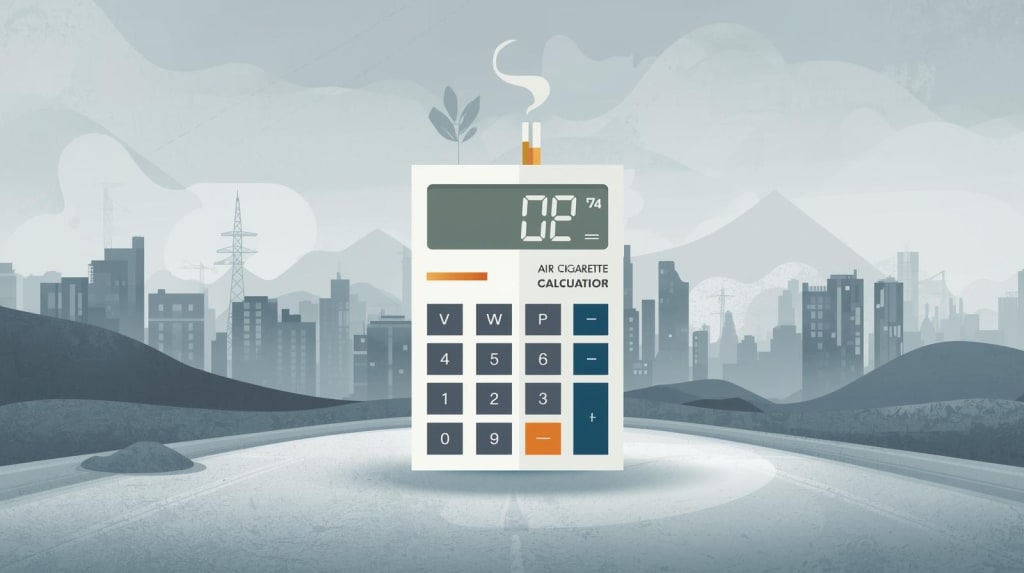
The air we breathe is a complex mixture of gases and particles, many of which are invisible to the naked eye. While we can feel the heat of a sunny day or the chill of the wind, the silent, creeping impact of air pollution is far less tangible. This lack of tangibility makes it a difficult public health threat to communicate and motivate action against. A powerful innovation in environmental health communication has emerged to bridge this gap: the concept of the AQI cigarette calculator.
This model translates the abstract data from an Air Quality Index (AQI) reading into a startlingly personal equivalent: the number of cigarettes one would have to smoke to ingest a comparable amount of harmful particulate matter. It's a provocative comparison designed not to equate the experiences, but to create a shared frame of reference for understanding risk. Much like financial models translate currencies, this tool translates pollution into a "health currency" people instinctively grasp.
Decoding the Equation: From PM2.5 to Puffs
At the core of this comparison lies a common villain: PM2.5. This term refers to particulate matter with a diameter of 2.5 micrometers or smaller—about 30 times thinner than a human hair. Due to their minuscule size, these particles bypass the body's natural respiratory defenses, embedding deep in lung tissue and even crossing into the bloodstream.
The Cigarette Benchmark: The combustion of tobacco is a prolific producer of PM2.5. Decades of public health research have meticulously studied the intake from smoking, providing a standardized, well-understood benchmark for particulate inhalation.
The Environmental Intake: On a smoggy day, the ambient air is filled with PM2.5 from sources like fossil fuel combustion, industrial processes, and wildfires. When you breathe this air, you are passively consuming these particles.
The AQI cigarette calculator operates on a straightforward, albeit sobering, mathematical premise. It estimates the total volume of air a person inhales over a set period (e.g., 24 hours), multiplies it by the concentration of PM2.5 in the air (reported via the AQI), and calculates the total mass of particles inhaled. This mass is then divided by the average mass of PM2.5 inhaled from a single cigarette, yielding the "cigarette equivalent."
To put this in perspective, consider a day with an AQI of 125, categorized as "Unhealthy for Sensitive Groups." For an average adult, exposure to this level of pollution over a full day could equate to passively smoking approximately 4 to 5 cigarettes. In regions experiencing severe pollution crises with AQI values soaring above 300, the daily equivalence can easily surpass an entire pack, presenting a clear picture of a chronic public health emergency.
Why This Analogy Resonates and Drives Change
The genius of this model is in its psychological impact. Abstract warnings about "moderate" or "unhealthy" air often fail to spur action. Converting that data into a cigarette count makes the threat personal and urgent.
Cognitive Anchoring: It provides a concrete anchor for an abstract concept. People understand the severe health risks of smoking. By creating a parallel, the calculator immediately conveys a similar level of risk from air pollution, bypassing complex scientific explanations.
Democratizing Environmental Data: It empowers individuals to interpret air quality data for themselves, regardless of their scientific background. One can check their local AQI and instantly understand what it means for their personal health in a relatable way.
Motivating Behavioral Shifts: Knowing that a bike commute on a bad air day might be akin to smoking two cigarettes can be a powerful motivator to choose alternative transportation, wear a protective respirator (like an N95 mask), or reschedule an outdoor workout. It transforms a public advisory into a personal health decision.
Navigating the Nuances: A Tool, Not a Perfect Mirror
It is crucial to apply this analogy with an understanding of its limitations. It is a comparative risk communication tool, not a direct medical equivalence.
Spectrum of Toxins: While PM2.5 is a primary concern, cigarette smoke contains unique carcinogens like tobacco-specific nitrosamines, and urban air contains its own cocktail of ozone, nitrogen oxides, and heavy metals. The health outcomes—such as heart disease, stroke, and respiratory illness—overlap significantly, but the biological pathways are not identical.
Dosage and Duration: The calculator provides a snapshot equivalence. The lifelong impact of active smoking, with its continuous, high-dose exposure to a concentrated toxin mix, differs from environmental exposure, which varies daily in intensity and composition.
Compounding Risk: Perhaps the most critical point is that these risks are additive. For a smoker living in a highly polluted city, the damage is not just added; it can be synergistic, leading to exponentially higher health risks. The tool should not be used to downplay the dangers of smoking, but rather to highlight that air pollution imposes a similar burden on the entire population.
From Personal Insight to Public Imperative
Widespread use of this calculator has profound implications. It shifts the narrative around air quality from an environmental concern to a direct, pervasive threat to human biology. When a parent learns that their child playing outside on a hazy day is inhaling a cigarette's worth of pollution, advocacy for cleaner policies becomes intensely personal.
This understanding fosters a more health-literate society that demands transparency and action. It underscores that clean air is not a luxury, but a fundamental determinant of population health, as critical as safe drinking water or nutritious food.
Conclusion
The AQI cigarette calculator stands as a landmark in public health communication. By translating micrograms per cubic meter into a universally understood metric of harm, it cuts through the noise and makes the invisible, visible. It equips us with the knowledge to make smarter daily choices for our health and frames the fight for clean air in urgently human terms.
In an era where data is abundant but wisdom is scarce, tools like these provide essential wisdom. They remind us that the quality of the shared atmosphere is the most fundamental public health resource, and protecting it is equivalent to protecting ourselves, one breath—and one clear understanding—at a time.
About the Creator
Keep reading
More stories from Walter Schiller-Anders and writers in Earth and other communities.
Understanding the Air Quality Index: Why Breathing Bad Air Feels Like Lighting Up a Pack
In a world where wildfires burn longer, cities are filled with traffic fumes, and industrial emissions linger, the quality of the air we breathe is under intense scrutiny. As we move into 2026, recent reports highlight a troubling reality: global particulate matter (PM2.5) concentrations climbed by 1.5% in 2023 compared to the previous year. This pushed levels nearly five times above World Health Organization guidelines in many areas.
By Walter Schiller-Anders2 days ago in Earth




Comments
There are no comments for this story
Be the first to respond and start the conversation.