
Ancient Supercontinents
The Story of Pangaea and Its Breakup

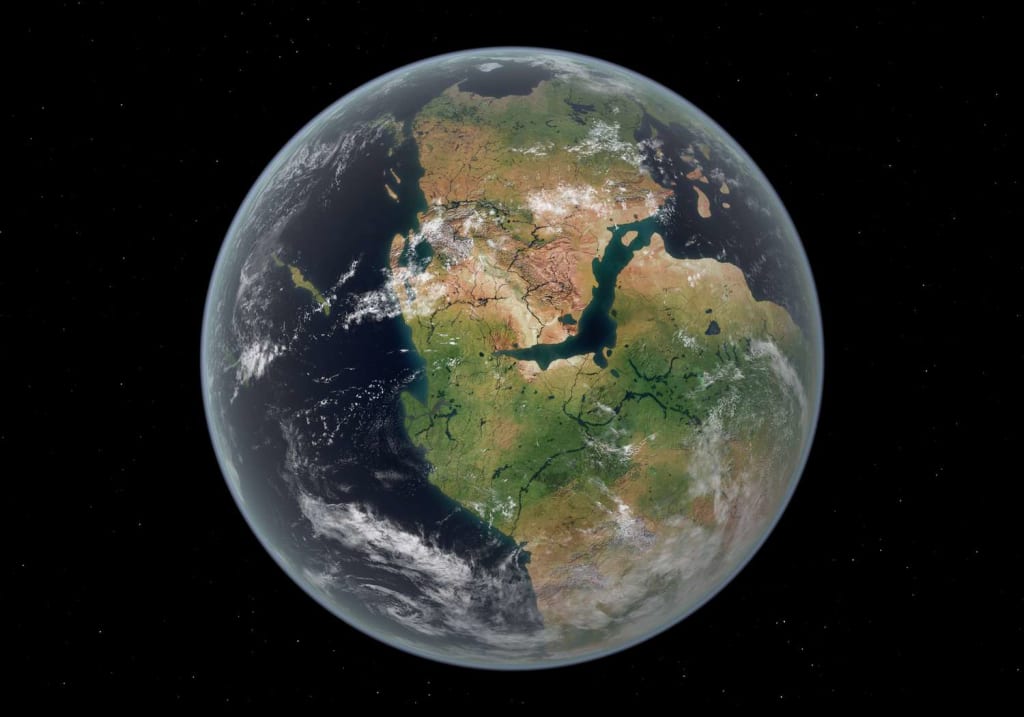
Ancient Supercontinents: The Story of Pangaea and Its Breakup
Have you ever looked at a world map and thought that some continents look like they could fit together like puzzle pieces? You’re not alone! Scientists noticed the same thing, and it helped them discover something amazing: the Earth’s continents haven’t always been where they are now. In fact, millions of years ago, all the continents were joined together in one giant landmass called Pangaea. This is the story of Pangaea, how it formed, why it broke apart, and how it changed our planet forever.
What Are Supercontinents?
Before we talk about Pangaea, we need to understand what a supercontinent is. A supercontinent is a massive piece of land made up of most or all of the Earth’s continents joined together. These supercontinents form over hundreds of millions of years and eventually break apart again. This cycle of joining and breaking is called the supercontinent cycle.
Pangaea wasn’t the first supercontinent in Earth’s history. In fact, there were several before it, including Rodinia and Gondwana. But Pangaea is the most famous because it’s the most recent one, and scientists know the most about it.
The Formation of Pangaea
Pangaea formed around 335 million years ago, during a time known as the late Paleozoic Era. At this time, Earth looked very different. There were no people, dinosaurs hadn't appeared yet, and strange sea creatures and early plants covered the planet.
Over millions of years, Earth's tectonic plates—huge pieces of the Earth's outer shell—slowly moved. These plates carry continents on them like rafts floating on water. The movement of these plates is called plate tectonics, and it’s caused by the heat deep inside the Earth.
As the plates shifted, the continents came together. South America crashed into North America. Africa moved toward Europe and Asia. Eventually, almost all the land on Earth joined to form one giant supercontinent—Pangaea. The name “Pangaea” comes from Greek and means “all Earth.”
What Did Pangaea Look Like?
If you could go back in time to when Pangaea existed, you’d see a huge landmass shaped kind of like a giant letter “C.” It stretched from the North Pole to the South Pole and was surrounded by a vast ocean called Panthalassa. Inside the curve of the “C” was another smaller sea called the Tethys Ocean.
Pangaea included all the continents we know today—North America, South America, Europe, Africa, Asia, Australia, and Antarctica—but they were all stuck together. There were huge deserts, giant mountain ranges, and forests filled with early plants and insects.
Life on Pangaea
During the time of Pangaea, life on Earth was changing quickly. This was the time when some of the first amphibians and reptiles appeared. Later, dinosaurs would evolve and become the rulers of the land.
Because the continents were all joined, animals and plants could move around more easily. Creatures that lived in what is now Africa could travel to what is now South America or Europe. Fossils of the same types of animals and plants have been found on different continents, which is one way scientists know Pangaea existed.
The Breakup of Pangaea
Pangaea didn’t last forever. Around 175 million years ago, during the Mesozoic Era, it started to break apart. Why? The same force that helped form it—plate tectonics—also tore it apart.
Deep inside the Earth, hot material called magma was rising and pushing against the plates. This caused the land to crack and slowly drift apart. Over millions of years, Pangaea split into smaller continents.
First, it broke into two large pieces:
- Laurasia (which would become North America, Europe, and Asia)
- Gondwana (which would become South America, Africa, Antarctica, and Australia)
Later, those big pieces broke into the continents we know today. This process is still happening! For example, the Atlantic Ocean is getting wider as North America and Europe slowly move away from each other.
How Do We Know Pangaea Was Real?
You might be wondering how scientists know that Pangaea really existed. After all, it was hundreds of millions of years ago! Here’s how:
1. Fossil Evidence
Fossils of the same ancient plants and animals have been found on continents that are now far apart. For example, fossils of a small land reptile called Mesosaurus were found in both South America and Africa. That animal couldn’t swim across the ocean, so the continents must have been connected.
2. Matching Rocks and Mountains
Some mountain ranges on different continents match up perfectly. For instance, rocks in the Appalachian Mountains in the U.S. are the same as those found in Scotland. This shows that those areas were once joined.
3. Glacial Marks
Marks left by ancient glaciers (huge ice sheets) are found in strange places—like Africa and India. These places are too warm for glaciers today, but back when they were near the South Pole, they had ice.
4. The Shape of the Continents
If you look closely at a map, South America’s east coast fits neatly against Africa’s west coast. This puzzle-like fit gave scientists their first clue about the idea of continental drift.
The Man Behind the Theory: Alfred Wegener
The idea that continents move wasn’t always accepted. In the early 1900s, a German scientist named Alfred Wegener suggested that continents drifted apart over time. He called this idea continental drift. People thought he was crazy at first, because he couldn’t explain how the continents moved.
Wegener died before his idea was accepted, but later discoveries about plate tectonics proved he was right. Today, he’s remembered as a pioneer of modern geology.
Why Pangaea Matters Today
You might wonder why it’s important to learn about Pangaea. After all, it happened so long ago! But understanding Pangaea helps us learn about:
Earth’s history: How the planet has changed over time.
Fossils and evolution: How animals and plants spread across the world.
Natural disasters: Plate movements still cause earthquakes, volcanoes, and tsunamis today.
Climate change: The way landmasses move affects ocean currents and weather patterns.
Scientists also use this knowledge to look into the future. They believe that in about 250 million years, the continents might come together again to form a new supercontinent. Some call it Pangaea Proxima—a new version of Pangaea!
Fun Facts About Pangaea
- Pangaea lasted for over 160 million years!
- The Atlantic Ocean didn’t exist until after Pangaea began to break apart.
- The Himalayas, the tallest mountains today, didn’t exist during Pangaea—they formed later when India collided with Asia.
- Earth has had at least six supercontinents over its history.
Pangaea was one of the most important land formations in Earth’s history. It brought the continents together and then set them on a journey that continues today. Understanding Pangaea helps us make sense of our planet’s past, present, and future. So next time
About the Creator
Jeno Treshan
Story writer Jeno Treshan creates captivating tales filled with adventure, emotion, and imagination. A true lover of words, Jeno weaves unforgettable stories that transport readers to far-off lands.
Keep reading
More stories from Jeno Treshan and writers in Earth and other communities.
The Deepest Places on Earth: Exploring the Mariana Trench
The Deepest Places on Earth: Exploring the Mariana Trench Beneath the vast expanse of the Pacific Ocean lies a chasm so deep and enigmatic that it challenges our understanding of Earth's final frontiers. The Mariana Trench, stretching over 2,550 kilometres (1,580 miles) in length and plunging to depths exceeding 10,900 metres (35,800 feet), is the deepest known part of the world's oceans . This crescent-shaped trench, located about 200 kilometres (124 miles) east of the Mariana Islands, represents not just a geographical marvel but a realm of scientific intrigue and discovery .
By Jeno Treshan 9 months ago in Earth
After the year 2030, what will become of the International Space Station? Explanation of NASA's Deorbit Strategy
The International Space Station (ISS), the most expensive and complex structure ever assembled in space, has become both an unrivaled hub of scientific research and an increasingly difficult aging outpost to maintain in low Earth orbit. The International Space Station (ISS) has been a laboratory for experiments in everything from advanced materials science to microgravity biology for more than two decades. But as it nears its planned retirement, stakeholders are grappling with how to responsibly wind down its operations, manage its physical end, and transition to new orbital platforms.
By Raviha Imran3 days ago in Earth



Comments
There are no comments for this story
Be the first to respond and start the conversation.