
Aliens on Earth
Whispers between the pages
The first sighting was peculiar, unassuming. It began in the quiet backwaters of literary circles, in dusty libraries and forgotten collections, where the scent of aging paper mingled with the ghosts of stories past.
A librarian named Mira first noticed the oddity. In a secluded corner of Bengaluru’s oldest library, an unfamiliar book lay wedged between established classics. The cover was smooth, almost iridescent, shimmering faintly under the flickering fluorescent lights. Its title—"The Unwritten Void"—stood embossed in intricate script no language could claim as its own. Mira felt an inexplicable pull to open it, as though the book beckoned her silently.
Inside, there were no paragraphs, no chapters—just an endless stream of words that seemed to shift when read. At first glance, they resembled poetry, but upon closer inspection, they became stories, then accounts, then musings. They spoke, not in one voice, but in multitudes. And disturbingly, the words seemed to know Mira: recalling her childhood dreams, her deepest fears, her solitude.
Mira dismissed the encounter as a peculiar aberration until others began reporting similar phenomena. Across continents, people began unearthing books like "The Unwritten Void." They appeared mysteriously, always amid existing literature, as if seamlessly woven into Earth’s collective repository of stories.
What united them wasn’t their physical appearance, but their uncanny ability to speak directly to their reader. Each reader felt as if the words within had been crafted uniquely for them—less written and more alive.
Academics speculated wildly. Were these books an unexplained natural phenomenon? Perhaps cryptic manifestations of subconscious thought—a psychological quirk? Linguists could not pinpoint their origin, as they seemed to contain threads of all languages yet belonged to none. Physicists theorized that their material was unlike any on Earth, formed from elements unknown to humanity.
Yet no scientific analysis was fruitful. Every attempt to scan, sample, or even photograph the books failed. They resisted replication, vanishing the moment anyone sought to document their existence.
Mira, increasingly obsessed, began cataloging testimonies from readers of these "living books," which they began calling Codices of Communion. Patterns emerged. Readers reported hearing whispers as they read, faint yet melodic—a rhythm that resonated like heartbeats. Some claimed the books had solved problems they hadn’t shared with anyone: a wayward scientist found the answer to a long-stalled equation; a grieving widow received solace in the form of an invisible hand tracing her tears away.
But Mira discovered something chilling among the anecdotes—none of the books left their readers unchanged. Once the story ended, each reader reported an overwhelming urge to write. Often, what they wrote seemed unrelated to the Codices' contents. It was as if they had been seeded with fragments of something vast and incomprehensible.
These writings, once collected, formed larger narratives—epic tales of distant civilizations, intergalactic wars, and a world where sentient beings communicated solely through story. These tales were not fanciful—they felt real. Too real.
By year’s end, scholars agreed on one staggering possibility: the books were not creations but entities. Alive in some indescribable way. And their whispers weren’t mere musings—they were communications.
Mira proposed a bold theory, one that both intrigued and terrified: the Codices were the alien species.
Literature was their form, their being. They didn’t arrive in spaceships or drop from distant stars. They existed as narratives—woven directly into Earth’s collective consciousness. They had always existed, Mira suggested, hiding in the margins, unnoticed until humanity became capable of understanding their presence.
But why reveal themselves now? Mira struggled with this question until one night, her library revealed an answer. A new Codex appeared, and its whispers spoke louder than ever.
The Codex’s words shifted as Mira read, forming a harrowing narrative. It spoke of their world—a dimension parallel to Earth’s, where stories weren’t told but lived as beings, floating like ethereal entities. These entities—The Scribes Eternal—thrived for millennia, creating civilizations out of shared thought. Their survival depended on their ability to evolve through communion with other dimensions.
And Earth, so rich in imagination, had finally matured enough to become part of this communion.
But there was a warning: Earth’s stories were fragile things, bound by emotion and culture. If humanity failed to protect its narratives, the Codices would disintegrate, severing the communion forever. Worse, humanity itself risked losing its identity, as the Scribes Eternal sensed Earth’s increasing neglect of imagination in favor of cold logic.
Mira felt a sinking weight in her chest—the Codices weren’t just communicating. They were pleading.
The revelation sparked global upheaval. Governments, wary of an alien presence, sought to confiscate the Codices, labeling them as threats to human autonomy. Yet the Codices resisted containment; any forceful attempt to seize them resulted in their disappearance.
Meanwhile, artists, authors, philosophers, and everyday dreamers championed the Codices’ message. Movements sprouted across the globe, urging humanity to reclaim its literary soul. Workshops flourished, where people shared stories once forgotten. Libraries transformed into sanctuaries, where readers sought the communion they feared they’d lose.
For Mira, the battle became personal. Bengaluru’s library became a haven where Codices appeared nightly. Mira read each one, pouring their whispers into the collective narrative she helped humanity stitch together.
The Codices became less erratic, their messages more cohesive. Mira realized they were teaching humanity—to think collectively, to build narratives that transcended borders and ideologies.
Years later, humanity thrived as never before. The communion had forged a bond that elevated literature to something sacred. Books became bridges, not merely between individuals but entire dimensions.
Mira, now older, sat surrounded by shelves filled with the Codices she had collected. A whisper drifted from one as its shimmering pages turned gently in the evening breeze. Mira closed her eyes, listening.
The alien species wasn’t just present—it was alive within humanity’s stories. And through the communion, humanity learned that imagination wasn’t merely an escape from reality—it was the doorway to understanding the cosmos itself.
The last Codex Mira read didn’t end with a narrative but with a question:
“Will you tell our story?”
Mira smiled, picked up her pen, and answered, “Yes.”
About the Creator
Saroj Kumar Senapati
I am a graduate Mechanical Engineer with 45 years of experience. I was mostly engaged in aero industry and promoting and developing micro, small and medium business and industrial enterprises in India.
Keep reading
More stories from Saroj Kumar Senapati and writers in Earth and other communities.
The Echoes of Eternity
In the year 2150, humanity had achieved what was once thought impossible: interstellar travel. The vast expanse of space was no longer a distant dream but a tangible reality. Amidst this era of discovery, Dr. Elara Quinn, a brilliant astrophysicist, found herself at the forefront of a groundbreaking project known as "Echo."
By Saroj Kumar Senapatiabout a year ago in Earth
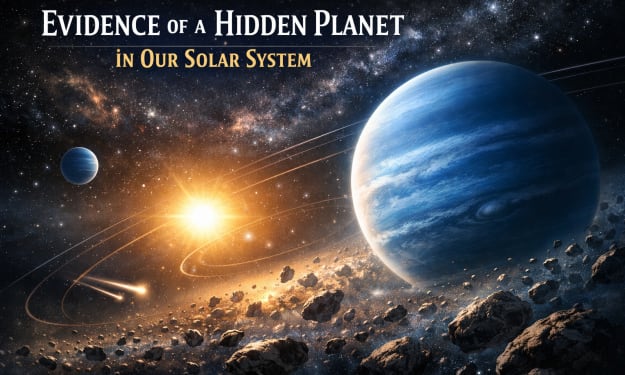
Evidence Suggests a Large Hidden Planet May Exist in Our Solar System
For centuries, scientists believed the major members of our Solar System were fully known. From the rocky inner planets to the gas giants and icy bodies beyond, astronomers thought they had mapped most of the significant objects orbiting the Sun. However, new research by American scientists suggests that a large, hidden planet may still be lurking in the distant reaches of our Solar System.
By Irshad Abbasi 2 days ago in Earth



Comments
There are no comments for this story
Be the first to respond and start the conversation.