
Africa's Geographical Challenges on its Economy
Rivers and Mountains
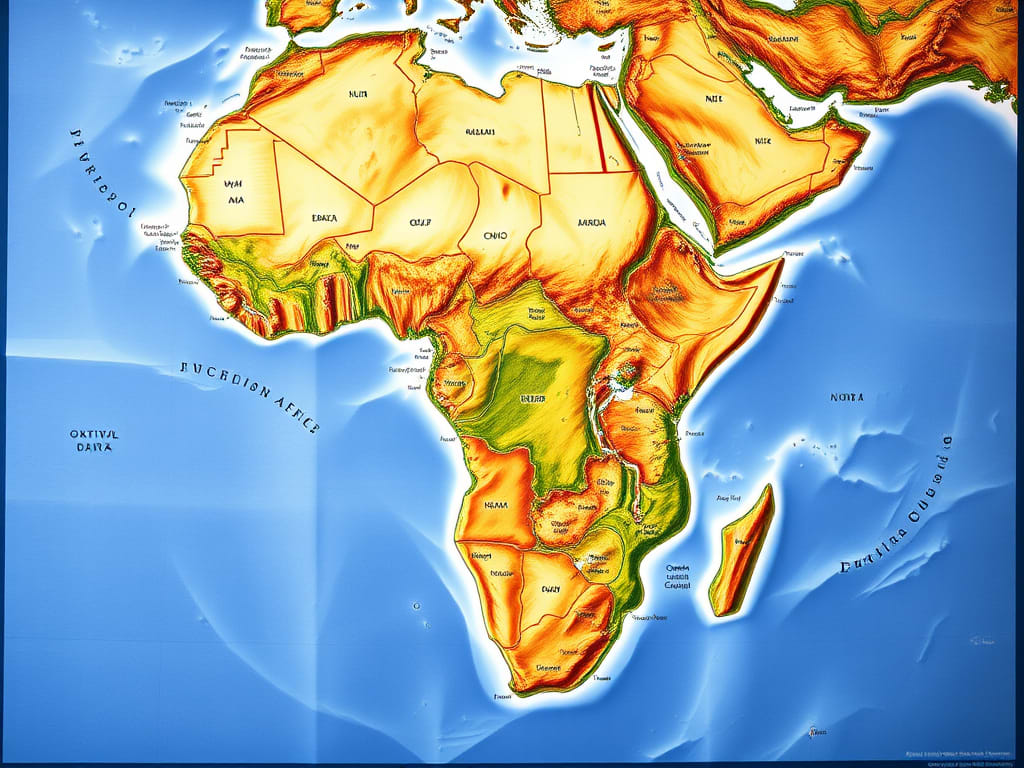
The article explores the intricate relationship between Africa's geography and its persistent poverty, articulating how various geographical factors have historically hindered economic development across the continent.
Vast Size and Diverse Climates
Africa is the second largest continent, encompassing diverse climates and ecosystems. This vastness creates significant distances between populations, complicating trade, communication, and infrastructure development. Unlike continents such as Europe, where geographical proximity facilitates interaction, Africa's enormous size means that regions can be isolated from one another. The varied climates—from deserts to rainforests—also lead to inconsistent agricultural conditions. While some areas may support crops, others are arid or inhospitable, making it difficult for cohesive agricultural practices to emerge.
Isolation by the Sahara Desert
One of the most critical geographical barriers is the Sahara Desert, which spans much of North Africa. This immense desert isolates Sub-Saharan Africa from the north and the rest of the world. Historically, the Sahara has served as a formidable barrier, preventing the flow of trade, ideas, and technologies that have shaped other regions. The difficulty of traversing the desert has limited trade routes and cultural exchanges, effectively making Sub-Saharan Africa feel like an island. This isolation has stunted economic growth and development, as the continent struggles to integrate into global trade networks.
Coastline Limitations
Another significant issue highlighted in the video is Africa's coastline. Unlike the jagged coastlines of Europe, which are dotted with numerous natural harbors conducive to maritime trade, Africa's coastlines are relatively smooth and lack suitable ports. This smoothness limits the ability of ships to dock safely, making maritime trade more challenging. The article emphasizes that the absence of good harbors has historically handicapped African nations in their ability to engage in trade with other continents, which has consequences for economic growth and development.
Unnavigable Rivers
The article further points out that many of Africa's major rivers, such as the Congo and Niger, are not navigable for significant stretches. This lack of navigability limits access to international markets and creates logistical challenges for transporting goods. While rivers in other continents, such as the Mississippi or the Danube, serve as vital arteries for trade, Africa's rivers often become impediments due to rapids, waterfalls, and other natural barriers. The inability to use these rivers effectively for trade has contributed to higher transportation costs and limited economic opportunities for inland communities.
Health Challenges
Geographically, Africa's climate also plays a role in public health. The prevalence of tropical diseases, such as malaria and yellow fever, is exacerbated by the continent's warm and humid conditions. These health challenges not only reduce life expectancy but also impact workforce productivity. The article argues that the high incidence of disease further complicates economic development, as resources are diverted to address health crises rather than being invested in infrastructure, education, or industry.
Landlocked Countries
It also highlights that Africa has a disproportionately high number of landlocked countries, which face severe disadvantages in international trade. Without direct access to coastlines, these nations struggle to engage in maritime trade, making it difficult to import goods or export resources efficiently. The lack of navigable rivers and natural harbors compounds these challenges, creating a situation where landlocked countries are often reliant on neighboring nations for access to ports. This dependency can lead to higher costs and logistical difficulties, further entrenching poverty.
Conclusion
In summary, the artcle presents a compelling argument that Africa's geographical challenges are deeply intertwined with its economic struggles. From vast distances and diverse climates to isolation by the Sahara Desert and limitations posed by smooth coastlines and unnavigable rivers, these factors collectively hinder the continent's ability to engage in international trade and foster economic development. The health challenges exacerbated by geography, coupled with the prevalence of landlocked nations, create a complex web of obstacles that perpetuate poverty across Africa.
Understanding these geographical challenges is crucial for developing effective solutions to combat poverty and promote economic growth. Addressing infrastructure needs, improving health care, and enhancing trade relations are essential steps toward overcoming the geographical disadvantages that have historically held Africa back. The article also effectively underscores the importance of geographical context in understanding Africa's socio-economic landscape, highlighting how geography is not just a backdrop but a significant player in shaping the continent's future.
About the Creator
Keep reading
More stories from joseph ganthu and writers in Earth and other communities.
Malawi’s Agricultural Crisis: Insufficient Maize Supply in 2024-2025
In the heart of southeastern Africa lies Malawi, a nation predominantly reliant on subsistence farming, where the primary staple is maize. This grain not only sustains the populace but also constitutes the backbone of the country’s agrarian economy. The year 2024-2025, however, marked a turning point as Malawi faced a significant agricultural crisis characterized by insufficient maize supply, with repercussions reverberating throughout the nation.
By joseph ganthu12 months ago in Earth
The Universe That Dreams Us
For centuries, humanity believed the universe was expanding. Galaxies drifting farther apart. Space stretching endlessly like an invisible fabric. The theory had been supported by decades of observations, especially from the famous Hubble Space Telescope, which showed distant galaxies moving away from Earth in every direction.
By Abubakar2205 days ago in Earth




Comments (1)
nice st