

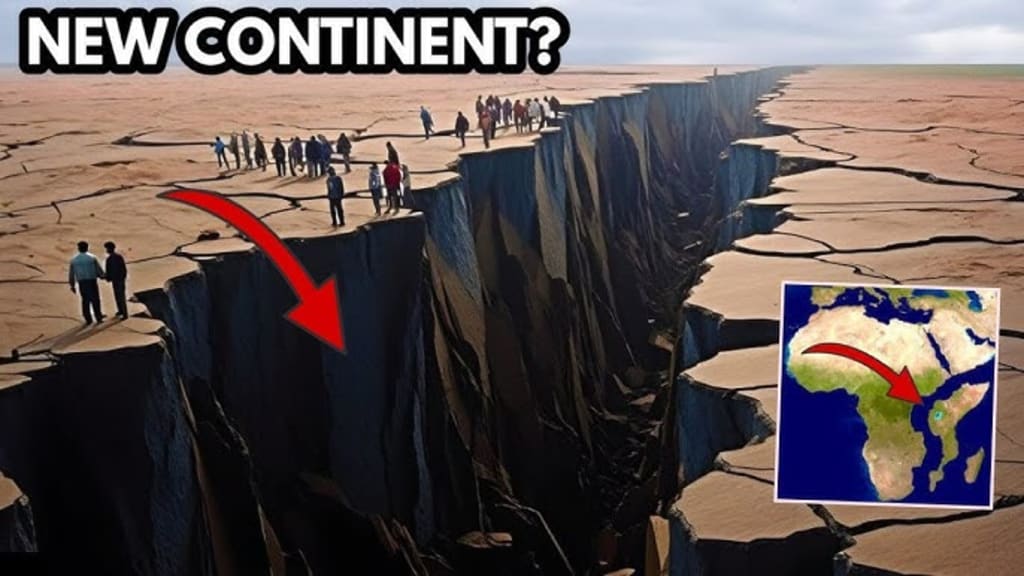
Africa is Splitting: The Slow Birth of a New Ocean
Beneath the sun-scorched landscapes of eastern Africa, a geological drama of epic proportions is quietly unfolding. The very ground is tearing itself apart, heralding a future where the continent of Africa will be split in two, giving birth to a new ocean. This is not the plot of a disaster movie but a scientific reality driven by the inexorable forces of plate tectonics. The process, known as the East African Rift, is a powerful, albeit slow-motion, demonstration of our planet’s dynamic nature.
At the heart of this continental cleavage is the Great Rift Valley, a vast geological trench stretching over 3,000 kilometres from the Gulf of Aden in the north down to Zimbabwe in the south. This rift is a divergent plate boundary, a place where tectonic plates are pulling away from each other. Specifically, the colossal African Plate is in the process of fracturing into two smaller plates: the larger Nubian Plate (which comprises most of the continent) and the smaller Somali Plate to the east.
The engine driving this separation is believed to be a massive mantle plume—a column of abnormally hot rock rising from deep within the Earth's mantle. As this plume pushes upwards against the lithosphere (the rigid outer part of the Earth), it causes the crust to dome upwards, weaken, and stretch. This stretching results in the characteristic features seen across the region: vast, sunken valleys (grabens), towering volcanic mountains like Mount Kilimanjaro and Mount Kenya, and frequent seismic activity.
While the complete separation is millions of years away, the signs of its progress are already visible. The rate of separation varies along the rift, but in areas like the Afar Triangle in Ethiopia, it is estimated to be pulling apart at a rate of roughly $6-7$ millimetres annually. This may seem insignificant, but over geological time, it is more than enough to tear a continent asunder.
In recent years, this slow process has made dramatic headlines. In 2018, a massive fissure, several kilometres long and dozens of feet deep, suddenly opened in southwestern Kenya, splitting a major highway and forcing families to flee their homes. This event was a stark and tangible reminder of the powerful forces at play, revealing a fault line that had been stretched to its breaking point by tectonic movement.
The Afar Triangle is a particularly significant location. It is a "triple junction," the point where the Nubian, Somali, and Arabian tectonic plates meet and are all pulling away from one another. This unique geological hotspot is one of the few places on Earth where a continental rift can be seen transitioning into an oceanic rift. As the crust thins here, magma rises closer to the surface, creating a landscape dotted with volcanoes and geysers that resembles the floor of a nascent ocean.
So, what is the ultimate fate of Africa? Geologists predict that in the next 5 to 10 million years, the process will reach its culmination. Seawater from the Red Sea and the Gulf of Aden will flood into the widening rift valley, creating a new, long, and narrow ocean basin. The Horn of Africa, along with Somalia, parts of Ethiopia, Kenya, and Tanzania, will detach from the mainland to become a massive island continent, sometimes referred to as the "Somali Continent."
The map of the world will be irrevocably redrawn. This future African island will have a new coastline facing the old continent, fundamentally altering geography, climate, and ecosystems. While this transformation is far beyond any human timescale, its beginnings are etched into the African landscape today. The Great Rift Valley is more than just a stunning natural wonder; it is a live laboratory for studying plate tectonics and a window into the planet-shaping forces that have sculpted our world for billions of years, and will continue to do so for billions more.
About the Creator
Trump ‘Not Thrilled’ With Iran Talks Progress, Contemplates Military Action
Frustration Over Diplomatic Stalemate Former US President Donald Trump has expressed dissatisfaction with the pace and direction of talks involving Iran’s nuclear programme, stating he is “not thrilled” with the progress being made. His remarks, delivered during a public appearance and echoed by campaign representatives, suggest that patience with diplomatic efforts may be wearing thin.
By Aarif Lashari7 days ago in Earth
REEEEEEEEE!
I'm on a low road right now. There are a literal million things to do and not one of them worth my time. I would rather sit in place and burn but the orbit takes me on its inevitable route 'round the center; and I a center in my own right, around which others orbit, and so on and so forth, ad infinitum, ad nauseum.
By C. Rommial Butler4 days ago in Poets




Comments
There are no comments for this story
Be the first to respond and start the conversation.