
A volcano more violent than Tonga's eruption
In-depth restoration details, a city has since disappeared.

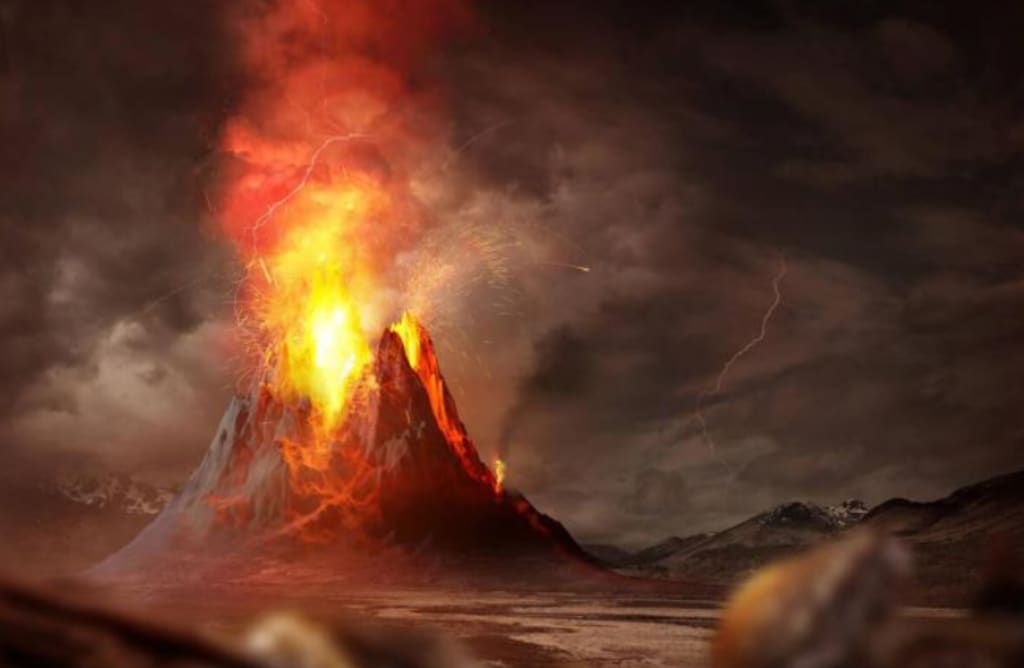
A submarine crater around the Pacific island kingdom of Tonga suddenly erupted, and its tremendous roar was felt throughout the Pacific. Gases, dust, and debris from the volcano's eruption rushed 20 kilometers into the air.
Soon, the tsunami wave spawned by the eruption hit Australia and New Zealand, as these two countries are closest to Tonga. It was also felt on the west coast of Japan and the Americas, and atmospheric shock waves were measured all over the world. The tsunami wave reached New Zealand within five hours and reached Alaska, USA, in about ten hours.
Fortunately, however, the tsunami waves were not very high, about one to two meters or less, so there was little danger. The Tongan government says the eruption was an unprecedented disaster for the island nation, and that it instantly paralyzed Tonga's communications with the outside world, reportedly because the undersea cables were blown out. In addition, there is a theory that communication equipment suffered from volcanic ash and was blocked, so people in the outside world are still not sure what happened there in the first place, and do not know how to rescue it. So what is Tonga like now?
After the eruption, the land around the crater sank underwater, and the two islands sank except for the higher ground.
Tonga's eruption is not yet clearly graded, but according to the observed data, it is likely to be a magnitude 5 to 6 eruption, the most extensive one since the beginning of the 21st century.
The crater near the Kingdom of Tonga is in the southwest of the Pacific Rim volcanic belt, a whole Pacific Rim belt gathered more than 80% of the world's active volcanoes, so it is also called the Pacific Rim fire. The eruption of the Tongan volcano at least indicates that the local caldera has awakened, as to whether it has reached its peak of activity and when it will quiet down are still unknown.
The good thing is that Tonga is on a relatively small, independent plate, so we can only pray that its roar will not wake up other volcanoes in the Pacific Rim volcanic belt.
Overall, the eruption was a blessing in disguise, as the two islands that sank were not inhabited and the casualties were relatively minor, but perhaps we won't be so lucky with the next eruption.
Then we need to briefly introduce the classification of the volcano. The volcanic Explosivity Index, or VEI for short, is divided into nine levels, from 0 to 8, and for each additional level from level 2 on up, the energy of the eruption increases tenfold.
Volcanoes have a lot of eruptions, solid, liquid, and gaseous, liquid eruptions, is the bubbling magma, and gaseous, is a mixture of various gases, such as carbon dioxide, water vapor, sulfur dioxide, and so on.
Solid eruptions such as rock fragments, powder, volcanic glass, burning rocks, and so on. From the fourth level up, even if it is a large eruption, it will affect the Earth's environment, but also the role of various species.
Let's look at a level 4 eruption, which would eject more than 0.1 cubic kilometers of material, the equivalent of a soccer field-sized block.
In 2010, Iceland has a volcano called Eyjafjord erupted, which is a level 4 eruption, the ash cloud spread to the whole of Europe, so that many people lung damage, and airplane flights throughout Europe because of this matter canceled 2 days, making European aviation industry economic losses of up to $ 4.7 billion.
The consequences of a level 4 volcanic eruption can be summarized as it will cause localized economic losses to humans, causing individual loss of life and health damage. However, if the level goes up, the consequences will be very terrible.
The following is the turn of the fifth level eruption, this level will eject an extra cubic kilometer of material. The most classic eruption of this level is the eruption of Mount Vesuvius in 79 A.D., which modern geologists judge to be a level five.
This eruption left a deep impression on history because the city of Pompeii at the foot of Vesuvius has since disappeared, the entire Roman Empire witnessed the scene, so did the inhabitants of Pompeii have a chance to escape?
The answer is that the vast majority of people did not have a chance to escape.
First of all, the user is the head pouring down the volcanic ash, although called ash, burnt to charred rock debris. Authoritative experts estimate that Pompeii in a very short period fell 3 cm thick ash. We can imagine, a basket of red-hot charcoal fire poured down on your head as a scene.
So the roof of each house soon reached a high temperature of more than 140 degrees Celsius, and residents almost did not have time to go out in a state of heat shock, and in an instant, many people lost the ability to move.
Even if some people can escape from the house, the streets are covered with a thick layer of red-hot volcanic ash, when you think about it, there is no place to put your feet, as usual, there is nowhere to escape.
We often see volcanic eruptions, there is a cloud column, that is because there is water vapor rising support, when the high temperature of water vapor is lost after the volcanic debris will form something called debris flow, under the action of gravity, it rushes down the slope.
The Hollywood blockbuster "Pompeii" released in 2014, also translated as "the city of fire", the climax of its ending is a man and a woman riding a fast horse to escape from the purgatory-like city, and run to the suburbs. The hero said, a horse carrying two people, that can not run the volcano, so my dear, you escape yourself.
The heroine is determined not to steal her life alone. The hero and heroine finally embraced and kissed in front of the raging stream of fire and were carbonized into a statue. This raging stream of fire is the volcanic debris flow, fast, even a thousand miles can not run it, so you say the residents of Pompeii can still escape?
About the Creator
Sukkning
Science will give mankind's greatest gift is? Is to make the power of humans believe that truth。
Hillary Clinton Accuses Republicans of ‘Fishing Expedition’ in Epstein Testimony
Hillary Clinton has accused Republican lawmakers of conducting a “fishing expedition” amid renewed testimony and investigations connected to Jeffrey Epstein, the late financier whose criminal activities and high-profile associations continue to generate political controversy. The former Secretary of State’s remarks underscore deep partisan divisions as congressional scrutiny surrounding Epstein’s network resurfaces in Washington.
By Aarif Lashari7 days ago in Earth




Comments
There are no comments for this story
Be the first to respond and start the conversation.