

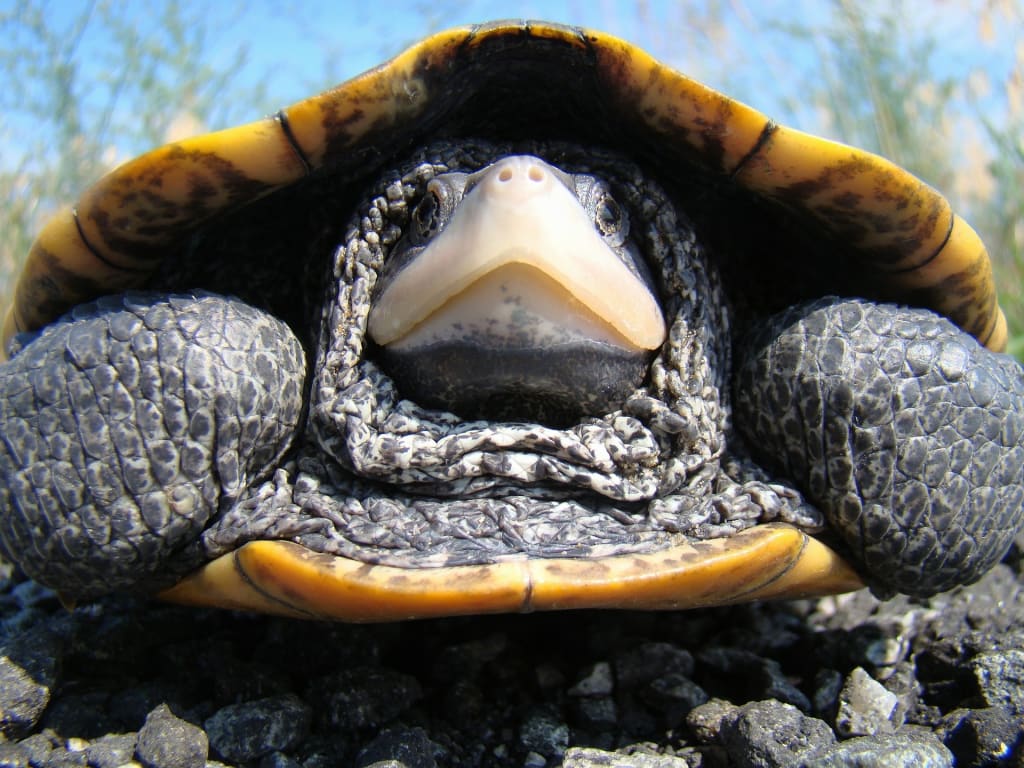
On a sunny morning later in the spring, something special was about to happen. The weather did not look as gloomy as it did in the winter. Pine trees stood alongside the Connecticut River. One next to another, like soldiers, they seemed to be protecting it. The sun came out like usual and its rays were reflected in the grass. The mushy plants grasped the sunlight and purple and rose flowers dotted the green landscape. Birds chirped. Ducks quacked. It was time to wake up. Inland, a tiny shape started forming as something started making its way out of the sand
A head showed up. Then a neck, and a shell. It shined, with intricate patterns, rings of different sizes. Each diamondback terrapin has its own pattern. Its skin, blue and gray with dots glowed as it slowly crawled out of the hole she made for hibernation. Blue the terrapin was making her way to the water again. She moved lazily and slowly, as if she was still asleep. Her eyes drifted towards the river bank. It was still a long way to go. She squirmed and wiggled as her fins started waking up. Her webbed feet stretched as she leaned on them, and in a few seconds, Blue was almost there.
Diamondback terrapins hibernate during the winter, and emerge in the spring. They are the only turtles in America that are capable of living in brackish water (one that is not as salty as seawater.) They extend along the U.S. Atlantic and Gulf coasts from Cape Cod, Massachusetts, to Corpus Christi, Texas, including the Florida Keys. Since terrapins are known to return to the place they were born in, The Connecticut River was Blue's home.
The river was filled with fish. Trout, catfish, and salmon swam alongside Blue, whose big, bright shell stood out in the current of the brownish river. The terrapins are strong swimmers, and she skipped and dived deep into the stream. When they are not avoiding the hatchlings predators such as raccoons or rats, they spend most of the time in the water. Sometimes they bask in muddy surfaces on land, like Blue would do on her travels. As she went downstream, she encountered others like her, on their way to nest or to mate. Usually, female terrapins mate with more than one, during nighttime.
On this particular occasion, Blue caught the attention of a male terrapin, who came closer and started dancing around her, as a mating ritual. Terrapins are known to have sexual dimorphism, which is why the male is several inches smaller than the female. The male followed Blue around until she stood still, which allowed him to get into a 90-degree angle and attach himself to her. 15 minutes after mating was completed, he detached himself and swam away, upstream.
The life of a terrapin is a long one. They can live from 25 to 40 years of age. You can tell how old they are by looking at the number of rings in their shells. They usually have three clutches of eggs per year, and nesting occurs during the summer. This season, Blue migrated downstream, looking for the perfect conditions to lay and nest her eggs. Diamondback terrapins prefer to nest in sandy beaches, so she was headed to Long Island Sound, the mouth of the river. On her way there, she ate marsh crabs, snails, mussels, and clams. Sometimes terrapins eat barnacles too, depending on where they live.
July came around the corner, and it was egg-laying time. Blue had spent countless days bravely migrating, looking for adequate temperature and water conditions. She reached the shore in Long Island Sound and started crawling towards land. The weather seemed just fine, and the beach did not seem too crowded. Her fins left an imprint in the sand as she walked through it, looking for the right spot. Females are known for traveling thousands of miles in the sand searching for an appropriate nesting place.
As soon as she found her spot, she started digging. Using her front legs, and rubbing the sand with her nose to see if the sand was moisturized enough for the eggs, she dig the whole. Once it was completed, Blue entered a trance-like state as she laid her eggs, one at a time, holding them before they landed with her rear foot and dropping them slowly in the hole. Terrapins lay from 6 to 10 years per clutch. This was Blue's first one for the season, and she would return for the second one, and maybe a third.
Once she was done, she crawled back in the water and started swimming again. This time she was going upstream. On that hot day in July and after a long season, it was time to go home.
About the Creator
Keep reading
More stories from Daniela Pirela and writers in Earth and other communities.
Letter to Mom.
March 3, 2017 Mom: Today was a good one! As usual, you would love to be here. And I would love it if you were. I was on my way to work and I realized that spring is definitely on its way! You know I always send you pictures of the dead trees and the somber look they give to the campus. Well, today it has been pretty warm! Actually, it has been this way since I came back from Winter Break. I have to confess I am glad it is. I was tired of using boots and double sweaters! You know how easily cold I get.
By Daniela Pirela4 years ago in Humans
Plans Lodged for Assembly Rooms Replacement
Plans have been officially submitted for the replacement of the historic Assembly Rooms, signaling a significant transformation in the heart of the city. The Assembly Rooms, long regarded as a cultural and architectural landmark, have been a venue for public gatherings, performances, and civic events for decades. With the new plans now lodged, the community, local authorities, and heritage groups are preparing for a debate over modern development versus preserving historical character.
By Muhammad Hassan2 days ago in Earth
Trump Signs Order to Limit Wall Street Investors in Single-Family Housing
Former U.S. President Donald Trump has signed an executive order aimed at restricting Wall Street investors from buying large numbers of single-family homes. The move comes amid growing concerns over the affordability of housing for middle-class Americans and the increasing role of institutional investors in the residential real estate market.
By Aarif Lashariabout 22 hours ago in Earth




Comments
There are no comments for this story
Be the first to respond and start the conversation.