
A Planet at a Crossroads
The Emotional Reality of Climate Change

Imagine standing on a beach, the waves lapping at your feet. The horizon stretches endlessly before you, but the calm is deceptive. Beneath the surface lies a storm brewing—a storm of rising seas, vanishing species, and communities on the brink of collapse. Climate change is not just a scientific phenomenon or a political debate; it is an emotional reality that touches every facet of our lives.
We often hear statistics: the Earth has warmed by more than 1.1°C since the pre-industrial era. Ice sheets are melting at an alarming rate, and carbon dioxide levels are higher than they’ve been in 800,000 years. These numbers are terrifying, but they fail to capture the heartbreak of watching a forest burn or seeing a child struggle to breathe in smog-choked air. Climate change is not just happening in the distant future—it is here, now, and it hurts.
For families in low-lying coastal areas, the pain is palpable. Entire villages in the Pacific Islands are disappearing beneath rising seas. Imagine having to leave your ancestral home, the land where your parents and grandparents were born, knowing it will soon be swallowed by the ocean. The trauma of displacement is not just physical; it is emotional and cultural. It is the loss of identity, the severing of a bond between people and their land.
Farmers, too, are feeling the weight of a changing climate. Droughts are becoming longer and more intense, leaving parched fields where crops once thrived. Floods are washing away entire harvests, destroying livelihoods in an instant. A farmer in sub-Saharan Africa or South Asia doesn’t need a climate report to know the weather is changing; they see it in their empty water reservoirs and in the hunger etched on their children’s faces.
Even in cities, far from the coasts or farmlands, climate change is a daily reality. Heatwaves bake urban areas, turning them into ovens. Vulnerable populations—the elderly, the homeless, the poor—suffer the most. Wildfires rage on the outskirts, sending ash raining down on streets and homes. Children grow up in a world where they can’t play outside because the air is unsafe to breathe. This is not the future we dreamed of for them.
And then there’s the emotional toll on those who are fighting to save the planet. Environmental scientists, activists, and everyday people who care deeply about the Earth often grapple with a profound sense of grief. This grief is not just for what has been lost—the glaciers, the forests, the species—but for what might still be lost if we fail to act. It is a grief mixed with frustration, knowing that solutions exist but are not being implemented fast enough.
Yet, amidst this despair, there is hope. The human spirit is resilient, and countless people around the world are rising to the challenge. Young activists like Greta Thunberg have inspired millions to demand change. Communities are banding together to plant trees, clean rivers, and embrace renewable energy. Scientists are developing innovative technologies, from carbon capture to solar-powered desalination, to mitigate the worst impacts of climate change.
But hope alone is not enough. We must act. Climate change demands more than individual efforts; it requires collective, systemic change. Governments must implement policies that reduce emissions and transition to renewable energy. Corporations must prioritize sustainability over profit. And individuals must use their voices, their votes, and their choices to demand a better future.
This is a moment of reckoning for humanity. The Earth is resilient, but it has its limits. If we fail to act, the world we leave behind will be unrecognizable—hotter, harsher, and less hospitable to life as we know it. But if we rise to the challenge, we can create a future that is cleaner, greener, and more equitable.
The clock is ticking, but it is not too late. The fight against climate change is not just a battle for the planet—it is a battle for our hearts, our homes, and the generations yet to come. Let us meet this challenge with the courage, compassion, and urgency it demands. The Earth is counting on us, and we must not let it down.
About the Creator
Reader insights
Outstanding
Excellent work. Looking forward to reading more!
Top insights
Compelling and original writing
Creative use of language & vocab
Easy to read and follow
Well-structured & engaging content
Excellent storytelling
Original narrative & well developed characters
Expert insights and opinions
Arguments were carefully researched and presented
Eye opening
Niche topic & fresh perspectives
Heartfelt and relatable
The story invoked strong personal emotions
Masterful proofreading
Zero grammar & spelling mistakes
On-point and relevant
Writing reflected the title & theme
Keep reading
More stories from writers in Earth and other communities.
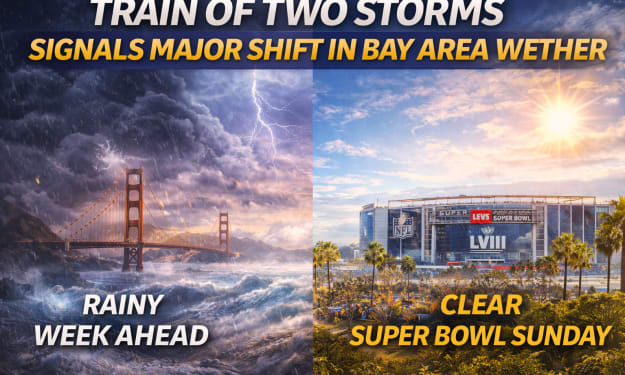
“Train of Two Storms” Signals a Major Shift in Bay Area Weather
After weeks of relatively dry and stable conditions, the Bay Area is preparing for a noticeable change in weather. Meteorologists are tracking what they describe as a “train of two storms,” a back-to-back weather pattern that could reshape the region’s forecast over the coming days.
By Adil Ali Khan6 days ago in Earth



Comments (1)
Really helpful nice work