

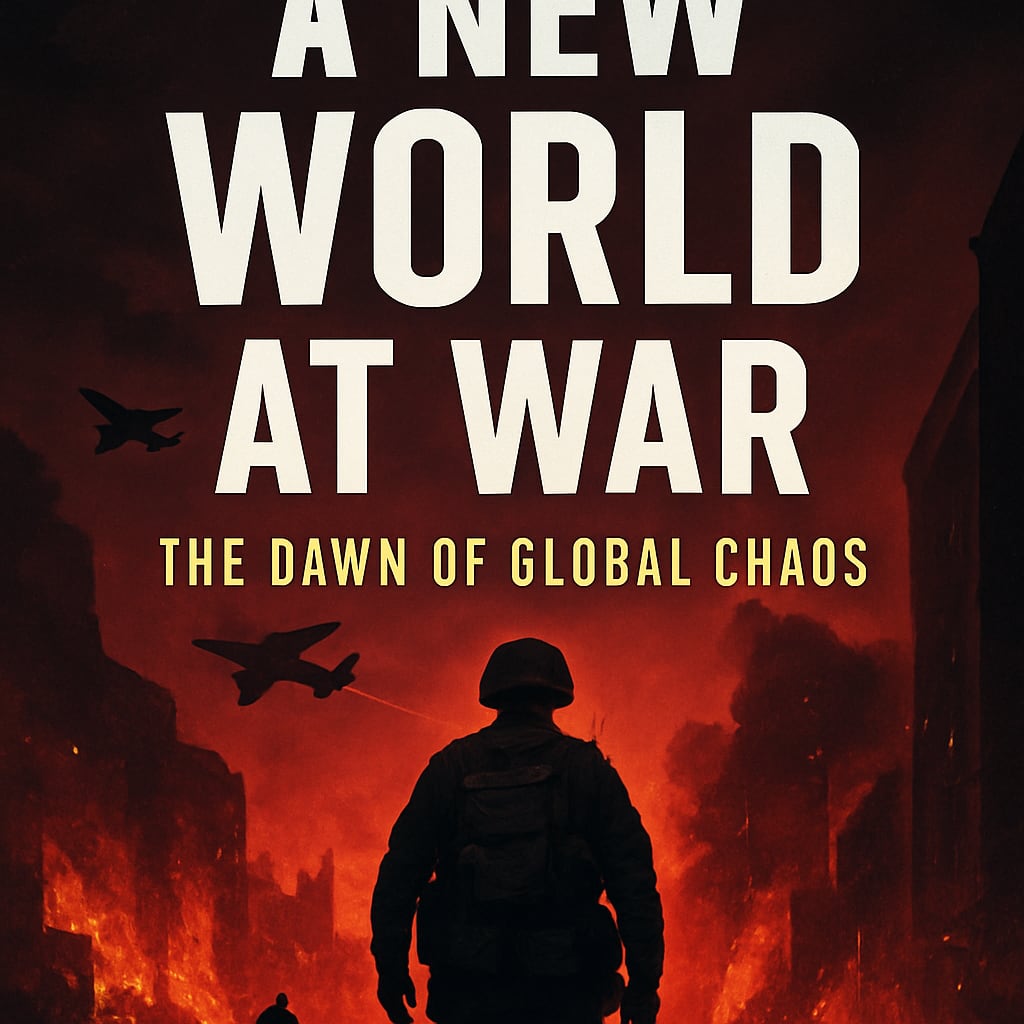
### **A New World at War: The Dawn of Global Chaos**
In a world that once hoped the horrors of global warfare were buried in the past, the unthinkable has returned. *A New World at War* is not just a title—it is a chilling reality echoing through the streets of devastated cities, the silence of broken alliances, and the cries of nations caught in the crossfire. As nations rally behind flags and ideologies, we are forced to confront the dawn of a new and unprecedented kind of global chaos.
#### **The Seeds of Conflict**
The road to this conflict did not begin with a single spark, but rather with a series of tremors that shook the foundations of the post-Cold War order. Rising nationalism, economic inequality, environmental collapse, and rapid technological militarization contributed to an increasingly unstable geopolitical landscape. Once-powerful alliances like NATO and the United Nations struggled to maintain relevance, paralyzed by internal discord and eroded trust.
Tensions simmered for years—over contested borders, cyber intrusions, trade wars, and political interference. But it was a convergence of multiple regional crises—some deliberate, others accidental—that ignited a chain reaction too fast to contain. A surprise missile strike here, a disputed election there, and suddenly the world was plunged into a conflict that spanned continents, ideologies, and generations.
#### **Technology: The New Battleground**
Unlike the wars of the 20th century, this new world war has unfolded across both physical and digital realms. Drones, autonomous tanks, satellite-disabling weapons, and advanced cyber warfare have replaced trench lines and storming infantry. Nations have turned artificial intelligence into both a shield and a sword, making battlefield decisions faster than human minds can comprehend.
Cyberattacks now precede missile strikes, targeting everything from power grids and water supplies to financial systems and communication networks. What were once civilian vulnerabilities have become tactical targets, collapsing the boundary between home front and war front. With every hack or blackout, ordinary people find themselves unwilling participants in the frontline of a global war.
#### **The Human Cost**
Beneath the strategies, technologies, and political rhetoric lies the human cost. Cities lie in ruins. Refugee populations have reached historic highs. Entire generations are being raised amidst the rubble of what were once homes, schools, and vibrant communities. Hospitals operate with dwindling supplies. Aid organizations are overwhelmed. And in many parts of the world, hunger, disease, and fear spread faster than any invading army.
The war has reignited old rivalries and deepened historical wounds. Ethnic and religious tensions have been exacerbated, with minority groups often caught in the crossfire or deliberately targeted. In areas with fragile governments, warlords and criminal syndicates have stepped into the power vacuum, adding further chaos to the landscape.
#### **Collapse of Diplomacy**
As the conflict spread, diplomatic efforts faltered. Peace talks were repeatedly disrupted by misinformation campaigns, assassinations, and shifting allegiances. The international institutions built in the aftermath of World War II—designed to ensure peace through cooperation—have proven inadequate in the face of a conflict driven by non-state actors, rogue powers, and artificial intelligence.
Efforts to impose ceasefires have been manipulated for strategic gain. Treaties, once honored as the sacred tools of diplomacy, are now viewed as temporary inconveniences. The lack of a unified global voice has allowed the conflict to grow unchecked, further deepening the sense that the world has entered a new, lawless era.
#### **Resistance and Resilience**
Amid the darkness, there are glimmers of hope. Civil resistance movements have emerged in countries across the world, led by everyday citizens demanding peace, justice, and a return to humanity. Independent journalists risk their lives to report the truth. Scientists and technologists, horrified by how their innovations have been weaponized, have begun to work toward solutions that can rebuild and reconnect.
Some nations have managed to avoid the chaos entirely, serving as neutral havens and sanctuaries for those fleeing the war. Others, while still involved, have committed themselves to humanitarian efforts—establishing corridors for aid, negotiating prisoner exchanges, and seeking common ground even as bombs fall overhead.
#### **A Turning Point in History**
This war is not just about military dominance or territorial gain. It is a battle for the soul of the 21st century. The choices made now—by governments, communities, and individuals—will shape the world for decades to come. Will humanity find a way to claw its way back from the brink? Or will *A New World at War* become the defining chapter in our collective downfall?
As the dust of battle continues to rise, and the world holds its breath, one truth remains: global peace is no longer a given. It must be earned, protected, and rebuilt—again and again.
About the Creator
Keep reading
More stories from Naveed khan and writers in Earth and other communities.
Hope in the Horizon
In the face of growing uncertainty, it’s easy to feel overwhelmed — by the headlines, the heatwaves, the heartbreak of vanishing forests and melting glaciers. Yet even in this turbulent era, one quiet force continues to rise: hope. A hope not rooted in wishful thinking, but in determination, innovation, and the human spirit’s timeless ability to adapt and overcome.
By Naveed khan10 months ago in Earth
The Eiffel Tower: Paris’s Iron Soul and the Story Behind Its Global Magic
The Eiffel Tower is more than a landmark rising above the Paris skyline. It is a symbol of human imagination, engineering courage, and the timeless romance of France. Millions visit it every year, yet few know the deeper story—how a controversial iron structure built for a temporary event became one of the most beloved monuments on Earth. Standing tall since 1889, the Eiffel Tower has witnessed revolutions, world wars, artistic movements, and generations of travelers who came to Paris searching for beauty, inspiration, or simply a moment they would never forget. 🌍 A Monument Born From a Global Celebration The Eiffel Tower was created for the 1889 Exposition Universelle, a world fair celebrating the 100th anniversary of the French Revolution. The French government held a competition for a monument that would represent modern engineering and national pride. Over 100 designs were submitted, but the winning proposal came from Gustave Eiffel, a renowned engineer whose company specialized in metal frameworks. Construction began on January 28, 1887, and was completed on March 31, 1889—an astonishing achievement in just over two years. When it opened, the tower served as the grand entrance to the exposition, welcoming millions of visitors from around the world. 🛠️ Engineering Genius: How the Tower Was Built The Eiffel Tower was a radical idea for its time. Paris was a city of stone, sculptures, and classical architecture. A 300‑meter iron tower seemed outrageous to many. Yet Gustave Eiffel and his team believed in the power of innovation. Key engineering facts - Height at completion: 300 meters (984 ft), making it the tallest structure in the world until 1930. - Current height: 330 meters (1,083 ft) including antennas. - Weight: About 10,100 tons. - Iron pieces: 18,038 individual components. - Stairs: 1,665 steps to the top. - Construction time: 2 years, 2 months, 5 days. The tower’s lattice design wasn’t just artistic—it was functional. The open iron framework allowed wind to pass through, giving the structure remarkable stability. Gustave Eiffel famously said the tower was “not only the art of the engineer, but also the art of the architect.” 🎨 From Controversy to Cultural Icon When the Eiffel Tower was unveiled, not everyone loved it. In fact, many Parisians hated it. Writers, artists, and intellectuals signed petitions calling it an eyesore. They said it looked like a “giant smokestack” and would ruin the beauty of Paris. But as time passed, the tower won hearts. - It became a symbol of modernity. - It became a symbol of Parisian pride. - It became a symbol of France itself. By the early 20th century, the Eiffel Tower had transformed from a temporary exhibition piece into a permanent global icon. 📡 A Tower That Saved Itself The Eiffel Tower was originally meant to stand for only 20 years. After the exposition, it was supposed to be dismantled. What saved it? Science. Gustave Eiffel allowed the tower to be used for radio experiments. Its height made it ideal for broadcasting signals. During World War I, the tower intercepted enemy communications, helping France in critical moments. Its usefulness ensured its survival. 💑 The Human Side: Why the Eiffel Tower Feels Magical People don’t fall in love with the Eiffel Tower because of its measurements or engineering. They fall in love with how it makes them feel. Standing beneath it, you feel small—but in a good way. Climbing it, you feel connected to history. Seeing Paris from the top, you feel like the world is bigger and more beautiful than you realized. The tower has become: - A symbol of love - A backdrop for proposals - A dream destination for travelers - A muse for artists and filmmakers It is the beating heart of Paris. 🌆 Visiting the Eiffel Tower: What to Expect A visit to the Eiffel Tower is a journey through levels of history, architecture, and breathtaking views. The Esplanade The ground level offers a close-up look at the tower’s massive iron legs and the engineering that holds it together. The First Floor - Transparent floors - Exhibits on the tower’s history - Restaurants and shops The Second Floor This level offers one of the best panoramic views of Paris—close enough to see details, high enough to feel the city’s scale. The Summit At 276 meters, the top floor gives a sweeping view of the entire Paris region. Gustave Eiffel’s private office has been recreated here. 🌙 The Eiffel Tower at Night Every evening, the Eiffel Tower lights up with a warm golden glow. And for five minutes at the start of each hour, it sparkles with 20,000 twinkling lights. This nightly ritual has become one of the most magical sights in the world. 📚 Fun and Surprising Facts - The Eiffel Tower was the tallest structure in the world until the Chrysler Building surpassed it in 1930. - It was originally painted red‑brown, then yellow, and now “Eiffel Tower Brown.” - Gustave Eiffel’s company also built the metal framework for the Statue of Liberty. - The tower sways slightly in strong winds—up to 9 cm. - It is the most visited paid monument in the world. 💬 Why the Eiffel Tower Still Matters The Eiffel Tower endures because it represents something universal: the human desire to create, to innovate, and to leave something beautiful behind. It is a reminder that even the most controversial ideas can become beloved. It is proof that art and engineering can coexist. It is a symbol of Paris, of France, and of the world’s shared cultural heritage. If this story brought the Eiffel Tower to life for you, share it with someone who dreams of visiting Paris. Leave a comment with your favorite Eiffel Tower moment—or the moment you hope to experience someday. And if you’d like to support more human‑centered, deeply researched stories like this, feel free to leave a tip. It helps bring more inspiring content to life.
By Haroon Pasha3 days ago in Earth


Comments
There are no comments for this story
Be the first to respond and start the conversation.