
A Mother’s Grief in Rosario Strait
The heartbreaking loss of J36’s newborn calf underscores the urgent fight to save the endangered Southern Resident killer whales.

Trigger Warning: This article contains descriptions of the death of a newborn whale and the visible mourning behavior of their mother, which may be distressing to some readers.
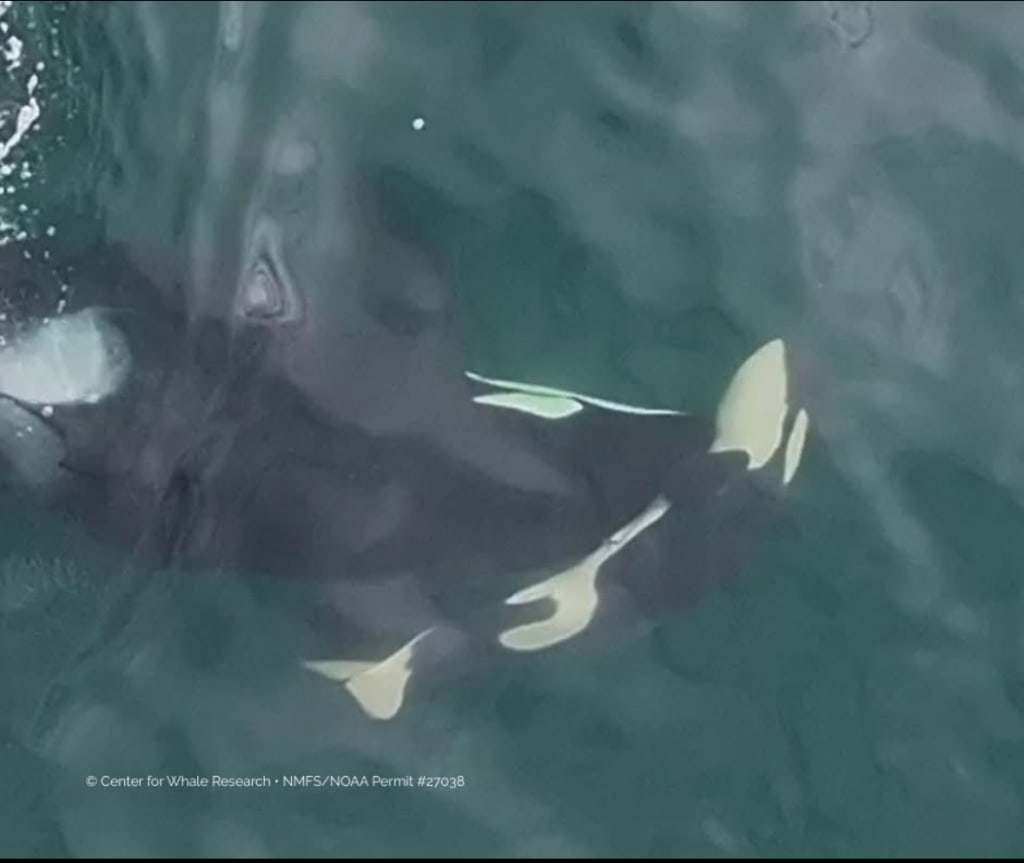
On September 12th, 2025, a heartbreaking event unfolded in Washington’s Rosario Strait. Marine researchers from the Center for Whale Research (CWR) observed J36 (Alki) carrying her deceased newborn daughter at the water’s surface. The female calf, estimated to be near or at full-term and still attached by the umbilical cord, is believed to have died within three days of birth.
This somber scene tragically mirrors previous losses for Southern Resident killer whales. J36’s earlier calf, J52 (Sonic), survived only two years, dying in 2017. While grief may be an unfamiliar concept to those observing these magnificent creatures, this pattern of mourning is all too familiar for the mothers of this endangered population. Much like her aunt J35 (Tahlequah), who carried a dead calf for weeks in both 2018 and 2025, Alki’s sorrowful display underscores the profound bonds within these whale families and the dire circumstances they face.
Southern Residents on the Brink
The Southern Resident killer whale (SRKW) population, a distinct and endangered group, currently numbers only about 75 individuals. Since 2005, NOAA Fisheries has recognized them as one of just two whale populations in the U.S. listed under the Endangered Species Act. This population has experienced a sharp decline over several decades, dropping from a peak of 97 in 1996 to its current mid-70s count.
Every loss, whether a death or a failed pregnancy, represents a significant setback for the SRKWs. NOAA reports that only one-third of whale pregnancies result in a viable calf, and approximately 50% of calves born do not survive to maturity. SeaDoc Society researchers also highlight that nearly 70% of SRKW pregnancies end in miscarriage or immediate calf death. These figures are exceptionally high, far exceeding those of most healthy whale populations. As one NOAA scientist aptly put it, Southern Resident orcas serve as poignant symbols of a once vibrant, yet now struggling, ecosystem.
A Unique Orca Culture
Southern Resident orcas are a unique and isolated population, both genetically and culturally. Genomic studies reveal high inbreeding and no gene flow with other orca populations, and their numbers have been further reduced by decades of live capture for aquariums.
These whales form tight-knit matrilineal pods (J, K, and L) and do not interact with nearby Bigg’s (transient) or Northern Resident whales. Culturally, Southern Residents are highly specialized salmon eaters, with fish comprising over 95% of their diet, and Chinook salmon making up about three-quarters of that. Unlike Bigg’s orcas, they famously do not consume marine mammals. Researchers emphasize that orca culture is deeply ingrained, making it virtually impossible for Southern Residents to eat anything other than salmon. Consequently, healthy salmon populations are crucial for their survival.
Alarming Pregnancy Loss
Many pregnancies among these whales fail, primarily because of chronic starvation. Long-term hormone studies show that up to 69% of detected pregnancies are unsuccessful, with approximately one-third of these losses occurring late in gestation or shortly after birth. Research directly links these late-term failures to a scarcity of Chinook salmon, highlighting its role as a significant stressor and cause of late pregnancy loss, including unobserved perinatal fatalities.
Other threats exacerbate this food scarcity. Whales are exposed to a "toxic soup" of PCBs and other contaminants stored in their blubber. When starving mothers metabolize fat, they inadvertently release these pollutants, which can harm their fetuses. Constant vessel noise and disturbance also contribute to stress, as does competition from fishing. However, the lack of prey remains the most prominent factor.
Salmon: The Orca Lifeline
Southern Resident Killer Whales (SRKW) depend critically on Chinook salmon, which make up 95% of their diet, with three-quarters of that being Chinook specifically. They rarely consume other prey. Consequently, the survival of healthy orcas is directly linked to abundant salmon runs.
The intimate connection between SRKW survival and Chinook salmon is starkly highlighted because Chinook salmon are also an endangered species. When Chinook runs decline, as observed in rivers like the Snake, Columbia, and Fraser, orcas suffer from hunger. A reduction in young salmon leads to leaner whales, decreased birth rates, and weakened calves, which often do not survive.
This crisis deeply affects the Indigenous tribes of the Pacific Northwest. For Coast Salish and other Indigenous cultures, orcas are "vessels of their relatives" and vital components of marine ecosystems, while salmon are held as sacred. Therefore, the restoration of salmon is not merely a biological recovery but is essential for preserving centuries of cultural heritage.
Dam Removal: A Key to Salmon Recovery
Breaching the four lower Snake River Dams (Lower Granite, Little Goose, Ice Harbor, and Lower Monumental) is widely considered the most impactful action to boost Chinook salmon runs. These dams, on Washington's Snake River, historically a prime salmon habitat, impede fish migration.
Extensive research, including NOAA's 2022 Columbia Basin report, supports that large-scale interventions, such as dam removal, are crucial for salmon rebuilding. Conservation groups emphasize that removing these dams offers the best chance for salmon populations to recover.
Studies on Washington's Elwha and White Salmon rivers have shown surprisingly rapid salmon population recovery following dam removal. Ultimately, breaching these dams is the single most significant step we can take to provide food for whales.
Cultural and Ecological Importance
The challenges faced by J36 and her calf extend beyond biological concerns. Southern Resident orcas are emblematic of the Pacific Northwest, embodying both its wild natural spirit and its cultural heritage. Indigenous tribes revere them as ancestors and educators, while they also attract tourists and whale-watchers who cherish their presence.
From an ecological standpoint, orcas are apex predators, and their health serves as an indicator of the Salish Sea's cleanliness, tranquility, and abundance of fish. Each reproductive setback or death acts as a dire warning of impending ecological decline. Conversely, every successful birth offers a beacon of hope for the entire ecosystem.
How You Can Help
You can make a difference in several ways:
- Support Salmon Recovery: Volunteer with or donate to organizations dedicated to planting trees, restoring rivers, and improving salmon habitats.
- Advocate for Dam Removal: Contact your representatives and urge action on the Lower Snake River dams.
- Spread Awareness: Share articles and reports to educate others about the Southern Residents’ struggles.
- Practice Mindful Whale-Watching: Maintain distance and minimize noise disturbance when on the water.
- Support Science and Conservation Groups: Donate to organizations like the Center for Whale Research, SeaDoc Society, and The Whale Museum, which perform vital work.
- Stay Engaged: Follow updates, sign petitions, and take part in community events focused on orca and salmon recovery.
A Final Word
The heartbreak over the loss of J36's calf is a call to action. If you feel grief after reading about this tragedy, know that your feelings are valid. These whales hold a special place in many hearts, including mine, and mourning them is natural. The most important thing is how we channel that grief. By supporting salmon recovery, advocating for dam removal, and sharing the Southern Residents' story, we can transform sorrow into strength and give these whales a real chance at survival.
References
- Center for Whale Research. (2025, September 12). Sad news: J36 observed carrying a deceased calf. Center for Whale Research. https://www.whaleresearch.com
- Environment Washington. (2022). Why removing the Snake River dams matters for salmon and orcas. Environment Washington. https://environmentwashington.org
- National Oceanic and Atmospheric Administration (NOAA) Fisheries. (2022, September 29). Southern Resident killer whales and salmon: A vital connection. NOAA Fisheries. https://www.fisheries.noaa.gov
- National Oceanic and Atmospheric Administration (NOAA) Fisheries. (2022). NOAA Columbia Basin Partnership Task Force report. NOAA Fisheries. https://www.fisheries.noaa.gov/resource/document/columbia-basin-partnership-task-force-report
- SeaDoc Society. (2021, June 7). Southern Resident killer whales: Status and challenges. UC Davis School of Veterinary Medicine. https://www.seadocsociety.org
- Wasser, S. K., Lundin, J. I., Ayres, K., Seely, E., Giles, D., Balcomb, K., … & Booth, R. (2017). High rates of pregnancy failure in Southern Resident killer whales: Proximate causes and population consequences. PLoS ONE, 12(6), e0179824. https://doi.org/10.1371/journal.pone.0179824
- Wild Salmon Center. (2023). Lower Snake River dams and salmon recovery. Wild Salmon Center. https://wildsalmoncenter.org
About the Creator
Jenna Deedy
Just a New England Mando passionate about wildlife, nerd stuff & cosplay! 🐾✨🎭 Get 20% off @davidsonsteas (https://www.davidsonstea.com/) with code JENNA20-Based in Nashua, NH.
Instagram: @jennacostadeedy
Keep reading
More stories from Jenna Deedy and writers in Earth and other communities.
The Ethics of De-Extinction: Should We Bring Back the Dire Wolf?
The birth of three dire wolf pups, Romulus, Remus, and Khaleesi, marks a groundbreaking scientific achievement by Colossal Biosciences. By utilizing advanced genetic engineering and ancient DNA, the company has effectively brought back the iconic Ice Age predator that disappeared over 10,000 years ago. This remarkable feat has ignited a global discussion surrounding the ethics and implications of de-extinction.
By Jenna Deedy9 months ago in Earth
Microbiota, microbiome or microflora: how to speak correctly and why it is for health.
You've probably heard the phrase, "We are what we eat." But modern science says more precisely: we are also those who live in us. Until 2016, it was believed that there are many times more bacteria in our body than our own cells. The latest calculations by mathematicians show that we divide the body with our microorganisms by about 50/50: about 30 trillion of our cells versus 38 trillion bacterial ones.
By Yaroslav Gorohova day ago in Earth
A building's lifetime climate impact is mostly determined by its daily energy use.
The majority of a building's climate impact is not caused by its construction. As the heating, lighting, and ventilation systems continue to function year after year, it gradually accumulates.
By Francis Damia day ago in Earth



Comments (1)
Very well explained so sad