
A Ghost from Another Star: Unraveling the Interstellar Traveler ATLAS
A personal journey to find the interstellar ghost that sparked a global debate and the scientific discovery that solved the puzzle

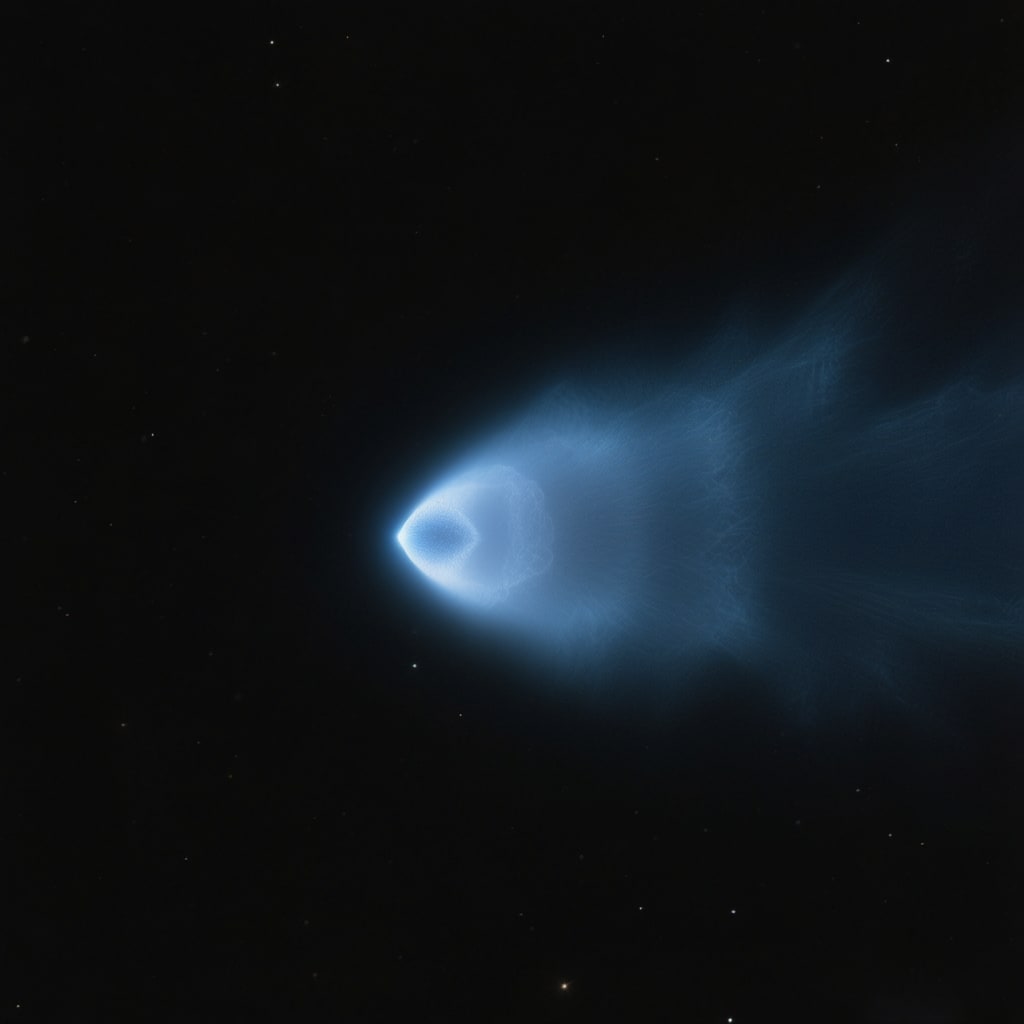
Is the Interstellar Traveler 'ATLAS' an Alien Spacecraft? A Personal Journey to Find a Cosmic Ghost
In Search of a Ghost
My phone's alarm shows 4:00 AM. Outside, in the cold of early December 2025, the air is dark and unforgiving. Every sane person is asleep at this hour. But I'm awake, because tonight isn't a normal night. Tonight is hunt night. I'm looking for the most controversial, frightening, and perhaps most important space object of the last decade: 3I/ATLAS.
As I set up my telescope in the backyard, my mind is consumed by the headlines that have set the internet on fire for weeks. "Global Alert: Mysterious Meteorite ATLAS." "Made by Aliens?" "Elon Musk Warns It Could Wipe Out a Continent." And, of course, the endless articles and interviews with Professor Avi Loeb of Harvard, who earnestly says this object might be "extraterrestrial technology."
The internet is in a fever pitch. People on Reddit are panicked, asking if this is the end. YouTubers are getting millions of views on videos titled, "What is REALLY happening to 3I/ATLAS?"
And now, here I am, with a 10-inch Dobsonian telescope, pointing it toward the constellation Leo. The star charts say it should be there. For an hour, I search in the freezing darkness. And finally... I find it.
It looks nothing like the flashy pictures. It's not a giant spacecraft. It's not even a bright comet.
What I see in the eyepiece is a fuzzy, incredibly faint, and honestly, disappointing patch. It looks like a small piece of cotton someone left behind in the velvety blackness of space. This is what has terrified the world?
This experience is exactly what other amateur astronomers have reported. On specialized forums like "Cloudy Nights," one observer with a 17.5-inch telescope reported they couldn't see it visually at all. Another with a 16-inch scope described it as "extremely faint" and "almost impossible to detect."
This massive gap between the media hype and the observational reality is the story itself. Why has this cosmic "ghost" become so important? To answer that, we have to go beyond the cold backyard observation and embark on a journey into the heart of a real scientific mystery.
Introducing the Interstellar Traveler
To understand the hype, we first need to know the traveler. 3I/ATLAS is an "Interstellar Object" (ISO). This is a fancy scientific term for a wondrous concept: a visitor. A piece of rock and ice that doesn't orbit our Sun, but has been hurled toward us from another star system, perhaps many light-years away.
This is a very exclusive club. 3I/ATLAS is only the third confirmed member of this club that humanity has ever identified:
• 1I/‘Oumuamua (2017): The first confirmed visitor. A mysterious, rocky, cigar-shaped object that sped past us with a strange velocity, leaving many unanswered questions.
• 2I/Borisov (2019): The second visitor. This one looked more like something we knew; a "normal" comet clearly releasing gas and dust, but it came from another world.
• 3I/ATLAS (2025): The third member. And it quickly became clear this one was the biggest, fastest, and by far the strangest of them all.
This object was first observed on July 1, 2025. But its discoverer wasn't a human; it was a system: the "Asteroid Terrestrial-impact Last Alert System," or ATLAS for short.
And here lies a beautiful philosophical irony. The ATLAS system is a network of robotic telescopes funded by NASA. Its primary mission, as its name suggests, is to constantly scan the sky for asteroids that might be on a collision course with Earth. It's our planetary defense frontline.
But on that July night, the system we built to protect ourselves from dangers in our own solar system accidentally became our primary tool for finding messengers from other systems. It was a victory for networked astronomy and rapid data sharing.
As soon as its hyperbolic orbit was calculated, scientists knew this object was free from the Sun's gravity and would leave our system forever. The good news? It's not going to hit us. At its closest, on December 19, 2025, it will pass at a safe distance of about 270 million kilometers.
But this was close enough for our best telescopes—Hubble, James Webb, and Swift—to get a detailed look and reveal its secrets. And what they found fanned the flames of this controversy even more.
The Alien Hypothesis
Why did this particular object become so controversial? The answer is summarized in one name: Avi Loeb, the controversial astrophysicist from Harvard.
Loeb, who had previously raised similar hypotheses about 'Oumuamua, doesn't believe it's definitely an alien spacecraft. But he and his colleagues argue that 3I/ATLAS's behavior is so strange and full of "Anomalies" that the "extraterrestrial technology" (Technosignature) hypothesis must remain on the table as a scientific possibility.
In numerous articles and interviews, he pointed to several items that exploded in the media. Let's look at four key ones:
• Non-gravitational acceleration: After passing the Sun on October 29, 2025, 3I/ATLAS showed acceleration that couldn't be explained by the Sun's gravity alone. Loeb says this could be the "technical signature of an internal engine."
• Strange chemical composition: Initial data showed a very high ratio of nickel to cyanide and an abundance of nickel compared to iron. Loeb likened this to industrial alloys that humans make.
• Extremely rare orbit: The object is moving almost exactly on the "ecliptic plane"; the same plane in which our solar system's planets orbit the Sun. Loeb calculated the chance of this happening for a random visitor from deep space is only about 0.2%.
• A reconnaissance mission?: The object's path was set to pass near Mars, Venus, and Jupiter. Is this a planned "mapping mission"?
These theories were gasoline on the internet's fire. But the scientific community's reaction was swift. Chris Lintott, an astrophysicist at Oxford University, called the hypothesis "nonsense on stilts." NASA officially stated that the object poses "no threat to life on Earth."
So who is right? Is this a conspiracy to hide the truth, or the hype of a controversial scientist? To answer this, we must move past the "alien" controversy and into a much deeper, more real, and more confusing scientific mystery. The solution to the "alien" riddle lies within another scientific paradox: The Water Paradox.
The Water Paradox
While the media was busy discussing "alien engines," astronomers behind the scenes were facing a real data crisis. Two of our best and most expensive space telescopes were giving completely contradictory reports about 3I/ATLAS's most fundamental component: water.
Case 1: The "WET" Comet
In July and August 2025, a team of scientists pointed NASA's Neil Gehrels Swift Observatory at 3I/ATLAS. Swift is a space telescope that observes in the ultraviolet (UV) spectrum, which is blocked by Earth's atmosphere. Their discovery was stunning: for the first time, they detected the "chemical fingerprint of water" in this interstellar object. They didn't see the water molecule (H2O) directly. Instead, they saw "hydroxyl" (OH), a molecule created when sunlight hits a water molecule and breaks it apart. This was definitive proof of water.
But the amazing data wasn't the discovery itself, but the amount. Calculations showed 3I/ATLAS was erupting water at a staggering rate of 40 kilograms per second. The paper's authors likened this phenomenon to "a fire hose running at full blast." This was a puzzle. At this distance, the sunlight is usually too weak to vaporize water ice on a comet's surface so intensely. This was the first clue that 3I/ATLAS was not a normal comet.
Case 2: The "DRY" Comet
At almost the exact same time, two other powerful space telescopes—the James Webb Space Telescope (JWST) and NASA's SPHEREx observatory—turned toward ATLAS. Their results turned the puzzle into an all-out paradox. The report from the SPHEREx observatory, which observes in the infrared spectrum, was shocking: "no gaseous water (H2O) cloud detected." They estimated a maximum water outgassing rate of 4.5 kg/s—almost ten times less than what Swift had reported.
But SPHEREx found something else instead: a massive cloud of carbon dioxide (CO2), or dry ice. The observatory measured the CO2 outgassing rate at about 70 kilograms per second. Shortly after, the James Webb Space Telescope confirmed this finding and reached an even more surprising conclusion: 3I/ATLAS has the "highest ratio of CO2 to water" ever observed in a comet.
Solving the Paradox
This was a classic scientific paradox. The Swift telescope saw a "water fire hose." The James Webb and SPHEREx telescopes saw a "dry desert full of CO2." Who was right? The answer, which transformed our understanding of this object, was: Both were right.
The key to solving the riddle is that these telescopes were measuring different things. JWST and SPHEREx were looking directly at the gases sublimating from the solid nucleus of the comet, which were clearly dominated by CO2. The Swift telescope was looking at the "echo" of water (the OH molecule) in the entire coma—the vast cloud of gas and dust surrounding the nucleus.
And this is how the mystery was solved: 3I/ATLAS is a "dry ice bomb." Its main engine of activity is not water, but the explosive sublimation of CO2. These powerful CO2 jets are so strong that they are launching solid water-ice grains from the nucleus out into the coma. Therefore, JWST correctly identified that the dominant gas at the nucleus was CO2. And the Swift telescope correctly saw the "echo" of those stray ice grains being broken down by sunlight, creating that strong "hydroxyl" signal. The scientific conclusion is astonishing: 3I/ATLAS is simultaneously "dry" at the core and "wet" in the coma.
Revisiting the Alien Hypothesis
Now that we have the scientific solution in hand, we can easily answer Avi Loeb's "anomalies."
1. Non-gravitational acceleration? It wasn't an alien engine. It was the thrust from the explosive sublimation of 70 kilograms of carbon dioxide per second. 3I/ATLAS is a powerful, natural rocket engine based on dry ice.
2. Strange chemical composition? This isn't an "industrial alloy." This is the chemical fingerprint of its home star system. It tells us that the chemical composition of the nebula 3I/ATLAS was born in was different from our own.
3. Rare orbit? This is a classic "Selection Bias" in science. We found this object precisely because it was moving in the plane where our telescopes are looking. We are missing the thousands of other visitors passing through different planes because we aren't looking there.
Science won. The "alien" hypothesis was sexy and got clicks, but the natural solution is far more exciting, complex, and scientifically rich.
A Practical Guide to Observation
Alright, so you want to see this interstellar traveler too. Here is a practical, no-nonsense guide to observing 3I/ATLAS in the coming weeks.
• Visible to the naked eye? No. Absolutely not.
• With binoculars? No. The object's brightness is far too dim for standard binoculars.
• What do I need? You need a telescope with an aperture of at least 8 inches (200mm) and a very dark sky, completely away from city light pollution.
• When and Where? The best window is early November to mid-December 2025. Look east about 90 minutes before sunrise. The object will be moving from the constellation Virgo toward the constellation Leo during this period.
• Manage your expectations. You will not see a glorious comet with a bright tail. You are looking for a "very faint fuzzy patch" or a "vague, star-like point." The thrill of this observation is not in the seeing; it's in knowing what you are looking at.
Lessons from Interstellar Visitors
I think back to that cold December morning and that faint fuzzy patch in my telescope's eyepiece. Visually, it was perhaps a failure, but conceptually, it was a victory. We are looking at a ghost. A time capsule. A piece of ice and rock that has perhaps wandered the interstellar darkness for billions of years, even before our Sun and Earth were formed.
This is the philosophical importance of interstellar visitors. We have entered a new era of "cosmic archaeology."
• The first visitor, 'Oumuamua, was dry, rocky, and weird.
• The second visitor, Borisov, was rich in carbon monoxide.
• And now the third visitor, ATLAS, is a "CO2 bomb" carrying water-ice grains as cargo.
Each one tells a different story. They prove to us that our solar system is not alone and that the "recipe" for planets in the galaxy is far more diverse than we ever imagined. 3I/ATLAS showed us that the real "alien" is not a metal spacecraft, but the limitless diversity of nature itself. And that is more wonderful than any science fiction story.
About the Creator
Mehdi Gh
A thinker and writer at the intersection of cosmology and cybersecurity. I explore hidden patterns among stars and codes.
Keep reading
More stories from writers in Earth and other communities.
Icy Chaos in Central and Eastern Europe
Winter has unleashed its fury across central and eastern Europe, leaving travelers frustrated and transport networks struggling to keep up. Over the past few days, freezing rain and ice have wreaked havoc on airports, train stations, and highways — forcing flight diversions, delaying trains, and making roads treacherously slippery. From Vienna to Budapest, Prague to Bratislava, this icy grip has brought travel to a near standstill. Let’s take a closer look at what’s happening, how it’s affecting people on the move, and what it tells us about winter travel in Europe. A Sudden Winter Blow A sudden wave of freezing rain swept across the region, coating runways, rail tracks, and roads with a dangerous layer of ice. Major airports in Austria, Hungary, Slovakia, and the Czech Republic were particularly affected. At Vienna International Airport, operations were temporarily suspended when runways became too slick for flights to land safely. Travelers already in the air had to divert to alternative airports in Munich, Frankfurt, and Venice. Meanwhile, Budapest’s Ferenc Liszt International Airport paused all arrivals and departures, and Prague’s Václav Havel Airport continued operating but at limited capacity. Trains Crawling Through Ice Rail networks weren’t spared. Across Austria, Hungary, and the Czech Republic, ice on tracks and power lines caused delays and cancellations. Austria’s national rail operator, ÖBB, urged passengers to postpone non-essential journeys. In the Czech Republic, travelers at Prague’s main station faced long waits as trains struggled to maintain schedules. Hungary’s tram and suburban rail services were temporarily suspended due to ice buildup on power lines. This combination of black ice, frozen switches, and heavy snowfall has tested the limits of winter infrastructure in Europe. Roads Turn Into Skating Rinks The icy weather didn’t just affect public transport — roads became treacherous, too. Authorities in Slovakia and the Czech Republic warned residents to avoid non-essential travel as highways turned into slippery skating rinks. Accidents and minor collisions were reported, and emergency services were busy responding to dozens of injuries from slips and falls. Even schools weren’t immune: parts of Romania shifted to online learning, keeping children safe during the extreme temperatures, which dropped to around -13°C in some areas. Why This Weather Is So Disruptive Meteorologists point to several factors that made this storm particularly severe: Freezing rain on top of existing snow creates an icy layer that’s extremely hard to clear. Rapidly refreezing surfaces make conditions unpredictable. Temperatures hovering around freezing prevent efficient melting during the day. This “perfect storm” scenario underscores just how vulnerable transport systems are to extreme weather. Even well-prepared airports and rail networks can struggle when weather transitions from snow to freezing rain. Voices From the Ground Passengers took to social media to express their frustration: Crowded airports as travelers scrambled to rebook flights. Train stations packed with delayed commuters, unsure when the next train would depart. Warming centers opened to provide shelter and hot drinks for stranded travelers. For many, a simple trip turned into a test of patience and resilience. Tips for Traveling in Freezing Conditions If you must travel during winter storms, experts recommend: Check flight and train schedules regularly, as delays can change quickly. Allow extra time for travel to avoid missing connections. Consider travel insurance that covers weather-related disruptions. If driving, carry winter essentials: blankets, food, water, and check road conditions before departure. Most importantly, prioritize safety over schedules — icy conditions can change rapidly, making travel risky. A Reminder From Winter This recent chaos in central and eastern Europe serves as a stark reminder of how interconnected transport systems are, and how vulnerable they can be to extreme weather. Flights grounded, trains stalled, and highways turned icy show that winter can bring travel to a halt — sometimes with very little warning. As Europe continues to face volatile winter conditions, travelers and authorities alike are reminded: preparation and flexibility are key. Sometimes, the weather truly has the final say. ❄️🛫🚆
By Muhammad Hassan4 days ago in Earth
Snow, Rain and Wind Warnings Continue After Storm Goretti Disruption
Severe weather has once again placed large parts of the country on edge, as snow, rain, and strong wind warnings continue in the aftermath of Storm Goretti. While the storm’s most intense phase may have passed, its disruption lingers, leaving transport networks strained, power services under pressure, and communities bracing for further unsettled conditions. Storm Goretti arrived with a powerful combination of heavy rainfall, gusty winds, and wintry conditions in higher and northern regions. The immediate impact was widespread: flooded roads, fallen trees, travel cancellations, and temporary power outages. Now, as emergency crews and local authorities work through the damage, meteorologists are warning that the weather pattern remains unstable, with fresh alerts issued for snow, rain, and wind in the days ahead. What Storm Goretti Left Behind Goretti’s passage was fast but forceful. Torrential rain caused rivers to swell and surface water flooding to develop quickly in low-lying areas. In exposed coastal and upland regions, wind gusts were strong enough to bring down trees and damage infrastructure. Meanwhile, colder air sweeping in behind the storm delivered snow and icy conditions, particularly affecting rural roads and higher elevations. For many commuters, the disruption was immediate and frustrating. Rail services were delayed or suspended due to flooded tracks and debris on lines. Roads became hazardous, with localised closures as emergency teams worked to clear fallen branches and manage flooding. Airports also reported delays, as strong crosswinds and poor visibility complicated operations. Although the storm itself has moved on, its effects are far from over. Ongoing Warnings: Why the Risk Remains High Weather agencies have stressed that the current warnings should be taken seriously. The ground is already saturated from recent rainfall, meaning even moderate additional rain could lead to further flooding. Rivers and drainage systems are under strain, and recovery time is limited before the next weather system arrives. Snow and ice warnings add another layer of concern. Overnight temperatures are expected to dip in several regions, increasing the risk of icy roads and pavements. For drivers, this creates dangerous conditions, especially in areas where gritting resources are stretched after consecutive weather events. Wind warnings also remain in place, particularly along coasts and in elevated areas. While gusts may not reach the peak levels seen during Goretti, even slightly weaker winds can still cause problems when trees and structures have already been weakened. Impact on Communities and Daily Life For local communities, the continuation of weather warnings means disruption becomes a drawn-out experience rather than a short-term event. Schools in some areas have faced temporary closures or delayed openings, especially where travel conditions remain unsafe. Businesses dependent on transport and foot traffic are also feeling the strain, as customers stay home and deliveries are delayed. Rural areas are often hit hardest. Narrow roads, limited public transport alternatives, and longer response times can make even minor weather incidents more serious. Farmers are also concerned about waterlogged fields, livestock safety, and damage to fencing and buildings. In urban centres, the focus has shifted to managing surface water flooding and ensuring public transport can run safely. Councils are urging residents to report blocked drains and avoid unnecessary travel during warning periods. Emergency Services Under Pressure Emergency and utility services continue to operate at high alert. Fire and rescue teams have been responding to flooding incidents, fallen trees, and weather-related accidents. Power companies are working to restore and reinforce electricity supplies, while also preparing for the possibility of new outages if conditions deteriorate again. Local authorities have opened temporary support centres in some regions, particularly for vulnerable residents affected by power cuts or flooding. These efforts highlight the importance of community preparedness, as repeated weather events stretch resources and personnel. The Broader Weather Pattern Meteorologists explain that Storm Goretti is part of a broader pattern of unsettled weather driven by active Atlantic systems. Instead of a single storm followed by calm conditions, the atmosphere is producing a succession of fronts, each bringing its own mix of rain, wind, and temperature changes. This pattern increases uncertainty and makes forecasting more challenging. Small shifts in temperature can mean the difference between rain and snow, while slight changes in wind direction can significantly affect coastal impacts. As a result, weather warnings may be updated frequently, requiring the public to stay informed and flexible. How to Stay Safe During Continued Warnings Authorities are urging people not to become complacent simply because the main storm has passed. Continued vigilance is essential, especially as conditions can change quickly. Key safety advice includes: Avoid unnecessary travel during periods of snow, ice, or strong winds. Check weather updates regularly from official sources. Secure loose items outdoors that could become dangerous in high winds. Be cautious near rivers, coastlines, and flood-prone areas. Look out for neighbours, particularly elderly or vulnerable individuals. Preparation can make a significant difference, especially when weather disruption extends over several days rather than a single event. Looking Ahead While there are signs that conditions may gradually improve later in the week, the immediate outlook remains unsettled. The continuation of snow, rain, and wind warnings after Storm Goretti serves as a reminder of how quickly weather can impact daily life and essential services. For now, recovery and preparedness must go hand in hand. Clearing up after one storm while preparing for the next has become an unfortunate reality for many communities. As climate patterns continue to shift, such sequences of disruptive weather may become more common, making resilience and awareness more important than ever. Storm Goretti may no longer dominate the forecasts, but its legacy lives on in the warnings that remain—and in the determination of communities working through yet another challenging spell of weather.
By Muhammad Hassan7 days ago in Earth
Silver Screen Magic with Mae West
American actress and singer Mae West became a popular film actress during the Great Depression. She started entertaining in vaudeville, then performed on Broadway, and finally went to Hollywood. She signed up with Paramount Pictures and made her debut in the 1932 film “Night After Night.” She also starred in musicals, comedies, and crime dramas. The American Film Institute named her one of the best classic Hollywood actresses.
By Rasma Raisters5 days ago in Geeks


Comments
There are no comments for this story
Be the first to respond and start the conversation.