
‘A Different Set of Rules’: Thermal Drone Footage Shows Musk’s AI Power Plant Flouting Clean Air Regulations
New aerial evidence raises questions about environmental accountability, corporate power, and whether emerging tech giants are playing by the same rules as everyone else.

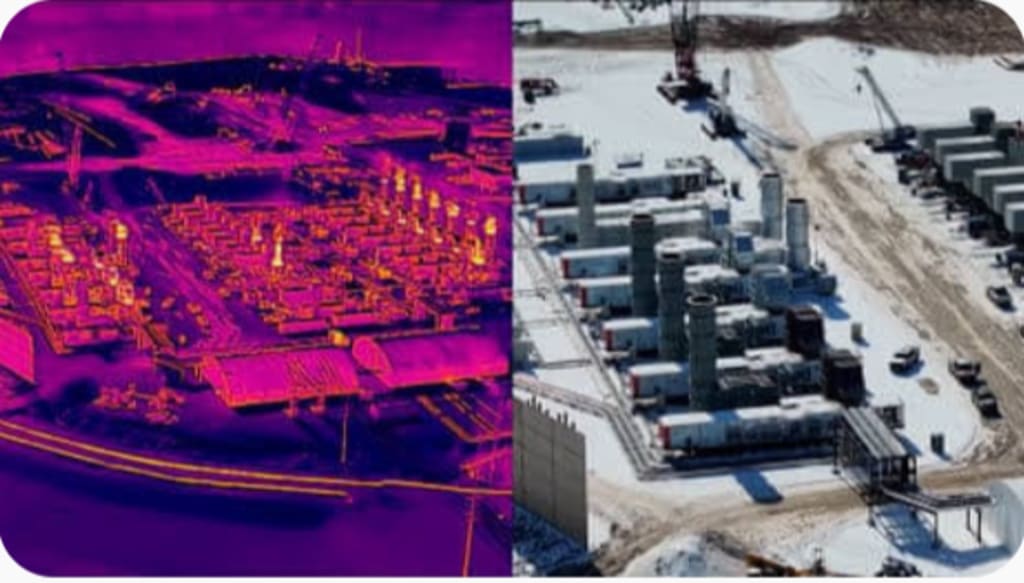
A new wave of controversy is surrounding tech billionaire Elon Musk after thermal drone footage appeared to show emissions from an AI-linked power facility exceeding limits set by U.S. clean air regulations. The footage, captured by environmental activists and shared widely online, has sparked debate over whether large technology companies are being granted unofficial exemptions in the race to build massive artificial intelligence infrastructure.
At the center of the issue is a power plant supplying electricity to Musk’s AI operations, reportedly connected to his company xAI. The plant, which uses gas-powered turbines to meet the enormous energy demands of AI data centers, was observed emitting heat signatures and exhaust plumes that critics argue suggest excessive pollution levels.
The phrase now circulating across social media and environmental circles is blunt: “a different set of rules.”
What the Drone Footage Reveals
Thermal imaging drones are often used to detect heat patterns, gas flaring, and airborne emissions that are invisible to the naked eye. In this case, footage allegedly shows continuous operation of multiple gas turbines without the pollution controls normally required under federal clean air standards.
Environmental watchdog groups claim the emissions appear far higher than what similar industrial facilities are permitted to produce. According to their analysis, the plant’s activity may violate limits on nitrogen oxides and particulate matter—pollutants linked to respiratory disease and climate change.
While the footage itself does not provide chemical measurements, experts say thermal patterns can strongly indicate combustion output and intensity. Combined with operational timelines, the images suggest the facility may be running far more often than regulators anticipated.
Why AI Needs So Much Power
Artificial intelligence is not just software—it is energy-hungry hardware. Training and running large language models requires vast server farms operating around the clock. These data centers consume electricity at levels comparable to small cities.
Musk’s AI venture has been racing to compete with industry leaders, and that means building infrastructure quickly. In regions where power grids are already strained, companies sometimes turn to on-site gas turbines as a fast solution.
But environmental advocates argue that speed does not justify bypassing regulations designed to protect public health.
“The problem isn’t AI,” one climate analyst said. “The problem is choosing the dirtiest energy solution because it’s convenient.”
Regulation and Responsibility
The U.S. Clean Air Act requires industrial facilities to install pollution-control systems and adhere to strict emissions caps. Oversight typically falls under agencies such as the Environmental Protection Agency, along with state environmental departments.
Critics claim that Musk’s facility was permitted under emergency or temporary power provisions that were never meant for long-term industrial use. If true, that would place the operation in a legal gray area—technically allowed, but environmentally harmful.
This has fueled accusations that wealthy tech companies receive regulatory flexibility that ordinary manufacturers do not.
When questioned, company representatives have stated that the facility is operating within its permits and that long-term plans include more sustainable power sources. However, no public timeline has been provided for when that transition would occur.
Community Impact
Local residents living near the power plant report concerns about air quality, noise, and long-term health risks. Some describe smelling exhaust fumes during nighttime operations, while others worry about what constant turbine use means for their environment.
For communities already burdened by industrial activity, the arrival of an AI power plant feels less like progress and more like another form of pollution.
“What’s frustrating,” said one resident, “is that this is being called the future of technology, but it looks like the past of fossil fuels.”
The Bigger Picture: Tech vs. the Climate
This controversy highlights a growing tension between innovation and sustainability. AI is often marketed as a tool to solve global problems—from medical breakthroughs to climate modeling. Yet its physical footprint tells a different story.
As companies scale up computing power, energy consumption skyrockets. Without strict environmental safeguards, the very technology designed to help humanity could worsen pollution and carbon emissions.
Musk has publicly championed renewable energy through ventures like electric vehicles and solar technology. That history makes the current allegations more striking. Supporters argue this is a temporary step, while critics see it as hypocrisy.
Public Trust and Transparency
One of the most damaging aspects of the situation may be the perception of secrecy. Drone footage went viral precisely because there was little public information about how the plant operated.
Transparency matters when private companies manage facilities that affect public air quality. Environmental groups are now calling for independent inspections and full disclosure of emissions data.
If regulators confirm violations, fines and operational changes could follow. If not, the case will still raise questions about how laws apply to emerging industries like AI infrastructure.
A Turning Point for AI Regulation
This incident could become a watershed moment in how governments regulate AI’s physical footprint. Until now, most AI oversight has focused on ethics, bias, and data privacy. Environmental impact has received far less attention.
But as AI expands, its carbon cost can no longer be ignored.
Lawmakers are increasingly pressured to update clean energy standards for data centers and require renewable sourcing rather than fossil-fuel stopgaps.
The message from activists is clear: technological advancement should not come at the expense of clean air.
Final Thoughts
The thermal drone footage showing emissions from Musk’s AI power plant has ignited more than a legal dispute—it has ignited a moral one. Who gets to bend the rules in the name of innovation? And who bears the consequences?
Whether the facility is ultimately found in violation of clean air regulations or not, the optics are powerful. A company shaping the future of artificial intelligence appears, at least for now, to be relying on old-fashioned fossil fuel solutions.
If AI is meant to represent human progress, then its infrastructure must reflect that ideal.
The controversy serves as a reminder that the future is not built only with code and algorithms—it is built with power plants, policies, and choices. And those choices will determine whether innovation becomes a force for sustainability or another chapter in environmental compromise.
For many watching this unfold, the question is no longer just about emissions. It’s about fairness, accountability, and whether the most powerful voices in technology are willing to live by the same rules as everyone else.
About the Creator
Sajida Sikandar
Hi, I’m Sajida Sikandar, a passionate blogger with 3 years of experience in crafting engaging and insightful content. Join me as I share my thoughts, stories, and ideas on a variety of topics that matter to you.
Keep reading
More stories from Sajida Sikandar and writers in Earth and other communities.
China banned all fishing to save the Yangtze River
When a river that has sustained life for thousands of years begins to collapse, drastic action becomes inevitable. That was the reality facing Yangtze River, Asia’s longest river and one of the most biologically diverse freshwater systems on Earth.
By Sajida Sikandar2 days ago in Earth
Storm Leonardo Triggers Mass Evacuations Across Spain and Portugal
Storm Leonardo has unleashed severe weather across parts of Spain and Portugal, forcing authorities to evacuate more than 11,000 residents as flooding, powerful winds, and widespread disruption threaten public safety. Emergency services in both countries remain on high alert, warning that risks persist even as conditions show signs of gradual improvement.
By Adil Ali Khan7 days ago in Earth
Asteroid 2024 YR4 Could Slam Into the Moon—And Earth Might See the Flash
A newly published scientific study has captured the attention of astronomers and space enthusiasts worldwide with a fascinating possibility: Asteroid 2024 YR4, a recently discovered near-Earth object, could collide with the Moon and create a bright flash visible from Earth.
By Adil Ali Khan5 days ago in Earth
If You Write A Book, Don’t Tell Anyone
There are days when I’m grateful Amazon doesn’t tell me specifically who has bought my book and who hasn’t. If they did, I would be heartbroken when I read the list and noticed all the important names in my life were not on my list of customers.
By Ellen Frances7 days ago in Writers



Comments
There are no comments for this story
Be the first to respond and start the conversation.