
Asteroid 2024 YR4 Could Slam Into the Moon—And Earth Might See the Flash
Scientists say a rare lunar impact could light up the Moon’s surface and offer critical insights into asteroid threats and planetary defense.

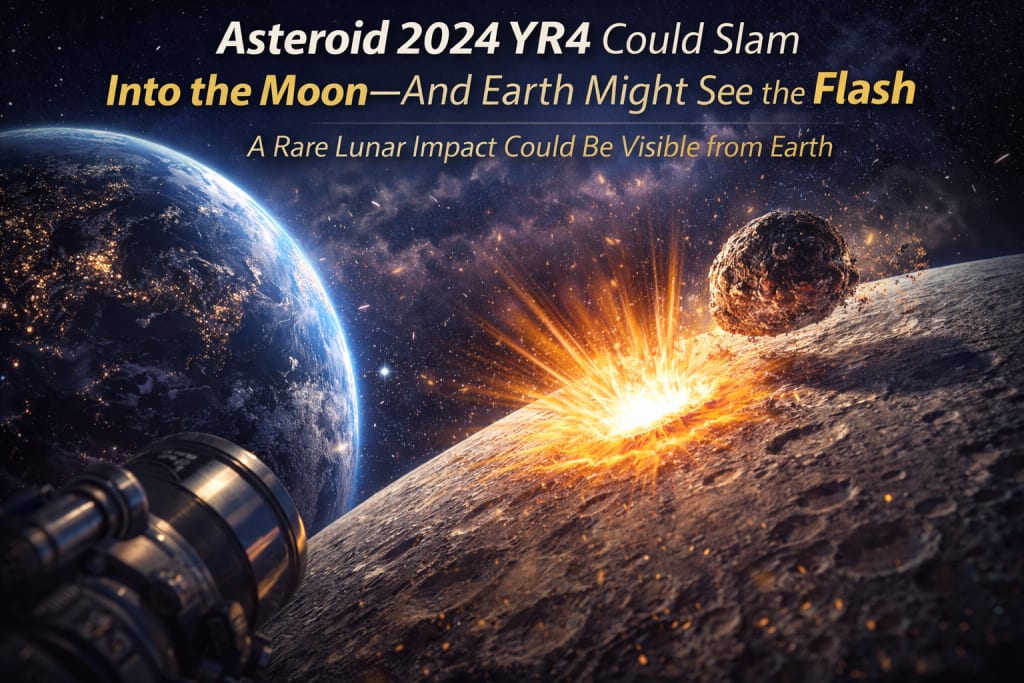
A newly published scientific study has captured the attention of astronomers and space enthusiasts worldwide with a fascinating possibility: Asteroid 2024 YR4, a recently discovered near-Earth object, could collide with the Moon and create a bright flash visible from Earth.
While the event poses zero danger to our planet, researchers say it could become one of the most scientifically valuable natural impact observations in years. From improving asteroid-impact models to enhancing planetary defense strategies, the Moon may soon offer humanity a rare cosmic lesson—one visible from nearly 384,000 kilometers away.
________________________________________
What Is Asteroid 2024 YR4?
Asteroid 2024 YR4 is classified as a near-Earth object (NEO), meaning its orbit brings it relatively close to Earth’s neighborhood. It was detected earlier this year through routine sky surveys designed to identify potentially hazardous space objects.
Based on current estimates, the asteroid measures tens of meters in diameter—large enough to survive its journey through space but small enough to avoid catastrophic consequences if it collides with a solid body like the Moon.
Importantly, astronomers stress that 2024 YR4 is not on a collision course with Earth. However, orbital simulations reveal a low-probability scenario in which gravitational interactions could steer it toward the Moon instead.
While unlikely, this possibility has generated intense scientific interest.
________________________________________
What Would Happen If It Hits the Moon?
If Asteroid 2024 YR4 were to strike the Moon, the impact would unleash energy equivalent to several tons of TNT. The collision would instantly vaporize part of the asteroid and lunar surface, producing a brief but powerful flash of light.
According to the study, this flash could last anywhere from a fraction of a second to several seconds, depending on the asteroid’s speed, angle of impact, and surface composition at the collision site.
Under ideal conditions—such as a dark lunar phase and clear skies—the flash could be detectable from Earth using telescopes, and possibly even visible to skilled amateur astronomers.
________________________________________
Why a Lunar Impact Is So Valuable to Science
Unlike Earth, the Moon has no atmosphere, no weather, and virtually no erosion. That makes it a perfect natural laboratory for studying asteroid impacts.
“When an asteroid hits Earth, most of the evidence is erased almost immediately,” one planetary scientist involved in the research explained. “On the Moon, everything is preserved.”
By observing a lunar impact in real time, scientists can gather critical data, including:
• The asteroid’s size and velocity
• The total energy released during impact
• How lunar soil and rock respond to high-energy collisions
• The formation of new craters
This information feeds directly into planetary defense models used to assess future asteroid threats to Earth.
________________________________________
Could People on Earth Actually See It?
The idea of witnessing a cosmic collision has understandably fueled public excitement. While visibility isn’t guaranteed, researchers say it’s entirely possible under the right conditions.
Several factors would determine visibility from Earth:
• The asteroid’s size and speed
• The Moon’s phase (darker phases are better)
• The angle of impact
• Local light pollution and weather conditions
If everything aligns, observers might see a brief sparkle or flash on the Moon’s surface, captured by professional observatories and possibly backyard telescopes equipped with cameras.
However, scientists caution that the event would be extremely brief—blink, and you might miss it.
________________________________________
No Danger to Earth—Just Opportunity
One message researchers emphasize repeatedly is that there is no risk to Earth. Even in the unlikely event of a lunar impact, it would not:
• Change the Moon’s orbit
• Create debris capable of reaching Earth
• Trigger any secondary hazards
“This is not a doomsday scenario,” scientists say. “It’s a scientific opportunity.”
The study highlights how planetary defense today goes beyond Earth-centric thinking. The Moon acts as a natural shield and reference point—absorbing impacts and revealing information Earth often hides.
________________________________________
A Boost for Planetary Defense Research
Planetary defense has become a major focus for space agencies like NASA and ESA, especially after recent missions proved humans can alter an asteroid’s trajectory under controlled conditions.
A natural lunar impact would complement those efforts by offering real-world data without risking lives or infrastructure.
By comparing predicted models with actual observations, scientists can refine:
• Detection systems
• Impact energy estimates
• Emergency response planning
In this sense, the Moon serves as both a guardian and a teacher.
________________________________________
Technology Already Watching the Moon
Modern technology ensures that if Asteroid 2024 YR4 hits the Moon, it won’t go unnoticed.
Multiple monitoring systems continuously scan the lunar surface, including:
• High-speed telescopes
• Infrared sensors
• Automated detection software
• Citizen-science observation networks
These systems are designed to detect sudden flashes and record them in real time. A confirmed impact would likely be observed by multiple independent teams worldwide, providing a wealth of data for analysis.
________________________________________
Why the Public Is So Fascinated
The possibility of seeing a cosmic event unfold in real time has sparked widespread public interest. Astronomy groups and online communities are already discussing observation windows and encouraging enthusiasts to keep an eye on the Moon.
With live streams, social media, and accessible astronomy tools, space events are no longer confined to scientists—they’ve become shared global experiences.
For many people, events like this reinforce a powerful truth: we live in a dynamic solar system, where change is constant and awe-inspiring.
________________________________________
A Reminder That Space Is Always Active
The Moon’s surface is covered in craters—each one a record of ancient collisions. Earth, protected by its atmosphere, doesn’t show the same scars, but the danger has never disappeared.
Asteroid 2024 YR4, whether it collides with the Moon or passes quietly through space, reminds us that cosmic motion never stops.
Space isn’t distant or abstract. It’s active, evolving, and occasionally puts on a show visible from our own backyard.
________________________________________
Looking Ahead
Even if the predicted collision never occurs, scientists agree the study itself is a success. It demonstrates how modern astronomy can forecast rare events, prepare observation campaigns, and turn chance encounters into scientific breakthroughs.
For now, Asteroid 2024 YR4 continues its silent journey through space. But if it does meet the Moon—lighting up its surface, even briefly—humanity may gain a front-row seat to the forces that shape our cosmic neighborhood.
And sometimes, a single flash is all it takes to illuminate the universe a little more.
About the Creator
Adil Ali Khan
I’m a passionate writer who loves exploring trending news topics, sharing insights, and keeping readers updated on what’s happening around the world.
Keep reading
More stories from Adil Ali Khan and writers in Earth and other communities.
The Arctic is Breaking Down: Why This Rare February Signal Has Meteorologists On Edge
As the calendar turns through February, something unsettling is happening 30,000 feet above the North Pole. High-altitude sensors and satellite data are flashing "code red" signals that haven't been seen in decades. Meteorologists are sounding the alarm on an unusually early Arctic breakdown—a massive disruption of the atmosphere that could flip the script on the rest of our winter.
By Adil Ali Khana day ago in Earth
Heat with No End: Climate Model Sets Out an Unbearable Future for Parts of Africa
The future of Africa, as outlined by emerging climate models, is growing hotter—and far more dangerous—than previously imagined. Scientists now warn that parts of the continent could soon experience levels of heat and humidity so extreme that human survival outdoors may become nearly impossible. This is not a distant science-fiction scenario. It is a forecast grounded in real data, unfolding within the lifetimes of millions alive today.
By Sajida Sikandar2 days ago in Earth



Comments
There are no comments for this story
Be the first to respond and start the conversation.