
A Cold Earth-Sized Planet Surprisingly Close to Our Solar System
Astronomers have discovered a frozen world roughly the size of Earth orbiting a nearby star, offering new clues about how small rocky planets form beyond our solar system.

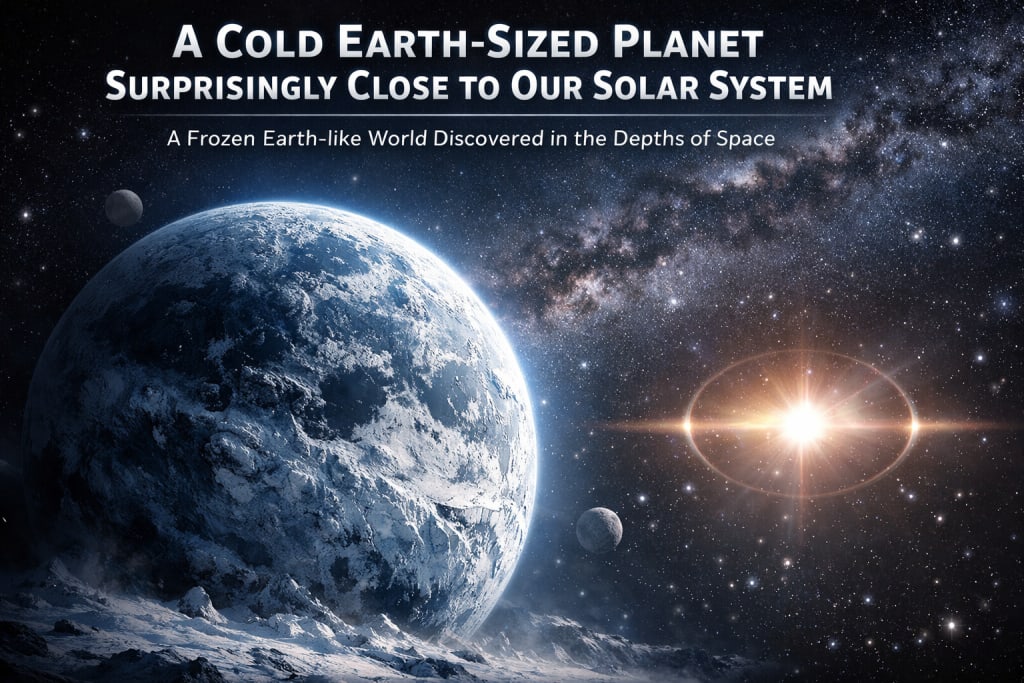
For decades, astronomers have searched the universe for planets that resemble Earth. While many discoveries have revealed massive gas giants or extremely hot rocky worlds, the discovery of a cold, Earth-sized planet near our cosmic neighborhood has sparked new excitement in the scientific community. This intriguing world demonstrates that small rocky planets like our own may be more common in the galaxy than once believed.
The planet, known as OGLE‑2016‑BLG‑1928, is roughly comparable in size to Earth and lies relatively close to our solar system on a galactic scale. Although it may still be thousands of light-years away, that distance is considered “nearby” when compared to many other known exoplanets discovered across the Milky Way.
Unlike Earth, however, this planet is extremely cold. Scientists believe that it either orbits very far from its host star or may not orbit any star at all. Instead, it could be what astronomers call a “rogue planet”—a planet drifting freely through space without the warmth and light of a nearby star.
The discovery was made using a technique known as Gravitational Microlensing. This method takes advantage of the predictions made by General Relativity, a theory developed by Albert Einstein. According to this theory, massive objects such as stars or planets can bend and magnify the light from more distant stars behind them.
When the cold Earth-sized planet passed in front of a distant star, its gravity briefly magnified the star’s light. This brightening lasted only a short time—about 40 minutes—indicating that the object responsible for the effect was relatively small. From this tiny signal, astronomers were able to estimate the planet’s mass and size, concluding that it is similar to Earth.
The discovery was made through the Optical Gravitational Lensing Experiment, commonly known as OGLE. This long-running astronomical survey monitors millions of stars in the direction of the Milky Way galaxy’s central region. By constantly observing such a large number of stars, scientists can catch rare microlensing events when planets or other objects pass in front of them.
What makes this discovery especially exciting is that Earth-mass planets are extremely difficult to detect. Most exoplanet discoveries have been made using methods that are better suited to finding large planets close to their stars. For example, the Kepler Space Telescope and the Transiting Exoplanet Survey Satellite have identified thousands of planets by observing slight dips in a star’s brightness when a planet passes in front of it. However, those methods are less effective at detecting small planets that are far from their stars—or planets with no star at all.
This is why microlensing has become such an important tool. It allows astronomers to detect planets that would otherwise remain invisible, including cold worlds located far from any star. The discovery of OGLE-2016-BLG-1928 suggests that many Earth-mass rogue planets could be wandering through our galaxy undetected.
If such planets are common, it could dramatically change our understanding of planetary formation. Many scientists believe rogue planets may have originally formed within planetary systems but were later ejected by gravitational interactions with larger planets. In other cases, they may have formed independently from collapsing clouds of gas and dust.
Despite being Earth-sized, the newly discovered planet is unlikely to host life. Without a nearby star, its surface temperature would be extremely low—far colder than any place on Earth. The planet would exist in perpetual darkness, illuminated only by distant stars in the sky.
However, the discovery still carries profound implications. Each new Earth-mass planet discovered helps astronomers better understand how common such worlds are and how planetary systems evolve. Some scientists even speculate that rogue planets might still have subsurface oceans if they retain internal heat, although this remains highly theoretical.
As telescopes become more powerful and observation techniques improve, astronomers expect to find many more worlds like this one. Upcoming missions and ground-based observatories will monitor even larger portions of the sky, increasing the chances of detecting small planets through microlensing.
In the grand scale of the cosmos, the discovery of a cold Earth-sized planet wandering through space is a reminder of how diverse planetary systems can be. Our own Solar System is only one example among billions in the galaxy, and each new discovery brings us closer to understanding the remarkable variety of worlds that exist beyond it.
About the Creator
Irshad Abbasi
Ali ibn Abi Talib (RA) said 📚
“Knowledge is better than wealth, because knowledge protects you, while you have to protect wealth.
Keep reading
More stories from Irshad Abbasi and writers in Earth and other communities.
The Canals of Phoenix: How Waterways Made Life Possible in the Desert
In the heart of the Sonoran Desert, where summer temperatures regularly climb above 110°F (43°C), the existence of a sprawling metropolitan city like Phoenix, Arizona, may seem almost impossible. Yet Phoenix thrives, home to millions of residents, vast suburbs, and a growing economy. The secret behind this unlikely success lies in a remarkable system of canals that carry life-giving water across the desert landscape.
By Irshad Abbasi about 15 hours ago in Earth
It’s too warm': Greenland’s fishermen are under threat from climate change
Greenland’s traditional fishing communities are facing an uncertain future as the Arctic warms faster than any other region on Earth, dramatically reshaping the landscapes and livelihoods of the semiautonomous Danish territory. Local fishermen, whose lives have long been tied to sea ice and predictable seasonal patterns, are now confronting unpredictable weather, shifting fish populations, and economic pressures that threaten both their culture and the local economy. A Changing Arctic Reality In the small coastal town of Ilulissat, veteran fisherman Helgi Áargil described how climate change has upended his routines. Where once he relied on stable sea ice and consistent fishing grounds, he now finds warmer waters, rainier conditions, and fish moving to deeper, cooler waters. Last year his boat became trapped in ice that calved from a nearby glacier; this year, instead of strengthening ice, it has been unusually wet — making conditions less predictable and incomes more volatile. Fishing accounts for up to 95 percent of Greenland’s exports, with key markets including China, the United States, Japan and Europe. This heavy economic reliance amplifies the impact of climate effects on fish patterns and harvests. Disappearing Ice, Changing Practices Traditional ice fishing — once conducted on sea ice more than a metre thick — has declined sharply. Older generations recall times when they could easily drill holes in stable ice to fish for cod, halibut, shrimp and snow crab. Today, sea ice is retreating earlier and forming later, forcing many fishermen to rely on boats even in the coldest months. While boats allow access to broader waters, they come with higher fuel costs and greater exposure to the elements, challenging sustainability. Karl Sandgreen, head of the Icefjord Center in Ilulissat, noted that ice thick enough to support traditional fishing began disappearing roughly three decades ago. The shift has not only changed how fishers operate but also increased competition and pressure on stocks closer to shore. Ecological and Economic Pressures Warmer conditions are also affecting fish behavior. Many species are moving deeper or into new areas as they seek cooler waters, complicating efforts to maintain stable catches. A warming ocean can temporarily boost plankton growth — potentially increasing some fish stocks — but it also alters ecosystems in unpredictable ways. Experts warn that fish may not behave as they once did, complicating traditional fishing forecasts and practices. The head of Royal Greenland, the territory’s largest employer, has expressed concern about a future with significantly diminished sea ice, which could push more traditional fishers toward larger, commercial fishing operations. However, this transition is not without risks. Increased fishing pressure near shorelines already shows early signs of overfishing; halibut are getting smaller, a classic indicator of stock stress noted by experts. Cultural Identity at Risk Fishing in Greenland is more than an economic activity; it is a cultural bedrock. In towns and villages across the island, harbours where daily catches are unloaded and sold remain central to community life. Many Greenlanders associate fishing with identity and tradition, and climate change is directly threatening these cultural ties as environmental conditions change faster than adaptation measures can keep pace. “You can have too much ice to sail and yet too little to qualify for safe ice fishing,” noted Toke Binzer, describing the paradoxical challenges fishermen now face. The unpredictability makes planning difficult and income erratic — one trip might bring significant earnings, while the next yields little or nothing. Limited Alternatives and Future Paths Beyond fishing, economic alternatives in Greenland remain limited. Tourism is growing but not at a pace that could offset losses in the fishing sector. With a total population barely over 50,000, opportunities outside harvesting marine resources are comparatively sparse. As dog sledding and other ice‑based traditions also diminish due to changing conditions, entire ways of life are under threat. Efforts to support traditional fishers include loans for boats and business assistance, but long‑term resilience will likely require broader strategies. These could involve sustainable fishing quotas, diversification into aquaculture, and investments in climate adaptation infrastructure. Yet many local observers emphasize that meaningful change must also address the root causes of warming — a challenge far beyond Greenland’s shores. A Climate Warning Sign Greenland’s fishermen are becoming a human indicator of rapid Arctic change. The region is warming faster than the global average, reshaping ecosystems and economies alike. As these communities adapt or struggle, their challenges shed light on the broader global consequences of climate change — illustrating how environmental shifts ripple through cultures, industries and livelihoods thousands of kilometres from major industrial centres.
By Fiaz Ahmed 3 days ago in Earth



Comments
There are no comments for this story
Be the first to respond and start the conversation.