
99.999 percent of the ocean floor is unknown to us
ocean floor
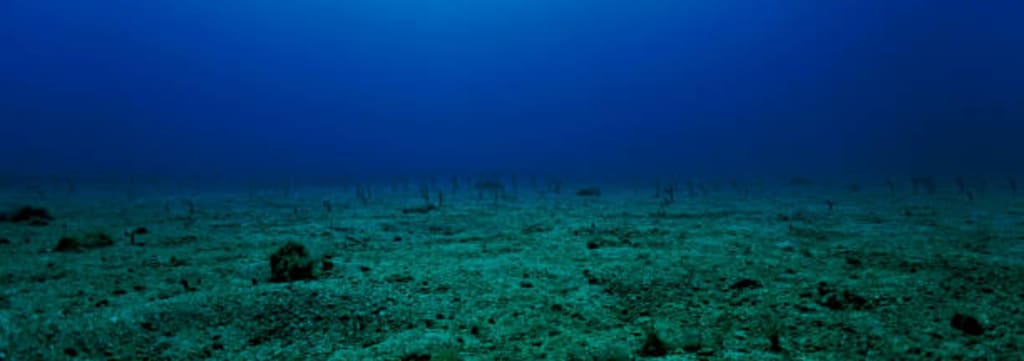
More than 70 percent of the world is water, the rest is land in this universe. But we do not know about most of this water. Scientists say that about 99.999 percent of the deep sea floor has not been seen by humans yet. A study on this topic was recently published in the US Science Advances peer-reviewed journal.
Humans have started going to the deep sea regularly since 1950. Catherine Bell of the US Ocean Discovery League and her colleagues have calculated how many times humans have gone to explore the deep sea so far. The results of this study are surprising. The team analyzed 43,681 deep sea expeditions and found that humans have only seen 2,130 to 3,823 square kilometers. The rest is still unknown.
It is necessary to analyze what exactly is meant by the words 'seen' vs. 'unknown' here. Many telescopes have been sent into deep space. Even though we cannot see them directly with the naked eye, images of the planets in the solar system have been taken with cameras mounted on spacecraft, and these have been analyzed. Again, we get a slightly different kind of 'images' of many parts of space—such as the planets outside the solar system. They are not exactly images, but rather a matter of analyzing signals to find out various types of information or creating maps. This second task has also been done in the case of the oceans, but people have not yet had the opportunity to take direct images with cameras or go there.
Let's expand on this a bit. About 71 percent of the Earth's surface is covered by the ocean. About 93 percent of it is 200 meters or deeper. We call it the 'deep seafloor'. Humans have mapped some of this vast region using satellites and ship-borne sonar devices—that is, they have created maps from signals or data. But we have seen very little of this region by going there directly or sending cameras. In other words, what we have seen is almost as if we have not seen it. According to Catherine and her colleagues, we have not yet seen 99.999 percent of the deep seafloor.
In this regard, Catherine Bell told New Scientist magazine, 'It shows us with our fingers how much we know about the ocean floor, and how much of it is still unknown!'
Catherine also gave a great example. In 1977, the first hydrothermal vent was discovered near the Galapagos Islands in the Pacific Ocean. There are some things in the deep sea that are like hot springs, and they are hydrothermal vents. They release hot, mineral-rich water from the bottom of the sea. Around that water, a huge ecosystem is formed, born in the dark. Without light, many organisms survive there, relying only on water.
The study also showed that 80 percent of the deep-sea exploration in the past 67 years has been in the territorial waters of a few countries. For example, most of the exploration has been in the waters near the United States, Japan, and New Zealand. But very few have been in international waters. The area of the sea where no country has rights is called the international waters.
Catherine Bell also said, "If we think we know the world by looking at the seabed of North America, Japan, and New Zealand, how will we know about the savannahs of Africa or the forests of Southeast Asia?"
According to Catherine, we need to study more of the seabed. The more we know about the seabed, the more we will know about the world.
About the Creator
Keep reading
More stories from tanmoy nazmul and writers in Earth and other communities.
Old Red Cedar
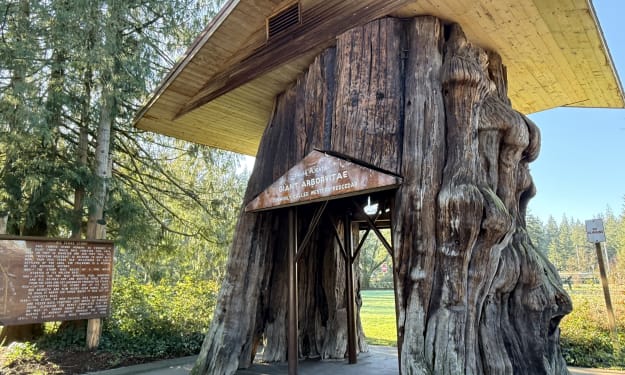
Western red cedar, over 1000 years old, you grew for 200 years and towered over others, silently observing sights in the forest that are no more, your secrets buried within your spirit. The bark covering your tree trunk, said to be about 23 feet around, was hollow when men discovered you. Inside the hollow trunk, a fire somehow began; you cannot tell us when, how, or why, and there is no record of it. The fire caused your death. Slowly, you died, from the inside out. Such a sad loss for an old soul of the forest, with centuries of knowledge in its cells. Houses, watercraft, shingles, bowls, bows and arrows, and paper that men used to write what they knew of your history could have been made from your body, branches, and bark. Truly, fire was a better death for you than a logger’s saw.
By Andrea Corwin about 6 hours ago in Earth
Severe Geomagnetic Storm Could Bring Northern Lights Across Much of the U.S.
On Monday evening, skywatchers from the Pacific Northwest to the Midwest got ready for something out of the ordinary: a celestial display that typically occurs at high northern latitudes. Americans who provide forecasts as a powerful cloud of charged particles from the sun accelerates toward the Earth's magnetic field, the National Oceanic and Atmospheric Administration (NOAA) has issued a "G4 (Severe) geomagnetic storm watch."
By Raviha Imrana day ago in Earth



Comments
There are no comments for this story
Be the first to respond and start the conversation.