
520 million year old worm solved the mystery of arthropods evolution
evolution of modern arthropods

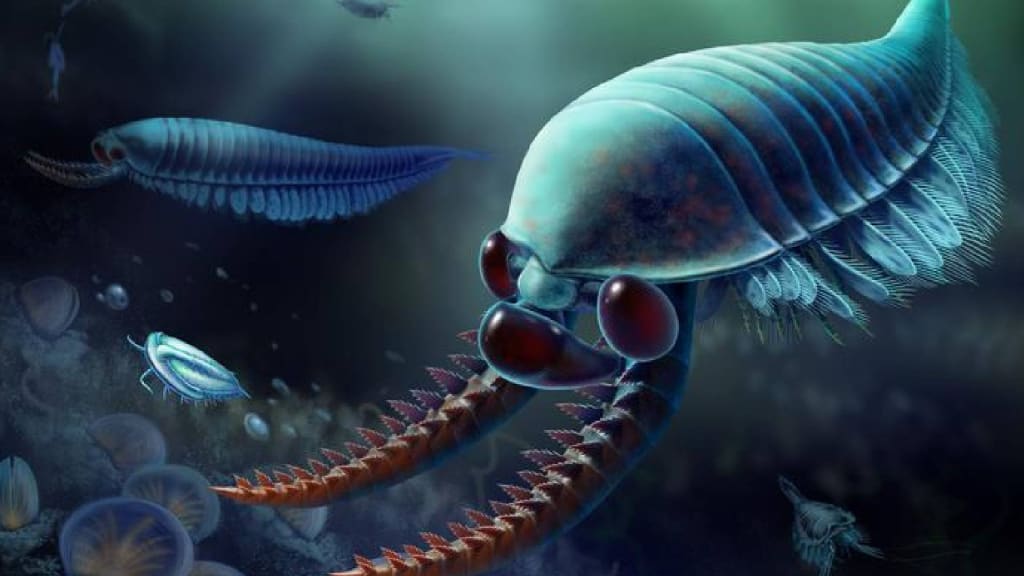
Arthropods are a diverse and highly successful group of invertebrate animals that include insects, arachnids (such as spiders and scorpions), crustaceans (such as crabs, lobsters, and shrimp), and myriapods (such as centipedes and millipedes). They are characterized by their segmented bodies, jointed limbs, and exoskeletons made of chitin. Arthropods are the largest phylum in the animal kingdom, with over a million described species, and they are found in virtually every habitat on Earth.

The discovery of a 520-million-year-old worm fossil has made a significant contribution to our understanding of the evolutionary origins of modern-day insects, spiders, and crabs. This fossil, uncovered by a team of paleontologists, belongs to an ancient creature from the Cambrian period.
The Cambrian Period:
The Cambrian Period is a significant time in Earth's geological history, spanning from about 541 million to 485 million years ago. It is the first period of the Paleozoic Era and marks a critical phase in the development of life on our planet. The Cambrian is best known for the "Cambrian Explosion," a relatively short evolutionary event that occurred around 541 to 530 million years ago, during which a remarkable diversity of life forms rapidly appeared in the fossil record.
The Cambrian Explosion:
The Cambrian Explosion refers to a time of rapid diversification of life, where most major groups of animals first appeared. This event marks the emergence of complex organisms with hard shells, exoskeletons, and various body plans, which allowed for better fossilization, making this period rich in fossil evidence.
Evolution of modern arthropods:
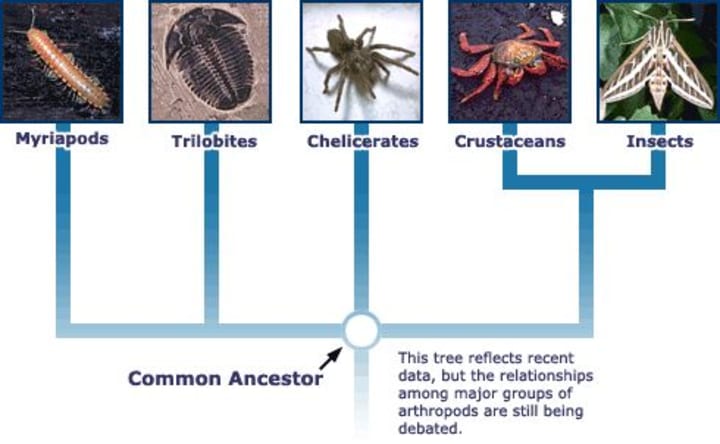
The evolution of modern arthropods, which include insects, spiders, and crustaceans, is a fascinating and complex process that has taken place over hundreds of millions of years. Arthropods are the most diverse group of animals on Earth, with over a million described species and many more likely undiscovered. Their success can be attributed to their adaptability, versatility, and the variety of ecological niches they occupy.
Evolutionary Path of Modern Arthropods:
1. Origins and Early Evolution:
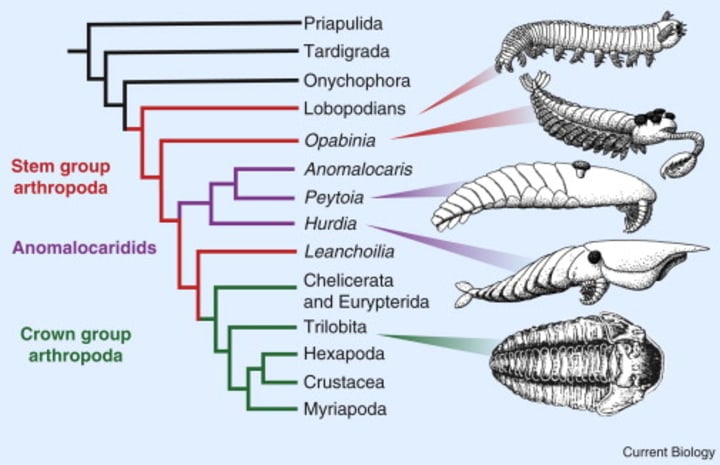
Arthropods are believed to have evolved from a common ancestor with segmented bodies, known as lobopodians, during the Cambrian period, over 500 million years ago. Early arthropods were simple, worm-like creatures with soft bodies and simple limbs. Over time, these organisms developed hard exoskeletons, jointed limbs, and other features that are characteristic of modern arthropods.
The Cambrian Explosion saw the rapid diversification of these early arthropods into various forms, some of which would give rise to the major groups we see today.
2. Major Groups of Modern Arthropods:
Insects: Insects are the most diverse and numerous arthropods, with millions of species. They evolved around 400 million years ago during the Devonian period. The development of wings was a key innovation that allowed insects to colonize various terrestrial environments. Over time, insects adapted to a wide range of habitats, leading to the emergence of many different orders, such as beetles, butterflies, ants, and bees.
Arachnids: This group includes spiders, scorpions, ticks, and mites. Arachnids are primarily terrestrial and are believed to have evolved from marine ancestors during the Silurian period, about 420 million years ago. Their evolution was marked by the development of specialized appendages, such as fangs, pincers, and spinnerets (for producing silk).
Crustaceans: Crustaceans, including crabs, lobsters, shrimp, and barnacles, primarily evolved in marine environments. They first appeared during the Cambrian period, with their evolution marked by the development of hard exoskeletons and highly specialized limbs. Crustaceans have adapted to a wide range of ecological niches, including both marine and freshwater environments.
3. Key Evolutionary Adaptations:
Exoskeletons: The development of a hard, chitinous exoskeleton provided protection from predators, support for muscle attachment, and a barrier against desiccation. This adaptation was crucial for the success of arthropods in various environments.
Segmentation and Jointed Appendages: Arthropods have segmented bodies and jointed appendages, which provide flexibility and efficiency in movement. This has allowed them to develop specialized limbs for different functions, such as walking, feeding, sensing, and reproduction.
Metamorphosis: Many insects undergo metamorphosis, a process that allows them to occupy different ecological niches during different life stages. This reduces competition between the juvenile and adult stages and has contributed to the evolutionary success of insects.
4. Evolutionary Radiation and Adaptation:
Throughout their evolutionary history, arthropods have undergone several periods of radiation, where they rapidly diversified into new species and forms. This has been driven by environmental changes, the availability of new ecological niches, and interactions with other organisms, such as plants and predators.
For example, the co-evolution of flowering plants and insects led to the diversification of pollinators, such as bees and butterflies, during the Cretaceous period. Similarly, the evolution of social behavior in ants and bees allowed these insects to form complex colonies and dominate certain ecosystems.
5. Modern Evolutionary Challenges:
Modern arthropods continue to evolve in response to changing environments, climate change, and human activities. Some species are adapting to urban environments, while others are developing resistance to pesticides. The study of arthropod evolution is ongoing, with new discoveries constantly refining our understanding of how these organisms have adapted and thrived over millions of years.
520-million-year-old fossil of worm
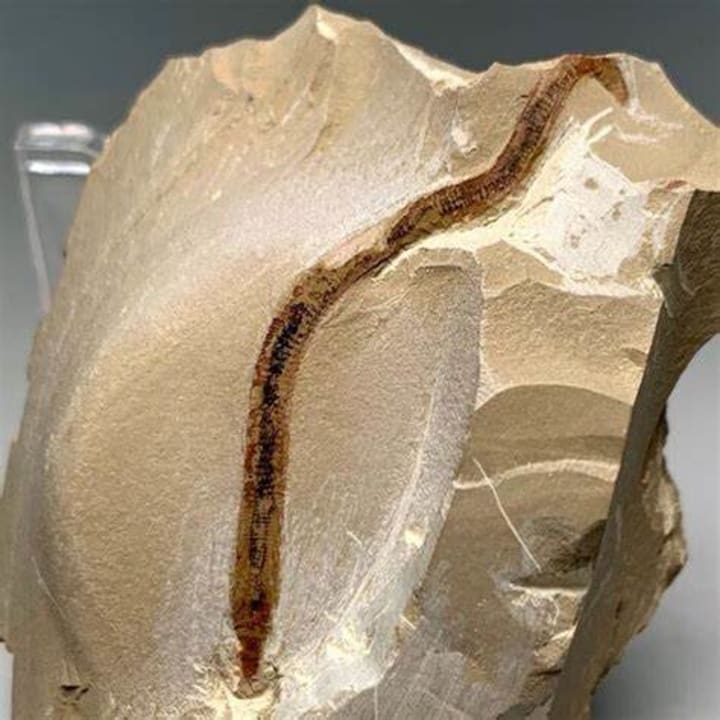
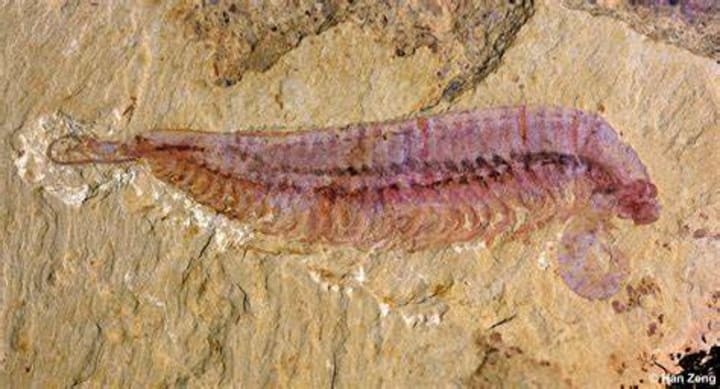
The discovery of the 520-million-year-old fossil of Kylinxia zhangi has provided significant insights into the early evolution of arthropods, the group of animals that includes modern insects, spiders, and crustaceans. This fossil, found in the famous Chengjiang fossil site in Yunnan, China, dates back to the Cambrian period and represents a crucial link in the evolutionary history of complex life forms.
Overview of Kylinxia zhangi:
1. Classification and Naming:
Kylinxia zhangi is named after a mythical Chinese chimera, the "Kylin," which symbolizes the combination of different features, reflecting the creature’s mix of primitive and advanced traits. The species name "zhangi" honors the paleontologist Zhang Xiguang, who made significant contributions to the study of Cambrian fossils.
2. Geological Context:
The fossil was discovered in the Chengjiang Lagerstätte, a fossil site renowned for its exceptional preservation of early Cambrian organisms. The site dates back approximately 520 million years and provides a snapshot of life during the Cambrian Explosion, a period when most major animal groups first appeared.
Anatomical Features of Kylinxia zhangi:
1. Body Structure:
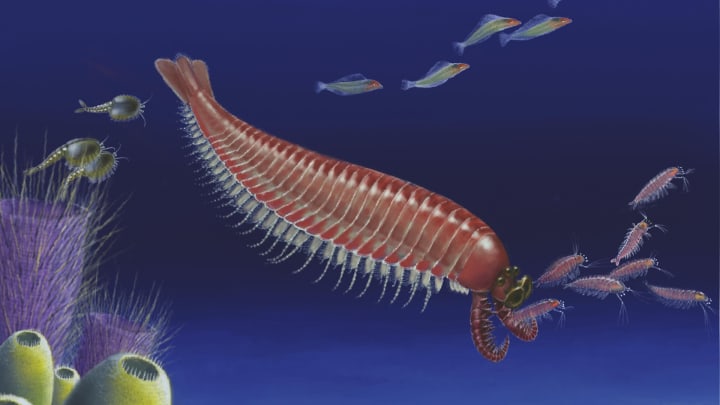
Kylinxia zhangi had a segmented body, which is a key feature of arthropods. The fossil reveals a creature about 5 cm (2 inches) in length with a head that includes complex sensory organs, such as a pair of compound eyes, which are typical of more advanced arthropods. The body is divided into several segments, each with a pair of appendages.
2. Limbs and Appendages:
The fossil shows that Kylinxia zhangi had five pairs of spiny, segmented limbs, which it likely used for capturing prey and for locomotion. These limbs are considered an evolutionary precursor to the jointed legs seen in modern arthropods. Additionally, the creature had a pair of frontal appendages that might have been used for feeding, similar to the modern arthropod's antennae or mandibles.
3. Exoskeleton:
Like modern arthropods, Kylinxia zhangi had a hard exoskeleton made of chitin, which provided protection and support for its body. The exoskeleton also facilitated muscle attachment, allowing for more efficient movement.
Evolutionary Significance:
Insights into Arthropod Evolution:
The mix of primitive and advanced traits in Kylinxia zhangi provides critical evidence for how arthropods developed their distinctive body plans. For example, the presence of compound eyes and specialized limbs suggests that key arthropod characteristics were already beginning to form during the early Cambrian period.
This fossil, found in the famous Chengjiang fossil site in Yunnan, China, dates back to the Cambrian period and represents a crucial link in the evolutionary history of complex life forms.
How 520-million-year-old worm fossil solves mystery of how modern insects, spiders and crabs evolved: (Linkage)
The fossil of Kylinxia zhangi provides critical evidence that helps bridge the gap between ancient, simple organisms and the more complex arthropods we see today. Here's how this fossil helps solve the mystery:
1. Transitional Form:
Kylinxia zhangi is considered a transitional form, meaning it possesses characteristics of both ancient, primitive creatures and more advanced arthropods. This is crucial because it shows the step-by-step progression of how complex body structures evolved.
The fossil has features such as a segmented body, jointed appendages, and a hard exoskeleton—traits that are essential to modern arthropods. By studying these features in Kylinxia zhangi, scientists can trace how these key characteristics developed over time.
2. Combination of Primitive and Advanced Traits:
The fossil exhibits a unique mix of traits: primitive features similar to those of its lobopodian ancestors (simple, soft-bodied, worm-like creatures) and advanced features that are characteristic of modern arthropods.
For example, Kylinxia zhangi had spiny, jointed limbs and compound eyes, which are more advanced features seen in modern arthropods. At the same time, it retained some simpler features, which shows how these advanced traits evolved gradually rather than appearing suddenly.
3. Evolution of Complex Body Plans:
The discovery of Kylinxia zhangi helps scientists understand how the complex body plans of modern arthropods evolved. For instance, the segmentation of the body and the development of specialized appendages (like legs and antennae) are critical to the success of arthropods today.
By examining the fossil, researchers can see the early stages of these features' development, providing insight into how arthropods' bodies became so specialized and efficient for different functions like movement, feeding, and sensing the environment.
4. Insights into Arthropod Diversification:
Kylinxia zhangi lived during the Cambrian Explosion, a period of rapid evolutionary diversification when most major animal groups first appeared. This period is crucial for understanding how life diversified so quickly.
The fossil shows that even at this early stage, arthropods were beginning to diversify into different forms. This supports the idea that the ancestors of modern insects, spiders, and crabs were already evolving distinct characteristics, setting the stage for the incredible diversity of arthropods we see today.
5. Filling Evolutionary Gaps:
Before the discovery of Kylinxia zhangi, there was a gap in the fossil record between the simple, soft-bodied ancestors of arthropods and the more complex arthropods that appear later. This fossil fills that gap, providing a clearer picture of the evolutionary pathway.
It helps scientists understand the sequence of evolutionary events that led to the development of modern arthropods, showing that features like jointed limbs and hard exoskeletons evolved gradually over millions of years.
6. Support for Evolutionary Theories:
The findings from Kylinxia zhangi support existing evolutionary theories that suggest arthropods evolved through a series of small, incremental changes. The fossil provides concrete evidence that backs up these theories, showing how gradual adaptations over time led to the complex creatures we see today.
7. Understanding the Cambrian Explosion:
This fossil also contributes to our knowledge of the Cambrian Explosion, a period of rapid evolutionary development when most major animal groups first appeared. Kylinxia zhangi shows that the diversification of life during this time included the early stages of arthropod evolution, highlighting the complexity and speed of evolutionary changes during this period.
8. Broader Implications for Evolutionary Biology:
The study of Kylinxia zhangi and similar fossils helps scientists better understand the processes of evolution, including how complex body structures and functions evolve over time. It underscores the idea that evolution is a gradual process, with new traits building upon existing ones over millions of years.
Conclusion:
The 520-million-year-old fossil of Kylinxia zhangi has been instrumental in solving the mystery of how modern insects, spiders, and crabs evolved. By providing a clear example of a transitional form, this fossil illustrates the gradual development of the key features that define arthropods today. It fills a crucial gap in the fossil record and supports the idea that evolution is a slow, step-by-step process that, over millions of years, can lead to the incredible diversity of life we observe in the natural world.
About the Creator
Keep reading
More stories from Mohammed thanvir and writers in Earth and other communities.
Invertebrata
Introduction to Invertebrates Invertebrates are a diverse group of animals that lack a vertebral column (backbone). They represent over 95% of all animal species on Earth and can be found in virtually every habitat, from the deepest oceans to the highest mountains. This group includes a vast array of organisms, ranging from the microscopic to the visibly complex and large. Invertebrates play crucial roles in ecosystems, serving as primary consumers, decomposers, and even pollinators. This blog will explore the fascinating world of invertebrates, delving into their classification, biology, ecological significance, and their importance to humans.
By Mohammed thanvirabout a year ago in Earth
Landscape Beneath Antarctica's Icy Surface Revealed in Unprecedented Detail
For decades, Antarctica has been the Earth’s ultimate mystery — a vast expanse of ice covering almost 14 million square kilometers, hiding secrets beneath its frozen surface. Now, thanks to advanced radar technology and satellite mapping, scientists have produced the most detailed map yet of the continent’s hidden landscape, revealing mountains, valleys, subglacial lakes, and river systems that were previously invisible. This discovery is more than just a scientific curiosity. Understanding Antarctica’s topography beneath the ice is critical for predicting ice sheet stability, global sea-level rise, and climate change impacts. The new data could also shed light on Earth’s geological history and the ways in which life may survive in extreme environments. How Scientists Mapped the Hidden Terrain For years, researchers have relied on a combination of methods to peek beneath the ice: Ice-penetrating radar: Devices mounted on aircraft or satellites send radio waves through ice layers, which bounce back when they hit bedrock, revealing contours beneath kilometers of frozen water. Satellite gravimetry: Small variations in Earth’s gravitational field help infer the presence of mountains, valleys, and subglacial lakes. Seismic surveys: Explosions or controlled vibrations allow scientists to detect underground structures by measuring the way seismic waves travel through different materials. Using these techniques, a consortium of international researchers created a high-resolution map of Antarctica’s sub-ice topography, revealing features that rival the landscapes of continents that have been visible for millions of years. What’s Beneath the Ice? The map reveals a striking variety of features: Mountain ranges: Peaks rise more than 4,000 meters above the surrounding terrain, hidden beneath miles of ice. Some of these ranges may be older than the Rockies or the Alps. Deep valleys: Vast troughs and gorges, carved by ancient rivers or tectonic activity, provide clues about how the continent evolved over millions of years. Subglacial lakes: Scientists have identified hundreds of liquid water lakes trapped beneath the ice, including the famous Lake Vostok. These lakes remain liquid due to pressure and geothermal heat and may host microbial life isolated for millions of years. Subglacial river networks: Surprisingly, water flows beneath the ice in channels and rivers, slowly carving pathways that affect ice sheet movement. This intricate landscape challenges the perception of Antarctica as a flat, featureless ice sheet. Instead, it is a dynamic and complex environment, where hidden topography influences everything from ice flow to global sea levels. Why This Discovery Matters The importance of understanding what lies beneath Antarctica’s ice cannot be overstated: Predicting Ice Sheet Stability: Ice sheets move more quickly over smooth surfaces than over rugged terrain. Knowing where mountains and valleys lie helps scientists predict which areas of ice may collapse first, potentially raising sea levels faster than anticipated. Climate Change Models: Subglacial lakes and water channels lubricate the ice from below, influencing melting rates. Incorporating these features into models improves accuracy in forecasting future sea-level rise. Earth’s Geological History: The newly revealed landscape offers a window into Antarctica’s past — from tectonic shifts to ancient rivers and climates. This data helps reconstruct how continents drifted and climates evolved over millions of years. Search for Extreme Life: Subglacial lakes may harbor microbial life isolated for millions of years, providing insights into life in extreme environments, potentially even on other planets. Global Implications Antarctica may feel distant, but its ice sheets hold the key to global sea-level stability. Even small changes beneath the ice can have profound consequences for coastal cities around the world. With melting accelerated by climate change, understanding the terrain under the ice is crucial for planning and mitigation. Governments, scientists, and environmental organizations are now using this information to: Improve climate models for sea-level rise predictions Identify vulnerable regions of the ice sheet Guide future research missions to subglacial lakes and mountains The discovery also strengthens the case for continued international collaboration in Antarctica, where research and environmental protection are governed by treaties emphasizing peaceful scientific study. Challenges Ahead Mapping Antarctica is far from complete. Extreme weather, thick ice sheets, and logistical difficulties make the continent one of the hardest places to study. While radar and satellite technologies have advanced, field validation and deeper exploration remain difficult and expensive. Researchers also face ethical and environmental concerns. Drilling into subglacial lakes to sample microbial life, for instance, must be done carefully to avoid contamination. Antarctica’s fragile ecosystem demands that scientific progress balances discovery with protection. Looking to the Future The detailed map of Antarctica’s hidden landscape opens new possibilities for exploration and understanding: Ice Flow Predictions: With accurate topography, scientists can model how ice sheets will respond to warming climates more precisely. Resource Insights: While exploitation is restricted by international agreements, understanding subglacial mineral deposits can inform potential future uses. Extreme Environment Biology: Studying subglacial lakes could reveal new species adapted to cold, dark, and high-pressure environments, broadening our understanding of life on Earth. The data also strengthens international scientific cooperation, as multiple countries share findings and resources to better understand a continent that belongs to no single nation. Final Thoughts Antarctica’s ice may appear static and endless, but beneath it lies a vibrant and rugged landscape filled with mountains, valleys, lakes, and rivers. The new detailed mapping of this hidden world is a landmark achievement in Earth science, combining advanced technology, international collaboration, and the human drive to explore. By uncovering what lies beneath the ice, scientists are not just satisfying curiosity — they are equipping humanity with the knowledge to protect our planet, anticipate climate challenges, and understand the deep history of Earth itself. Antarctica’s secrets, once locked beneath kilometers of ice, are finally being revealed, and what we learn could reshape our understanding of the planet and our place within it.
By Muhammad Hassana day ago in Earth



Comments (1)
Liked that content. It is new knowledge to me.