
“Why Did the Burqa Controversy Among Afghan Women Go Viral in 2025?”
“A deep dive into the social media storm, cultural tensions, and global reactions surrounding Afghan women’s dress choices in 2025.”
Afghanistan 2025: A Nation's Women Behind the Veil and Bars
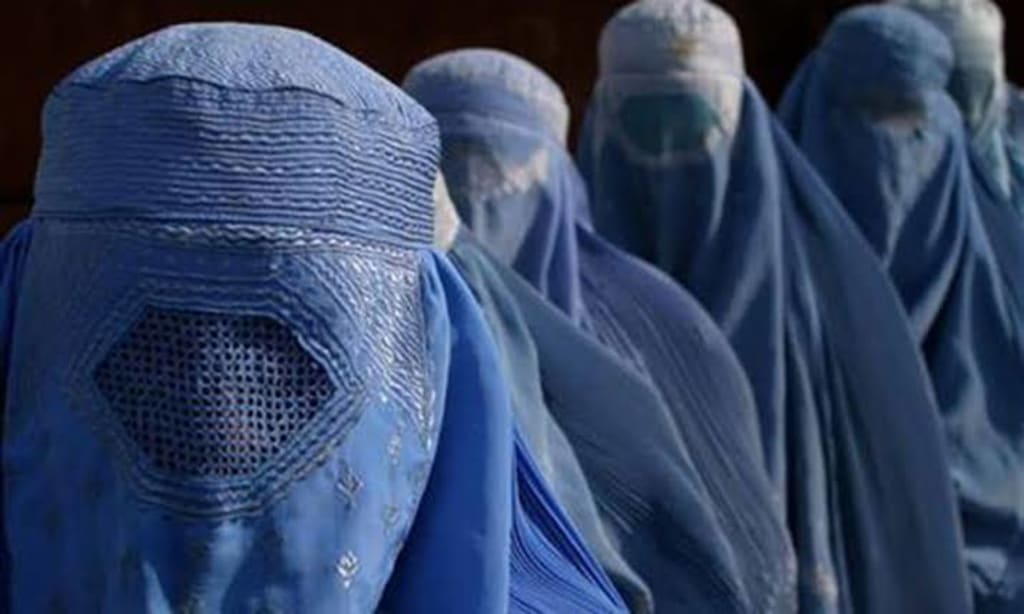
In a haunting image that has gone viral on social media, an Afghan woman clad in a full blue burqa grips iron bars from behind a window, her face hidden behind the mesh of her veil. The caption reads simply: "2025." This single image, shared by user @loniee_07, has stirred international emotion and sparked a renewed wave of outrage over the ongoing oppression of women in Afghanistan. But this is more than a picture—it is a visual outcry, a symbol of a nation where being a woman is equated with being a prisoner in one’s own home and body.
A Return to Darkness
When the Taliban returned to power in August 2021, the world watched with cautious optimism, many hoping that decades of progress in women’s rights would not be erased overnight. The Taliban, aware of the international scrutiny, initially promised moderation, stating that women would have rights “within the framework of Islamic law.” But those words quickly proved hollow.
By 2025, Afghanistan has become one of the most repressive countries in the world for women. The Taliban’s policies have systematically erased them from public life. Girls are banned from secondary schools and universities. Women are prohibited from most jobs, even those in humanitarian aid. They cannot travel without a male guardian, and in many provinces, they are not even allowed to visit public parks or gyms.
And now, the hijab—once a personal or cultural choice for many—has been weaponized.
The Hijab as a Tool of Oppression
The latest controversy arises from the Taliban’s increasingly aggressive enforcement of the hijab, and more specifically, the burqa. Women are not just expected to cover their hair, but their entire bodies. The preferred form is the chadari, the all-encompassing blue veil that leaves only a mesh screen for the eyes.
Failure to comply comes with consequences. Women have been arrested and detained for “bad hijab,” a vague term that allows authorities to punish anyone whose clothing they deem inappropriate. In some cases, male relatives—fathers, brothers, or husbands—are held accountable and punished for the perceived offenses of the women in their families.
Reports from major human rights organizations and local sources paint a grim picture. Women detained for dress code violations are often denied legal representation, held in inhumane conditions, and subjected to psychological pressure. Some are only released after making pledges not to repeat the offense or after male guardians make formal apologies.
This environment has fostered fear, confusion, and a growing sense of helplessness among women who once worked, studied, and dreamed freely.
A Life Behind Closed Doors
The symbolism of the now-viral image is painfully literal. Many Afghan women now live as prisoners in their homes. With restrictions on their movement, education, work, and even healthcare access, life has shrunk to the walls of their houses. The iron bars in the photo are not just a visual metaphor—they reflect the real-life confinement that has become the norm.
In urban areas like Kabul, where women had gained relatively more freedom over the last two decades, the sudden regression has been especially traumatic. Women who once held government posts, worked in media, or ran businesses have lost their livelihoods overnight. Many have fled the country. Others are in hiding.
In rural areas, where Taliban influence was already strong even before their return to power, the changes have only tightened the existing restrictions. Women are once again invisible—silent, unseen, and stripped of autonomy.
Digital Resistance
Yet even in the face of such despair, Afghan women continue to resist. In a digital age, resistance takes many forms. Social media platforms like TikTok, Instagram, and X (formerly Twitter) have become tools of defiance. Women anonymously share their stories, post images, and amplify each other’s voices in hopes of drawing global attention to their plight.
Accounts like @loniee_07 don’t just share images—they tell stories. Each post, each caption, each hashtag is a protest against the silence that the Taliban wants to impose. These platforms have become virtual protest grounds, where Afghan women challenge not only their oppressors but also a world that has, in many ways, moved on.
The International Response: Words Without Action?
The international community has condemned the Taliban’s treatment of women, but the response has largely been limited to statements and sanctions. While the United Nations, European Union, and human rights organizations have continued to speak out, tangible results remain elusive.
Sanctions imposed on Taliban leaders have had limited effect, and diplomatic engagement is fraught with complications. Humanitarian aid—critical for a population facing economic collapse and widespread hunger—has been disrupted by the Taliban’s restrictions on female workers.
Many critics argue that the world is failing Afghanistan’s women. By refusing to recognize the Taliban regime but also not doing enough to pressure it meaningfully, the global community risks perpetuating the suffering of millions.
The Psychological Toll
Beyond the physical restrictions, the psychological impact on Afghan women is profound. Experts warn of a mental health crisis, particularly among young girls who are growing up in an environment devoid of hope. Suicides, depression, and trauma are on the rise. The sense of betrayal—by their government, their society, and the international community—runs deep.
Imagine being a teenager who watched her mother work as a teacher or a journalist, only to now be told that school is off-limits and her voice must be hidden behind a veil. Imagine the mother, once a symbol of empowerment, now reduced to a shadow.
A Glimmer of Hope
Despite it all, Afghan women are not giving up. Underground schools continue to operate in secret. Online education programs are being run from abroad. Women’s rights activists, though often forced into exile, are finding new ways to support those still inside Afghanistan.
There is also hope in documentation. Every image shared, every testimony recorded, every news story written helps build a case for future accountability. History is watching—and remembering.
Conclusion: A Call for Conscience
The image of a veiled woman behind bars in 2025 is not just a symbol of Afghanistan's present—it is a warning to the world. What is happening in Afghanistan is not just a local or religious issue—it is a humanitarian crisis, a gender apartheid, and a test of global conscience.
Afghan women are not asking for pity. They are asking for support, solidarity, and action. The world must respond—not only with statements but with sustained pressure, support for grassroots resistance, and concrete measures to ensure that no woman, anywhere, has to live her life behind bars—real or symbolic.
If the photo tells a thousand words, let our actions speak millions more.
About the Creator
Reader insights
Nice work
Very well written. Keep up the good work!
Top insight
Easy to read and follow
Well-structured & engaging content
Keep reading
More stories from Farhan Rafid and writers in Critique and other communities.
"The Hair Flip Heard Around the World: How a Viral Gesture Stunned Trump and Disrespected Arab and Islamic Values"
The Viral Hair Flip That Stunned Trump: A Cultural Misstep with Negative Implications for Arab Countries and Islam In the digital age, where a single gesture can ignite international debates and stir emotions across continents, a viral hair flip has become the latest example of how global perceptions can be shaped in moments. What seemed like a trivial flick of hair in a high-profile setting involving former U.S. President Donald Trump quickly spiraled into a symbolic controversy—one that exposed the fragility of cultural respect, highlighted Western ignorance toward Islamic and Arab values, and ultimately left many in the Arab world and Muslim communities feeling disrespected and misrepresented.
By Farhan Rafid8 months ago in Critique
Standing While Falling
Quotation from Friedrich Nietzsche "He who wrestles long with monsters should beware lest he himself become a monster. And if you gaze long into an abyss, the abyss also gazes into you. Man is not destroyed by suffering, but by the meaning he makes of it."
By LUCCIAN LAYTH12 days ago in Critique
Venezuela
By Leavie “Soul on Fire” Scott Her name was Nava, a 23‑year‑old shopkeeper’s daughter from Tehran, though she didn’t feel young anymore. Not after the week she had survived. Not after watching the value of Iran’s currency collapse so fast that shop windows changed prices twice a day. Not after seeing her father stand in his empty store and whisper, “I cannot afford to open tomorrow.”
By Organic Products 2 days ago in Critique


Comments (2)
This image is truly powerful. It makes you realize how far Afghanistan has regressed. I remember when the Taliban first took over, there were hopes things wouldn't get this bad. Now, banning girls from school and restricting women's jobs is just wrong. How can we help change this situation?
I read your all story,Logical story all of them go ahed