
The Impotence of the United Nations
A Soldier’s View

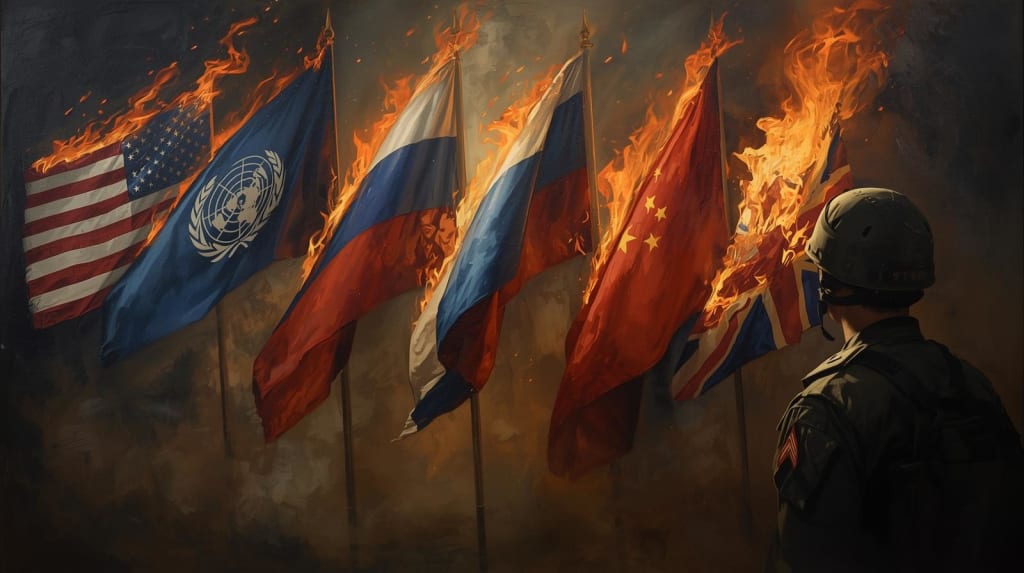
A Soldier’s View: The Impotence of the United Nations
I’ve served twice in combat as a U.S. Army soldier. I’ve seen what happens when decisions are delayed — when hesitation costs lives. On the battlefield, waiting for consensus can mean losing your brothers, your mission, or your own life. That’s why, when I look at the United Nations, I see not an instrument of peace, but a monument to paralysis.
The UN was founded in 1945 to ensure that humanity would “never again” witness the horrors of global war or genocide. Its charter spoke of collective security, diplomacy, and human rights — words that once inspired hope. But in my eyes, those ideals have become hollow. Just thoughts and prayers. The UN’s record shows not a guardian of peace, but an organization trapped in its own political web, powerless to act when the world needs it most.
The Design of Failure
The UN’s greatest flaw lies in its design. The Security Council — the body that decides when and how to act — is controlled by five permanent members: the United States, Russia, China, France, and the United Kingdom. Each of these nations holds a veto, meaning one political objection can silence the entire global community. That single mechanism has turned the UN from an enforcer of peace into a hostage of geopolitics. While diplomats veto, civilians die.
Equally crippling is the UN’s lack of a standing force. Instead, it must beg member nations for troops every time a crisis erupts. By the time mandates are negotiated and deployments approved, the killing has already happened. In war zones, delay is death. Yet delay is the UN’s default setting.
A Record of Inaction
The world has watched this impotence unfold over and over again.
In Rwanda in 1994, UN peacekeepers were ordered not to intervene as nearly a million people were slaughtered in a hundred days. They were literally standing there — watching — bound by political red tape while men, women, and children were hacked to death.
A year later, in Bosnia, the town of Srebrenica was declared a UN “safe zone.” More than 8,000 Muslim men and boys were massacred under the UN’s watch because peacekeepers were given no mandate to defend them. “Never again” happened again, right in front of blue helmets.
Fast forward to Syria. For more than a decade, the Security Council’s deadlock has blocked any unified response to mass atrocities. In Ukraine, Russia’s veto ensures that no meaningful UN action can be taken against its own aggression. Once again, the world body meant to uphold peace can’t even enforce its own principles.
From the Ground Up
From a soldier’s perspective, this isn’t just policy failure — it’s moral failure. Those of us who’ve served in combat understand urgency in a way politicians often do not. When you’re under fire, every second matters. You learn that leadership means making hard decisions quickly and standing by them, even at great cost.
The UN operates on the opposite logic: endless debate, procedural caution, and political theater. The result is global paralysis disguised as diplomacy. For those of us who’ve been in the dirt, the human cost of that paralysis is all too real. The faces of civilians caught in the crossfire — the ones no resolution ever reaches — stay with you long after the war ends.
The irony is bitter. Soldiers risk their lives to uphold values that international leaders only talk about. We live the consequences of their hesitation. And while the UN debates semantics, the blood of inaction stains every flag beneath its banner.
Acknowledging the Few Successes
To be fair, the UN isn’t entirely useless. It has facilitated humanitarian relief, coordinated refugee aid, and overseen limited peacekeeping successes in places like Liberia and East Timor. But these moments are the exception, not the rule. They are modest victories overshadowed by catastrophic failures. The question is not whether the UN sometimes helps — it’s whether it fulfills the promise it was built on. And from where I stand, it doesn’t.
The Cost of Hesitation
In combat, hesitation kills. In global politics, it kills by the thousands. The UN’s culture of inaction has normalized the unacceptable. Every time the Security Council fails to act, every time troops are ordered to “observe” instead of “protect,” the credibility of international law erodes a little more.
Reform isn’t optional — it’s overdue. The UN needs to be rebuilt from the ground up: no more vetoes that silence justice, no more peacekeeping forces with empty mandates, no more moral posturing without power to act. A body designed to prevent war must have the authority to confront it when it appears.
A Veteran’s Reflection
After two combat tours, I’ve learned that courage isn’t about perfection — it’s about taking responsibility when it matters most. The United Nations was created to embody that courage on a global scale. Instead, it has become an institution of excuses. Its silence in the face of suffering is a betrayal of the very people it was meant to protect.
The UN was supposed to be humanity’s conscience. Instead, it has become its alibi.
If there’s one thing I know as a soldier, it’s this: hesitation is the enemy of peace. The United Nations has hesitated on its policy. And until that changes, the world will keep paying the price.
About the Creator
KarayaNi Trismegistus
I walk between worlds poet,priestess, & healer speaking in the tongues of water,fire, & wind.My voice carries the rhythm of ancestral drums,my breath the echoes of forgotten temples. I am the scribe of soulwork & the midwife of remembrance.
Keep reading
More stories from KarayaNi Trismegistus and writers in Critique and other communities.
Standing While Falling
Quotation from Friedrich Nietzsche "He who wrestles long with monsters should beware lest he himself become a monster. And if you gaze long into an abyss, the abyss also gazes into you. Man is not destroyed by suffering, but by the meaning he makes of it."
By LUCCIAN LAYTH5 days ago in Critique
Mistakes in Stranger Things - Season 5
Stranger Things 5: A Train Wreck of Lazy Writing and Brand Blunders When Stranger Things first dropped in 2016, it was a masterpiece of atmosphere and tight storytelling. It felt like a love letter to the 80s. Fast forward to Season 5, and that love letter has been shredded. What we got instead was a bloated, nonsensical mess that felt like the creators were just checking boxes to get it over with. It wasn't just a disappointment; it was a total collapse of the logic and stakes that made us care about Hawkins in the first place.
By Teodor Monescu6 days ago in Critique



Comments
There are no comments for this story
Be the first to respond and start the conversation.