
Homo Narrans Vs. Phono Sapiens
From Storytelling to Storyselling

Peter Ayolov, Sofia University “St. Kliment Ohridski”
Abstract
This article examines the contemporary shift from storytelling as a shared, dialogical practice to storyselling as a performative, market-oriented mode of self-presentation. Drawing on Byung-Chul Han’s book The Crisis of Narration, the analysis argues that narration has lost its primary social function: the creation of a common symbolic world sustained through reciprocal exchange. Traditional storytelling depended on at least two participants and unfolded as a movement back and forth, producing memory, cohesion, and future-oriented meaning. In contrast, storyselling treats narrative as a one-directional instrument for selling identity, success, or visibility, reducing listeners to passive consumers. The article situates this shift within broader transformations of digital capitalism, self-optimisation culture, and communication coaching, showing how conversational depth is replaced by predictable, strategic self-branding. The loss of genuine conversation is presented not as a stylistic problem but as a structural erosion of social bonds and shared meaning.
Key words
Narration, storyselling, conversation, discourse, Byung-Chul Han, digital culture, self-presentation, social cohesion, communication ethics
Introduction
In The Crisis of Narration, Byung-Chul Han diagnoses a profound transformation in contemporary culture: the replacement of narration by information, and storytelling by what he calls storyselling. His argument does not concern a decline in stories as such, since contemporary society is saturated with narratives, posts, captions, testimonials, and personal brands. Rather, it concerns a change in the social logic of narration itself. What is disappearing is not narrative content, but narrative relation.
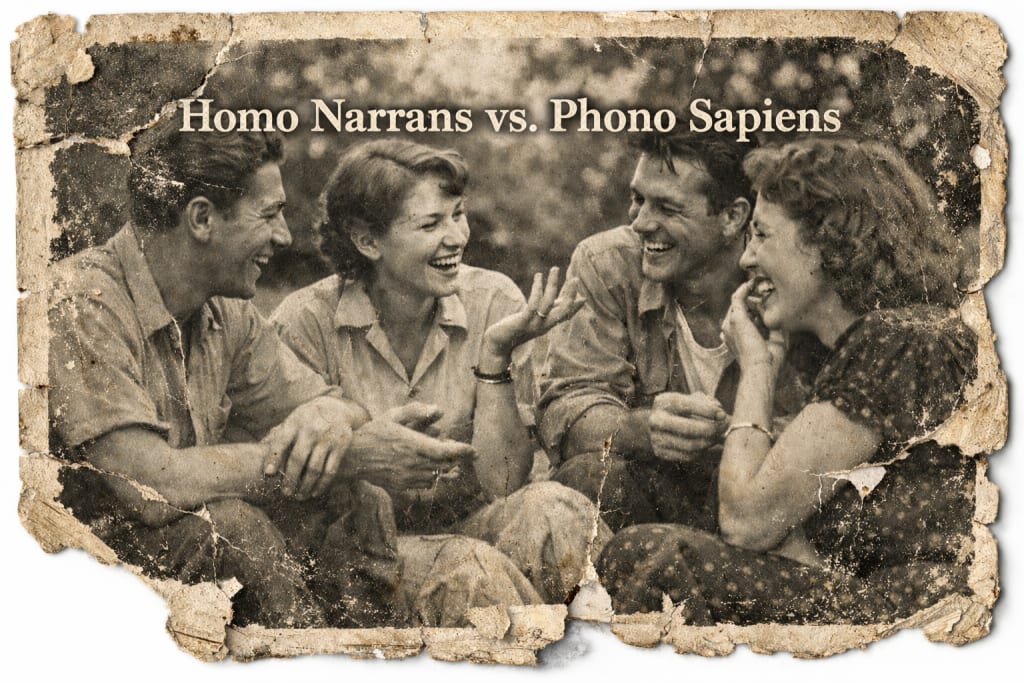
Storytelling in its classical sense was never a monologue. It was a social act that required at least two participants and unfolded as a shared temporal experience. A story told between friends, even when based on an ordinary episode of everyday life, did not aim at persuasion, optimisation, or self-promotion. Its function was to create a small, shared fictional world that could be revisited later, carrying memory, emotion, and recognition across time. The story moved back and forth, was interrupted, corrected, laughed at, expanded, and reactivated years later through a single reference or phrase. This circulation created cohesion. The goal was not performance but communion.
The contemporary communicative environment increasingly undermines this structure. What now circulates under the name of storytelling is often a highly predictable form of self-presentation aimed at producing a desired impression. Stories no longer run between people; they stop at the speaker. The listener does not enter a shared world but merely acknowledges the performance with polite nods. Conversation is replaced by exhibition.
Narration and the Logic of Reciprocity
For Han, narration differs fundamentally from information. Information accumulates without depth, while narration binds events into a meaningful sequence that connects past, present, and future. This temporal structure is inseparable from community. Narration presupposes trust, patience, and the willingness to listen without immediate utility. It also presupposes vulnerability, since the story unfolds in response to another presence rather than being optimised in advance.
Crucially, narration is dialogical even when only one person speaks at a time. The listener is not passive. Facial expressions, interruptions, shared memories, and emotional resonance shape the unfolding of the story. Meaning emerges in the space between speakers. This is why a story told to one friend cannot simply be repeated unchanged to another. The story belongs to the relationship, not to the speaker alone.
This reciprocal structure explains why shared stories continue to function long after their original telling. When mentioned years later, they reactivate not just content but a shared emotional landscape. Narration, in this sense, is a technology of cohesion. It creates a small world that can be inhabited together without calculation.
From Shared Worlds to Marketable Selves
Storyselling breaks this structure. It treats narrative as an instrument with a predefined goal: to sell competence, authenticity, success, morality, or uniqueness. The story is no longer open-ended but engineered for effect. It does not invite participation but recognition. Listeners are expected to consume, admire, or validate, not to enter the narrative space.
Han situates this shift within the logic of digital capitalism, where visibility, metrics, and optimisation dominate communication. Social media platforms, self-help industries, and communication coaching systems actively train individuals to speak in this mode. One is taught how to tell a compelling story, how to frame failure as growth, how to package emotion for impact, and how to control audience perception. Narrative becomes technique.
The result is a paradoxical uniformity. Although storyselling claims to express individuality, it relies on shared narrative templates. Life becomes legible only when formatted according to recognisable scripts: the entrepreneurial struggle, the wellness journey, the productivity hack, the moral awakening. Stories become interchangeable. Predictability replaces surprise.
In this environment, conversation becomes difficult. Since the story is already optimised, there is no space for interruption, contradiction, or mutual elaboration. The story cannot run back and forth because it is already finished before it is told.
The Politeness Trap and the Death of Discourse
One of the most damaging effects of storyselling is its impact on everyday conversation. When people speak primarily to present themselves, listeners are placed in an awkward position. Genuine engagement risks disrupting the performance. Questioning or reframing the story may appear impolite. As a result, listeners withdraw into passive affirmation.
This creates a new form of communicative loneliness. People speak more than ever, yet fewer stories circulate between them. What appears as constant communication is often parallel monologue. Discourse in its original sense, as a running back and forth that unites at least two participants, is replaced by serial self-presentation.
Han’s critics, including commentators in the Guardian and Front Porch Republic, have noted that his diagnosis can appear overly pessimistic or rhetorically rigid. Yet even these critiques often confirm his central intuition: that consumption-oriented cultures struggle to sustain genuine forms of shared meaning. The disagreement concerns solutions, not the problem itself.
Coaching Culture and the Instrumentalisation of Speech
The rise of communication coaching exemplifies the transformation Han describes. Individuals are increasingly trained not to converse but to manage impressions. Speech is framed as a tool for success, persuasion, and control. Authenticity becomes a technique. Vulnerability becomes a strategy.
This instrumentalisation of language undermines the conditions of trust required for narration. When every story may be calculated, listeners become suspicious. When every confession may serve branding, intimacy erodes. Conversation loses its ability to absorb contradiction, silence, and ambiguity.
The irony is that this culture claims to improve communication while systematically destroying its deepest function: the creation of shared worlds that are not reducible to utility.
Conclusion: Phono sapiens as LLM
The crisis of narration is not a nostalgic complaint about lost traditions but a diagnosis of a structural shift in how people relate through language. The movement from storytelling to storyselling replaces reciprocity with performance, conversation with exhibition, and shared worlds with marketable selves. What is lost is not eloquence but cohesion.
Great conversations do not aim at success. They suspend calculation. They allow people to become heroes, fools, or witnesses within a shared narrative without thinking about image management. Such conversations require at least two participants willing to enter a story together and let it change them.
If narration has a future, it will not be restored through better techniques or platforms, but through the rediscovery of conversation as a non-instrumental act. The recovery of storytelling is inseparable from the recovery of listening, patience, and the courage to speak without selling.
There is today an intense fascination with the reification of AI and large language models, as if chatbots were already the intelligent, autonomous thinking beings imagined in science-fiction novels and films, when in fact this is a category mistake. These systems do not understand the difference between justice and a table; justice, for them, is merely a grammatical unit whose placement is learned from patterns of prior use and deployed for rhetorical effect. Yet the more unsettling question lies elsewhere: what happens when people who have lost the art of conversing and replaced narration with coached storyselling begin to resemble these systems in their own speech? When justice is no longer lived as a shared human experience accumulated over centuries, but reduced to a manipulable linguistic token used to sell identity to other personal language machines, Phono sapiens does not merely use the language of machines but quietly becomes one.
Bibliography
Han, B.-C. (2023). The Crisis of Narration. Cambridge: Polity Press.
Jeffries, S. (2024). ‘The Crisis of Narration by Byung-Chul Han review – how big tech altered the narrative’. The Guardian, 18 February.
Weinacht, A. (2024). ‘Rendering Me into We: A Review of The Crisis of Narration’. Front Porch Republic, 16 May.
About the Creator
Peter Ayolov
Peter Ayolov’s key contribution to media theory is the development of the "Propaganda 2.0" or the "manufacture of dissent" model, which he details in his 2024 book, The Economic Policy of Online Media: Manufacture of Dissent.
Keep reading
More stories from Peter Ayolov and writers in Critique and other communities.
Lingua ex machina
Peter Ayolov, Sofia University "St. Kliment Ohridski" Abstract This article examines the claim that language is not merely a product of human nature and evolutionary adaptation, but a force that, once constituted, begins to shape humans in its own image. Drawing on Elan Barenholtz’s Substack essay ‘Syntax is Dead! Long Live Syntax!’ and the University of Toronto discussion ‘The (Terrifying) Theory That Your Thoughts Were Never Your Own’, the text argues that language initially emerged as an adaptive coordination system but gradually detached from its biological origins through external memory technologies such as writing, print, audio, and video. With the advent of large language models, this autonomy becomes visible for the first time. Syntax appears not as an innate causal engine but as an emergent statistical shadow of predictive systems. Language, understood as an autogenerative informational system, now operates as a cultural and cognitive environment that produces meaning, belief, identity, and even metaphysical concepts such as God. In this sense, language does not reflect reality so much as organise it, creating human subjects through symbolic structures that precede intention and awareness.
By Peter Ayolov2 days ago in Critique
Who Is Clavicular? The Looksmaxxing Streamer Who Ran Over A Stalker In His Cybertruck
What is so damaging to this current culture is the ant-intellectualism which pervades nearly every element of it. Clavicular, real name, Braden Peters equivocates physical form with getting women, making money, and overall being a strong “man.”
By Skyler Saunders23 days ago in Critique
Center Stage with Paul Stewart
*** I'm keen to republish the interviews I did for my series with Vocal creators. It's been a few years and I thought it might be nice to revisit these wonderful conversations. I'll be releasing them one at a time for a few weeks/months.
By Heather Hubler4 days ago in Interview



Comments
There are no comments for this story
Be the first to respond and start the conversation.