
Charming Classic - “The Revenant”
Levar’s Film Reviews

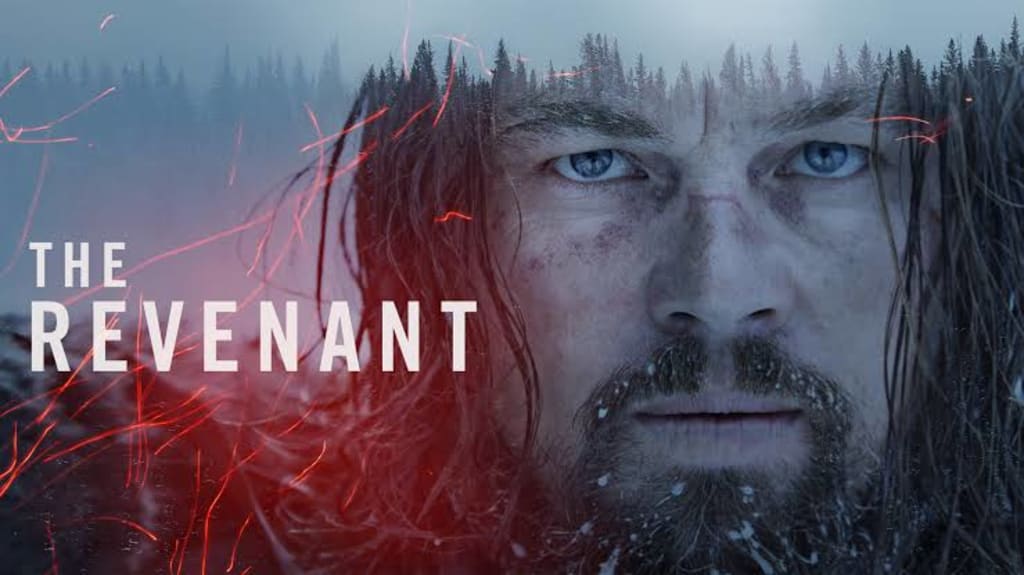
'Perish the universe, provided I have my revenge!' - Cyrano de Bergerac
I haven't written a film review in over a year (written February, 2016). When asked why, I've explained that a lack of time is the key factor, but on reflection this has just been an excuse. The real truth, is that I've not been inspired enough by a single piece of cinema in some time. I love film for reasons beyond entertainment. For me it's escapism, an art-form that resonates and that I enjoy tackling from an analytical stance (hence this blog!). It's been some time however, since I've left a film screening that has stirred an emotional response within me. Nothing has impacted to the point where it shook me from my analytical hibernation and reignited a desire to share my filmic thoughts. That is until I experienced Alejandro González Iñárritu's, The Revenant.
There's only one way to fully appreciate The Revenant and that is on the big screen. In fact, seeing it on the biggest screen possible is worth your while, because it's designed to be all encompassing, to envelope and draw you in. Without meaning to sound overly sentimental, great cinema is never intended to be experienced on a computer screen and The Revenant, is undoubtedly great cinema.
My way of deconstructing film, is rarely to regurgitate the plot, but rather explain my views deriving from the more personal, sub-textual elements, that may not necessarily stand out from the grander narrative. Thankfully, this film is full of such moments.
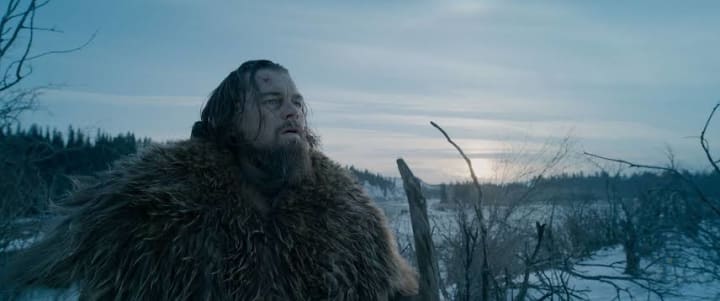
The story begins in 1823, in the American wilderness. It's a stark, rural landscape that feels freezing even from the comfort of a warm, cinema seat. A group of fur-trappers are returning home from an expedition, when out of nowhere they're set upon by a hoard of Native, American "Indians". Not since Steven Spielberg's Saving Private Ryan have we seen a battle captured on film so authentically, in a way that never feels glorified, but rather exposes the true horror of war. Man after man is stealthily executed by arrows, shot out of the darkness. It's frenzied and brutal. Little is said or heard outside of hysteria, but each arrow is felt and each gun shot reverberates. This sets the pace and tone of a film that is more about feeling, than words.
Among the surviving men, is Hugh Glass, a tracker/frontiersman played by an understated and mature Leonardo DiCaprio. Hugh Glass is an American folk hero, of whom I knew nothing about prior to this film. I'm sure creative and historical licence was taken here, much like Mel Gibson's William Wallace, but to what extent, I do not know.
Glass is tasked with getting his band of survivors out of harms way and back to their fort alive. This is done via a controversial decision to abandon their traceable barge and continuing the rest of the journey on foot.
The film is inter-cut with flashback scenes connecting an ethereal past, with his haunting present. Glass dreams of his wife, who we learn was of the Pawnee people, murdered on a village raid by French colonialists. There are early moments that hearken back to the aesthetics of Terence Malick, where nature is treated almost as a silent character, but with the most potent presence. Streams, trees, skies, rivers and landscapes are captured within long takes, where you feel as though a significant message is intended.
Glass' young son, Hawk, was badly burned in his village raid and now as a teenager, accompanies his father on expeditions. The relationship between the two is one of love, but Glass treats Hawk with a sternness befitting the unforgiving prejudices of the time. The film does well to distinguish between the different tribal politics of the era. Glass and his men are being pursued by the Ree, whereas his son is Pawnee, at war with the neighboring Sioux (a la Dances With Wolves, but this time from the perspective of the Pawnee as a benevolent tribe). Glass is quick to remind his son of the order of things within this World, to keep quiet and follow his lead for, 'they do not hear your voice, they only see your skin'.
It's these moments that go some way to establishing historical truth and poignancy to the film, which could otherwise have let itself down by way of romanticism and revisionism.
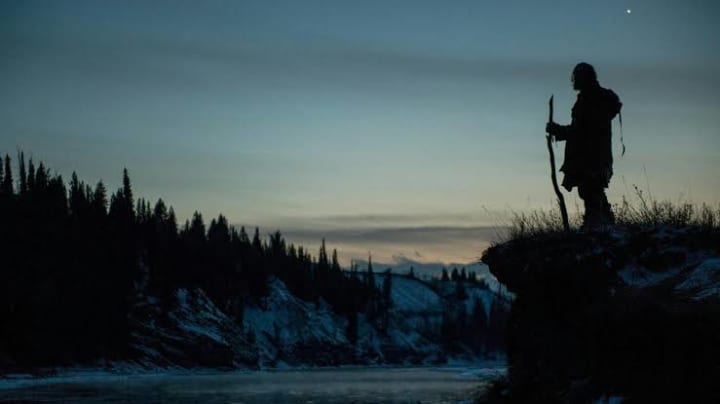
At no point is this evidenced more so, than when Glass ventures off alone and is attacked by a grizzly bear. The scene is a technical feat and fits well within what's already been established as a subversive dialogue over man and his sorrowful relationship with nature. The film soon finds itself delving into a revenge picture, with glass facing betrayal by the very men he was tasked with delivering safely. None are more treacherous than Tom Hardy's, John Fitzgerald. Hardy's portrayal of Fitzgerald is perfectly positioned as the other-side-of-the-coin to DiCaprio's Glass. He's dishonest, disloyal and selfish, everything Glass isn't. After murdering his son and leaving Hugh Glass for dead, the story shifts to a linear narrative of one man's relentless desire for revenge. How he enacts this revenge is less remarkable than the elements behind the story taking place; namely how love, spirituality and nature are driving forces for salvation.
There are several quality performances here and they need to be, in order to match the levels of DiCaprio and Hardy. Will Poulter gives an outstanding outing as Jim Bridger, a young fur trapper who's manipulated into leaving Glass for dead, while Domnhall Gleeson plays Captain Henry, the party's altruistic lead. But of all the performances, the most outstanding achievement is undeniably that of director, Iñárritu. He has delivered a spectacle that can be revisited time and again, a film that is not afraid to confront America's iniquitous history related to race, equality and respect for the indigenous, but all the while packaged within an entertaining narrative with awe inspiring visuals. Quite frankly, it's been some film to help return me back to the keyboard!
See the trailer here: The Revenant Trailer
About the Creator
Lev. Life. Style
I’m fascinated by culture’s ability to shape thought and behaviour. I value creativity as a means of aiding wellbeing and growth. Film, analysis, travel and meaningful discussion, are personal passions that I’m grateful to share.
Lev
Keep reading
More stories from Lev. Life. Style and writers in Critique and other communities.
Who Is Clavicular? The Looksmaxxing Streamer Who Ran Over A Stalker In His Cybertruck
What is so damaging to this current culture is the ant-intellectualism which pervades nearly every element of it. Clavicular, real name, Braden Peters equivocates physical form with getting women, making money, and overall being a strong “man.”
By Skyler Saunders20 days ago in Critique
A Jerk and an Idiot Meet in a Bar
A Jerk and an Idiot Meet in a Bar Well not in a bar, per se, social media. After all, it is the bar of our modern times. It’s where we hook up with friends, family, dates, or trysts. Places like Facebook, Instagram, TikTok, and others, all designed for social interaction with anonymity and limited consequences, for bad behavior. Often these entities dole out consequences to parties that are not causing a problem, and give a blind eye to serious problems.
By Alexandra Grant6 days ago in Critique


Comments (1)
I hear you on not being inspired by movies lately. But The Revenant sounds like it changed that. You're right about seeing it on the big screen. I remember a time when I watched a nature - themed movie at home and it just wasn't the same. How did those battle scenes in The Revenant compare to Saving Private Ryan for you? And what were those personal, sub - textual elements in the film that really stood out?