
Charming Classic - “Lincoln”
Levar’s Film Reviews

"Things which are equal to the same thing, are equal to each other." - Euclid
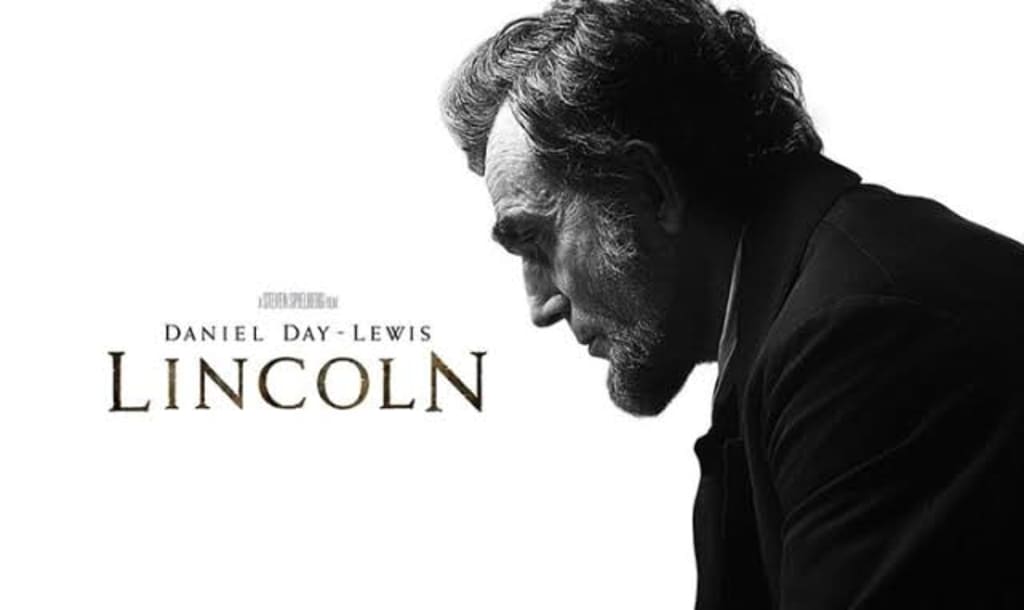
Daniel Day-Lewis sits comfortably on a small list of on screen talents that transcends the category of 'actor'. It would be more fitting to refer to him as a unique specialist of human embodiment. In 'Lincoln', Steven Spielberg's excellent biopic, he literally becomes America's 16th President, a man of whom we are all aware of, but up until now I actually knew so little about. 'Lincoln' isn't a movie. It doesn't follow the trends of mass, modern cinema by relying upon thrills and spills. It is more like a piece of specialist theatre that has been captured on film purely for our benefit. If I am speaking of this with a sense of astounded austerity, it's only because I was genuinely moved by this film and it's not often I'm moved by anything to this level. It is a film that is deserving of being deconstructed, based on my honest response to it.
Following the last few months of his life, here we see that President Abraham Lincoln was something of a paradox. He was a sullen man, who looked gaunt and frail, yet carried a gravitas that only people with true purpose have. His authority, as depicted by Day-Lewis, comes through sincere reasoning, as opposed to abrasive dogma. As a result, he is a leader that isn't feared, rather warmly revered. Lincoln rarely even raises his voice and this was a man who was president during a time of civil war. Director Steven Spielberg doesn't get bogged down by trying to portray mass battles on screen here. Although war is one of the key themes present within the film, this isn't a “war movie”.
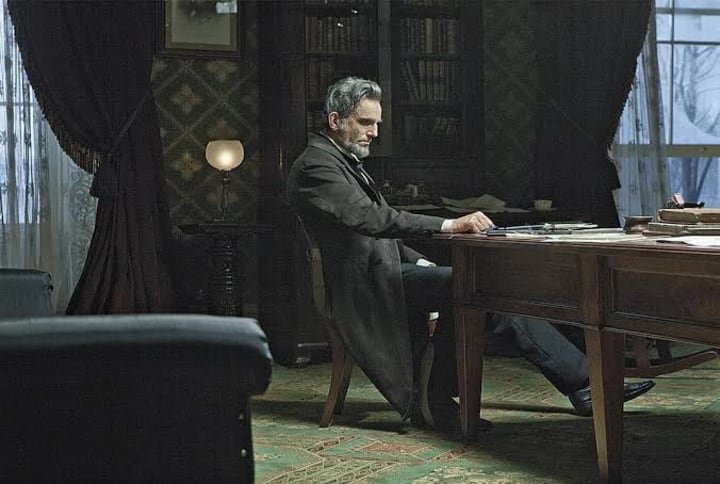
What we learn, which is new, is that Lincoln was a shrewd man, whose experiences as a lawyer gave him a very slim edge during his struggles to pass America's 13th amendment. This amendment was hotly disputed, being that it was a proposed law that would abolish slavery in America and in turn end the conflict between the northern and southern states. Due to the fact that slavery was America's biggest commodity and African slaves were depended upon for making wealthy men wealthier (naturally when labour is both free and forced) the 13th amendment was not readily agreed upon. Yet, Abraham Lincoln was a man who believed in equality, thus slavery was something he grew ever more opposed to.
Slavery, as a term, doesn't resonate as deeply today, due to the fact that it is seen as taking place so long ago and having little bearing on the present. What Spielberg's film does though, is raise questions over belief systems and prejudices, based on racial (in)equality. By doing so, he immediately manages to contemporise very relevant and all too prevalent themes; are we all equal as human beings, or are there natural differences between us that make some inherently superior to others? Nature vs. nurture is not a universally agreed upon debate.
The main plot of 'Lincoln' therefore, revolves around the historical vote that took place within the house of representatives, (a mass group of officials who run the country based on yes's or no's) and the ways in which this time acted as a catalyst, shifting America from a country of warring states, to one slowly merging towards being a united states.
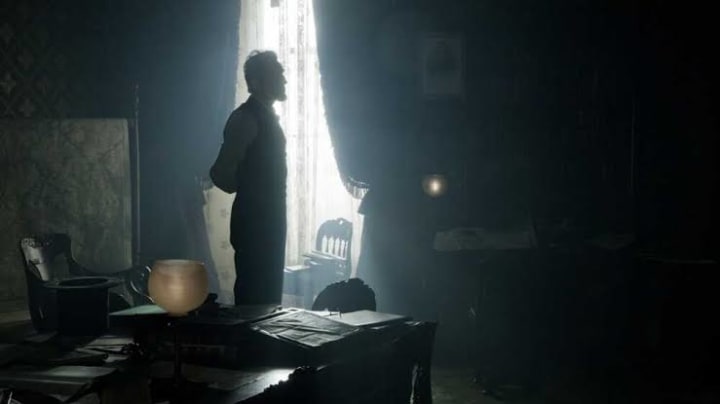
Why this film works and why it is so powerful is due to film-making of the highest calibre. That may sound like stating the obvious given that this is a Spielberg feature. But by that I mean the collaborative effects of an outstanding cast, excellent pacing and a John Williams score that is perfect in its subtle manipulation. Next to Daniel Day-Lewis, (who will surely be up for many best actor nominations during this year's awards season) you have Sally Field, an outstanding Tommy Lee Jones, Joseph Gordon Levitt and a number of great supporting cast members who give the film a sense of genuine authenticity.
As a historical film, which invariably takes place within a period setting, 'Lincoln' barely resembles our present. Yet for all the travesties of that time, more can be said for much of the greatness of his era than so much of what is valued today. I feel this point alone is encapsulated by a small scene between Lincoln and his wife's freed African-American aide, Elizabeth Keckley. In this scene, Lincoln asks the one time slave what she feels will become of her people if the 13th amendment is passed, to which she responds she is unsure. I wonder how she would feel today if she had he opportunity to see racial relations as they are 148 years later. Just a thought. For all it achieves, along with raising questions such as this, Steven Spielberg's 'Lincoln' is a masterpiece.
See the trailer here: Lincoln Trailer
About the Creator
Lev. Life. Style
I’m fascinated by culture’s ability to shape thought and behaviour. I value creativity as a means of aiding wellbeing and growth. Film, analysis, travel and meaningful discussion, are personal passions that I’m grateful to share.
Lev
Keep reading
More stories from Lev. Life. Style and writers in Critique and other communities.
Charming Classic - “Avatar”
"There comes a time in life where you have to wake up, and open your eyes" - Jake Sulley A unique and coherent mythology is never wasted on me. I believe that the creation of a fictitious World, history, people's and enduring message, is creative thinking at its most...creative! And if anything can be said of filmmaker James Cameron, it's that he is most definitely creative.
By Lev. Life. Style 9 months ago in Critique
Who Is Clavicular? The Looksmaxxing Streamer Who Ran Over A Stalker In His Cybertruck
What is so damaging to this current culture is the ant-intellectualism which pervades nearly every element of it. Clavicular, real name, Braden Peters equivocates physical form with getting women, making money, and overall being a strong “man.”
By Skyler Saunders21 days ago in Critique
Silver Screen Magic with Mae West
American actress and singer Mae West became a popular film actress during the Great Depression. She started entertaining in vaudeville, then performed on Broadway, and finally went to Hollywood. She signed up with Paramount Pictures and made her debut in the 1932 film “Night After Night.” She also starred in musicals, comedies, and crime dramas. The American Film Institute named her one of the best classic Hollywood actresses.
By Rasma Raisters4 days ago in Geeks


Comments (1)
You really captured Lincoln's essence well. His calm authority was so powerful. It made me think about how leadership isn't always about being loud. I wonder how Spielberg decided to focus on Lincoln's reasoning rather than big battles. And how did Day - Lewis prepare to so perfectly embody such a complex figure?