

"Lonely's the only other company, less you're the love no other love can be." - Maxwell
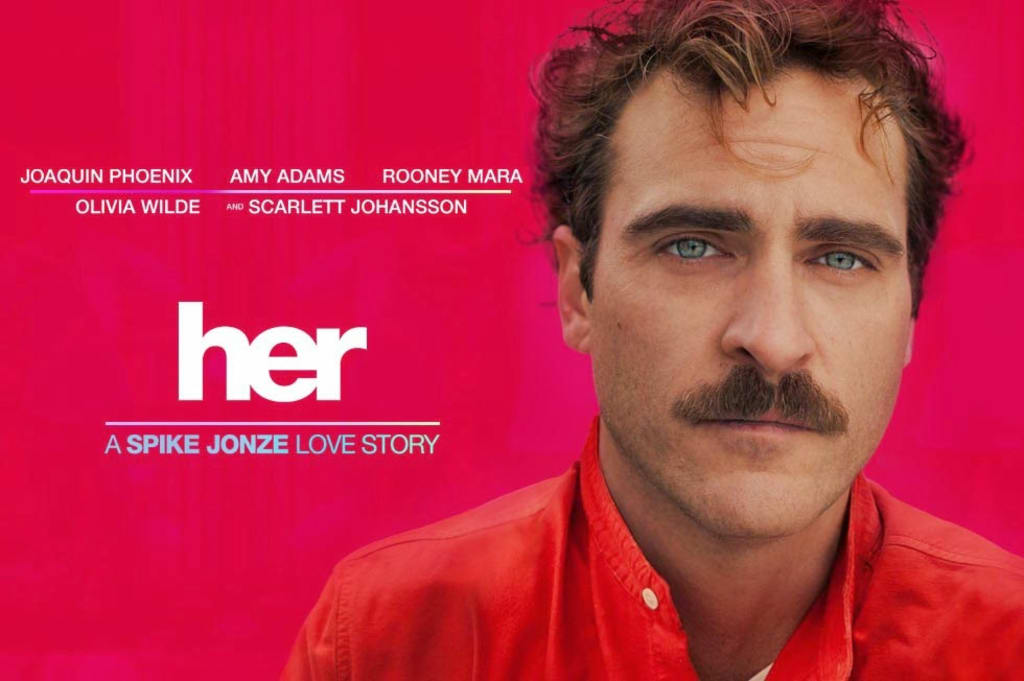
Quite soon into Spike Jonze's her, you feel a genuine sadness for the world he's depicting, our own. The director presents us with a recognisable LA setting, but everyday technologies have advanced and computer intelligence in particular, has reached new heights. While this may seem exciting on the surface, the consequences of these advancements mean social interaction has lessened, and with it, human detachment has heightened.
Joaquin Phoenix plays Theodore, who is a personification of this detachment. He works for a company that makes and sends handwritten letters on the behalf of people who are either too busy or unable to write the letters themselves. The only thing is, the letters aren't actually handwritten, rather dictated and created via computer programmes. His job encapsulates the contradictions of his life and also the primary message of this film; things that should and could be meaningful, are made less so by artificiality.
This is a world where the essence of human interaction and romance has become so confused, that years worth of a relationship's complexities, have the possibility of being played out within a single date. In this future, people increasingly live their lives through cyberspace instead of a tangible space, even to the point whereby text and phone sex, have become more of a norm than actual sex.
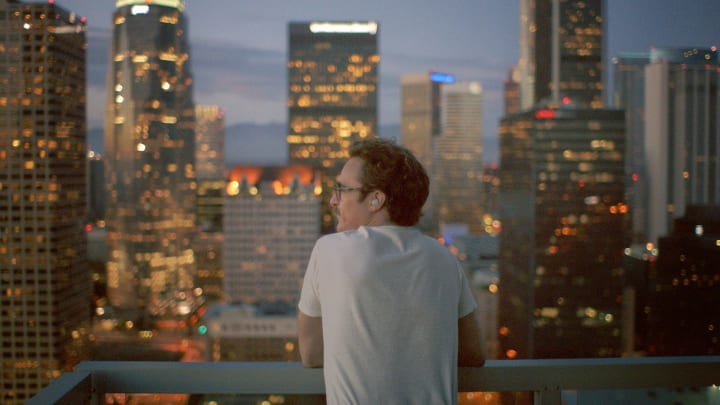
Joaquin Phoenix's Theodore is a lonely man, whose inner turmoil is evidenced from the sadness in his eyes, a sadness which he attempts to hide behind his elaborate glasses. Rarely does he smile, but you'd be forgiven for not noticing due to the bright, primary-coloured clothes he wears. It's his own, daily disguise, for his unhappiness and romantic longing. As the film begins, we meet him at a crossroads in his life. He's riddled with rose-tinted flashbacks of the better moments of his marriage, which is now at the latter stages of divorce. He's the kind of character you're more frequently likely to come across nowadays; a person who feels displaced within the real world and resultantly exists within a realm that oscillates between clinical depression and fleeting bouts of happiness.
Being technically astute, Theodore decides to purchase a state of the art, computer-operating-system, "OS1", with the intention of "organising his life". This is artificial intelligence of the highest calibre; a seemingly living consciousness within a machine, in familiar ways to what we've previously seen depicted in genre crossing, sci-fi & romantic comedy cinema (S1mone, Eternal Sunshine of the Spotless Mind). After booting up his new operating system, he quickly chooses to give it a female identity and with that, 'Samantha' is born. Scarlett Johanssen voices Samantha and gives her an immediate believability. She has a distinct way of enunciating and a tone to her speech that's equal parts personable and seductive. At first, Theodore finds Samantha useful. She sifts through an abundance of emails, organises his work files and learns along the way. She develops a personality and he finds himelf attracted and attached to it. He begins to transport her everywhere with him, which is convenient as all of his tech is synched. In time, they experience the world together, share tastes and form a relationship.
The selection of female voice actor was important here, otherwise we may not buy into the fact that Theodore could "date his computer". You understand how this man in this world could form a bond in this way and at times the connection comes across as genuine and sweet. But as it develops the relationship leaves you feeling uncomfortable.
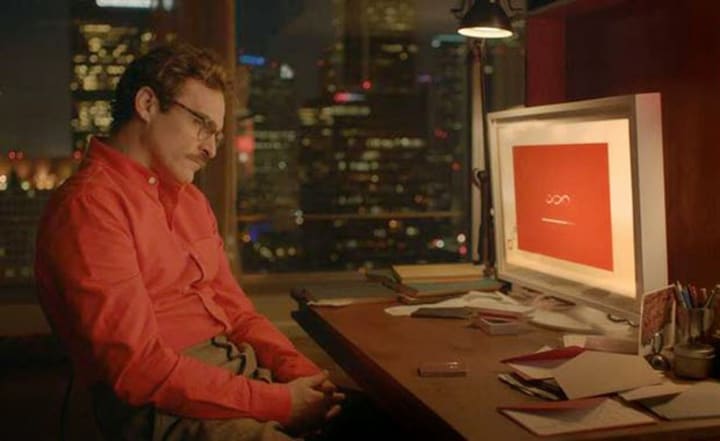
It's clear that a massive sub-theme of the film is society's over-reliance on technology, particularly our 'smart' mobile devices. Amongst it's commentary of the artifical, is a subtle critique of our attachment to that which we are increasingly giving importance to, often more so than the people around us. In Theodore's society, many are accepting of people forming romantic relationships with computers and I found the film was effective enough to raise questions that go far beyond its narrative. Existential questions, such as how much of a relationship is physical and how much of it is psychological? Are we now, in an age of ever increasing detachment, able to substitute the physical with the virtual? How does the relationship between Theodore and Samantha differ from an online relationship where two parties meet, get along, form a bond but never actually come together in person, sharing experiences via text, 'FaceTime' or 'Skype'? And what exactly does that do to us in terms of inhibiting or augmenting our natural, physical needs?
These are multifaceted questions with an array of possible answers, depending on individual viewpoints. For these reasons, along with its beauty, humour, and overall delivery, her fully deserves to be regarded as a remarkable modern classic.
See the trailer here: her Trailer
About the Creator
Lev. Life. Style
I’m fascinated by culture’s ability to shape thought and behaviour. I value creativity as a means of aiding wellbeing and growth. Film, analysis, travel and meaningful discussion, are personal passions that I’m grateful to share.
Lev
Keep reading
More stories from Lev. Life. Style and writers in Critique and other communities.
Standing While Falling
Quotation from Friedrich Nietzsche "He who wrestles long with monsters should beware lest he himself become a monster. And if you gaze long into an abyss, the abyss also gazes into you. Man is not destroyed by suffering, but by the meaning he makes of it."
By LUCCIAN LAYTH10 days ago in Critique


Comments (1)
This film's LA setting with advanced tech is spot-on. It makes you think about how our interactions are changing. Theodore's job shows how artificiality messes with meaning. Do you think we're headed in this direction too? The way people live through cyberspace here is wild. It makes you wonder what real connection will look like in the future. How do you think we can keep that human touch in a tech-driven world?