
Charming Classic - “Django Unchained”
Levar’s Film Reviews

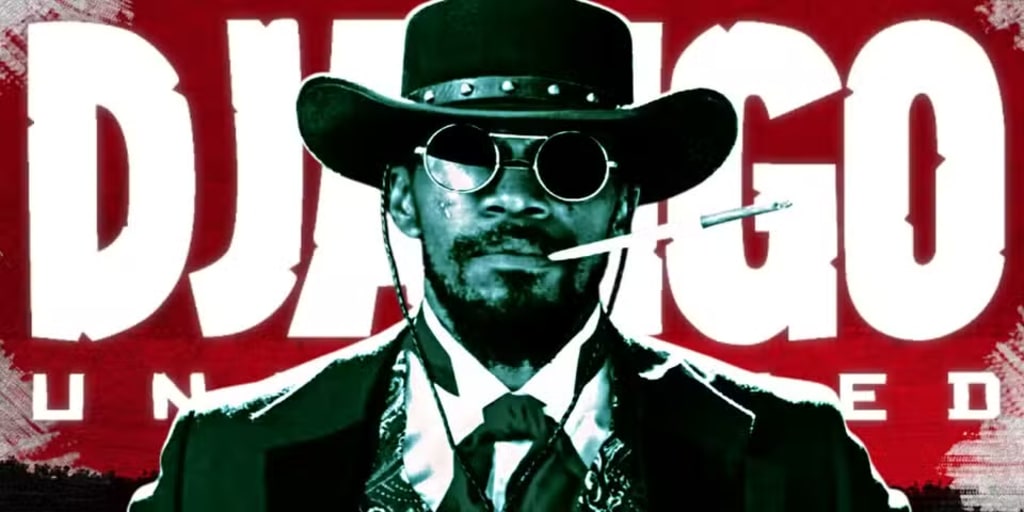
"I need a hundred black coffins for a hundred bad men. A hundred black graves so I can lay they ass in" - Rick Ross
You can literally group Quentin Tarantino's feature films into separate categories:
1) The quick witted flashback flicks: Reservoir Dogs and Pulp Fiction.
2) The exploitation pet projects: Jackie Brown, Deathproof, Kill Bill: Volumes 1 & 2.
3) The historical fantasy epics: Inglourious Basterds and now most recently, Django Unchained.
Tarantino has often said that he regards his films to be part of a sequential legacy. Not that the films are all necessarily related, but that they all have a signature quality to them defined by him as a filmmaker. Quentin's biggest fear is to be remembered as a director whose films eventually declined in quality. He despises the idea of ever having a film resume, tarnished by one or two rotten eggs for what would otherwise be a 'Michelin star' worthy omelette. With Django Unchained, his resume remains fully intact (but for a one misplaced egg shell in the form of Deathproof), as he has delivered yet another signature piece, that delivers in abundance, exactly what he had set out to do. I'll explain what that was over the course of this review.
Tarantino isn't Spielberg. By that same token he isn't Scorsese, Hitchcock or Spike Lee. He is his own director and has his own style, so it stands to reason that a film he tackles about slavery, will be no Lincoln. America's history with the racist ideologies that fuelled slavery, is the primary backdrop of these films, but they are wholly different pictures. Watching Django after having already seen Lincoln, I can say that my response to it was in no way comparable on an emotional level. Lincoln, as I've stated, is a film of poignancy. Django Unchained is a genre mixing, exploitation film, that revolves around the brutality of events that are wholly despicable. Yet somehow it manages to have many moments that are abhorrant followed by moments that humour. I was laughing in the screening where not many other people felt comfortable laughing. Maybe my approach to cinema means I retain a level of detachment. I think it's more a matter that only Quentin Tarantino could manage to make a film with themes such as these, that makes you question, entertains and is also funny.
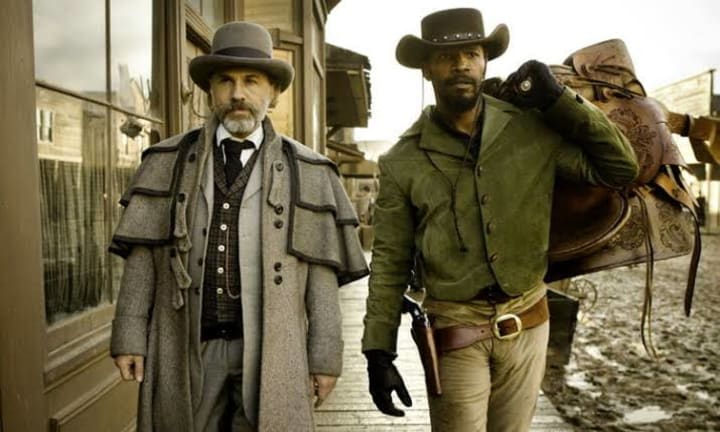
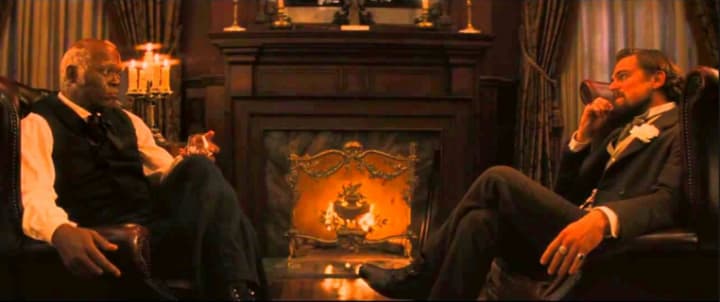
But what's all the fuss about? Well here's the premise: Django Unchained is the story of a slave, 'Django' (Jamie Foxx), who is being transported by shackles after having been sold and separated from his wife, 'Broomhilda' (the stunning Kerry Washington) as punishment, due to the fact the two are runaway slaves. At the beginning of the film, whilst en route to his new plantation, he and his new owners come across 'Dr King Schultz' (an Oscar worthy Christoph Waltz), a German immigrant who masquerades as a 19th Century dentist, but is actually a bounty hunter. Schultz is looking for Django because he needs him to identify three men who have a very large bounty on their heads. After much Tarantino esque dialogue (the film, thankfully, is full of it) it just so happens that Django ends up being taught the art of bounty hunting, which he excels at, and finds himself teaming up with Schultz in collecting various outstanding bounties throughout the southern states. Having found a mutual respect for one another and due to the fact that King Schultz is opposed to the idea of slavery, he agrees to help Django. They eventually end up hatching a grander plan to free his estranged wife Broomhilda, who has now been sold to an infamous slave plantation known as 'Candyland', of whom Leonardo DiCaprio's character, 'Calvin Candie', is the plantation owner.
This then, is the film's central plot. But just as with 'Inglourious Basterds', it has intricate side plots within the grander narrative, that are somehow all related. This is the beauty of Tarantino storytelling, because it offers greater, in depth character development that affords the characters some feasibility, no matter how silly or outlandish his films' premise. Whether or not that is a good thing is open to debate and in fact, it is currently a matter of debate by several critics of the film. Spike Lee, who has always vocally opposed Tarantino, refers to the film as being 'disrespectful to my ancestors'. Many regard Tarantino to have been misguided in dealing with a film with a topic such as this, in this way. My personal thoughts are that this is cinema and cinema is a form of art. Art is the result of individual (or collaborative) expression. Hollywood has historically made films from a very linear viewpoint, that belittles the position of minorities. Film-making of this time though was also artistic expression, which acted as a visual indication of exclusivity and social prejudices. Hollywood has in some ways moved forward, although it undeniably still has major strides to take. However, it's fair to say that a film such as this would not be made and as widely distributed were this the 1970's, in the height of exploitation cinema.
My point therefore, is that I don't believe Tarantino was at all insensitive in the way he approached what happened during times of slavery. In actual fact he doesn't shy away from depicting some of the most iniquitous acts of that time along with corporealizing the belief systems that went with along them. He deals with matters such as taught racial hatred, rape, female slave abuse, physical atrocity and the animalisation of black males.(** Post script, see bottom of this review) I have spoken of my views of Tarantino as a director who is racially and culturally inclusive before, (see here) and by including these themes in Django Unchained he has nobly attempted something that the vast majority of Caucasian-American film-makers have never grappled with.
Overall I would say that Quentin set out to make a film that dealt with America's history of slavery, but without making it one that lectures modern audiences. A modern audience wouldn't necessarily have the same visceral response to this film than if it had been released a generation ago. This is a film about slavery, set in a time where the idea of a black man ever being more than subservient to white authority, was a nonsensical notion. But we are now in an age where a man of black heritage is in one of the most powerful and revered positions in the World. And indeed he holds that position in the very country where, had he been born some hundred or so years earlier, he'd be living the very existence, generations of males like Django knew as reality. By delivering a film that is entertaining and offers enough to be thought provoking for those who will embrace that chance to think, in my view this film is a piece of work that is to be commended...and yes, it's cool to laugh!
See the trailer here: Django Unchained Trailer
** Some weeks after the film's release, there has been talk of the fact that Samuel L. Jackson's character 'Steven' is dichotomous to Jamie Foxx's 'Django' in that he's a 'villain' and the latter is a 'hero'. Questions have arisen over the usage of these terms and I thought I'd offer my own perspective on this with two brief character studies.
Steven: As a head house slave, Steven has a position of authority over all other slaves on the plantation. He has free reign as it were, in the 'big house', which was a common occurence for older, obedient house slaves who were of little threat and fully cohesive to the running of the plantation. For this reason, and given the fact that this position is afforded him by the plantation owner or 'master', there are parallels between the house slave and many black males within contemporary society who are in greater positions of privilege than the majority of 'the black demographic'. It's akin to subservient indoctrination as he is ultimately at the mercy of hegemonic/white decision making. For this reason and for the ultimate self ignorance of the character, I cannot view him in any way but with pity. I do not feel the term 'evil' is fitting for him, although in the narrative of the film he most certainly is there to disrupt and exhibits villainous motivations/actions.
Django: Similarly, Django cannot necessarily be said to be a hero, but in my view, he most certainly displays acts of heroism. Given that slaves were property, thus seen as sub-human, the act of marriage and genuine monogomous love, was a far fetched concept for slaves of the time (and as a result perpetually effect the thinking of many black males today). Yet Django exhibits these traits and furthermore does not victimise himself once he's freed. Django acts upon the opportunity afforded him by being 'unchained', both literally and figuratively and does whatever he can to achieve his ultimate objective; rescuing his wife. For that reason, I believe Django's motivations and drive are exemplarary, even if his necessary actions may not be.
About the Creator
Lev. Life. Style
I’m fascinated by culture’s ability to shape thought and behaviour. I value creativity as a means of aiding wellbeing and growth. Film, analysis, travel and meaningful discussion, are personal passions that I’m grateful to share.
Lev
Keep reading
More stories from Lev. Life. Style and writers in Critique and other communities.
Charming Classic - “The Revenant”
'Perish the universe, provided I have my revenge!' - Cyrano de Bergerac I haven't written a film review in over a year (written February, 2016). When asked why, I've explained that a lack of time is the key factor, but on reflection this has just been an excuse. The real truth, is that I've not been inspired enough by a single piece of cinema in some time. I love film for reasons beyond entertainment. For me it's escapism, an art-form that resonates and that I enjoy tackling from an analytical stance (hence this blog!). It's been some time however, since I've left a film screening that has stirred an emotional response within me. Nothing has impacted to the point where it shook me from my analytical hibernation and reignited a desire to share my filmic thoughts. That is until I experienced Alejandro González Iñárritu's, The Revenant.
By Lev. Life. Style 9 months ago in Critique
Standing While Falling
Quotation from Friedrich Nietzsche "He who wrestles long with monsters should beware lest he himself become a monster. And if you gaze long into an abyss, the abyss also gazes into you. Man is not destroyed by suffering, but by the meaning he makes of it."
By LUCCIAN LAYTH12 days ago in Critique
Miss Persephone's Manual to a Seemingly Ordinary Life
Miss Persephone was found at the dining table, her blue eyes swollen, her tears arriving and retreating like the tides of the ocean. Earlier that day, her family had visited her in the retirement home where she had lived for eight years. It was her eightieth birthday.
By Imola Tóth3 days ago in Fiction


Comments (1)
You've got an interesting breakdown of Tarantino's films. I agree he's in a league of his own. After seeing both Django and Lincoln, I was struck by how different they were. How did you feel about the mix of brutality and humor in Django? It was quite a ride. I also wonder if Tarantino's approach to slavery was the right one. While it made for an entertaining film, did it do justice to the horror of that era?