
Charming Classic - “12 Years A Slave”
Levar’s Film Reviews

"Emancipate yourselves from mental slavery, none but ourselves can free our minds" - Bob Marley
I was 5 years old when I first learnt of racialised, chattel slavery. I remember vividly a Saturday afternoon and my mum taking out our Roots, VHS box-set for me to watch. I remember seeing the box art of a man in chains and asking her if it was sad. She was honest enough to tell me it was, but lovingly explained that I needed to see it, "in order to know where your name comes from". I'm named after actor LeVar Burton who played the young slave, Kunta Kinte, in the Roots miniseries, as well as many roles in television and film (most notably Geordi La Forge in Star Trek: The Next Generation).
Unbeknownst to me at the time, the concept of 'knowing where my name comes from', had a double meaning. For most of us descended from generations of slaves from the many Caribbean Islands, as well as South and North America, our original, ancestral names have been lost. Therefore, our surnames today mainly derive from those our ancestors were symbolically and literally branded with, during the centuries' long, transatlantic slave trade. This history was taught to me through acting, cinema and narrative storytelling, which was a digestible way to learn of such things at a young age. Instilling a sense of identity and advocating equity, human dignity, justice and equality, are arguably the most important things you can teach any child. The old adage of course being; those who are unaware of human history, are destined to repeat it.
Since then, there have been a handful of high profile films centred around slavery, most coming in the last couple of decades and only one or two being of any credence. None of them however, have managed to accomplish what director, Steve McQueen has with 12 Years a Slave. There are an abundance of reasons why this film works so well, but the primary one, is its honesty. From top to bottom and any which way, this film resonates as truthful. It penetrates your consciousness in such a way that makes it feel utterly authentic. And quite rightly, it is completely unapologetic for being so.
Steve McQueen (Hunger, Shame) has explained his motivations for making this film. He had the desire to tell a story of slavery, but through the eyes of a free man who was then captured. His wife suggested he research historical accounts and he came across the memoir, "Twelve Years a Slave", written by Solomon Northup in 1853. The book details Northup's experiences as a free man, in 19th Century New York, who was drugged, captured and sold into the antebellum south. And so this became the basis of 12 Years a Slave the film. Much like the effective way Steven Spielberg borrowed from accounts of Oskar Schindler's life, to frame a story around the evils of the holocaust, McQueen utilizes a character piece, centering on one man's struggle, but juxtaposed against the backdrop of an era of unrelenting, human indignity.
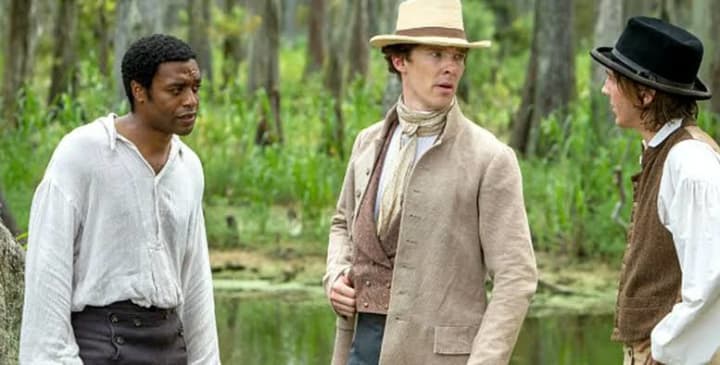
It is important to note that whilst Solomon is the film's anchor as it were, the story is moulded in such a way that he becomes a figurative passenger, who is involved in the cruel frenzy and confusion of these events, rather than the events being solely about him. In other words, Solomon is us. We are enduring his experiences and all of the tumultuousness that would arise for someone who is born with liberty, only to have that liberty stripped away. To portray this effectively requires something deeper than dialogue. Thankfully, Chiwetel Ejiofor is an actor of such aptitude, he is able to convey Solomon's perplexities, grief and despair, entirely through physicality; most notably through his eyes. This is a nuanced performance of the highest order, whereby expression is as important, if not more so, than words.
Once Solomon is captured, he is shipped to the south under the falsehood of being a "Georgia runaway" and is forced to adopt the name of, "Platt". It is at this point we experience the mechanisms that took place in valuing humans, with worth being based on health, sex and skin tone. Here we see a standout moment of cruelty, when a mother is separated from her children, with her lighter skinned daughter fetching a higher price, due to pigment related desirability. The film is full of these moments that hit your core. It doesn't shy away from depicting the brutality of the time, in order to convey just how exemplary a feat it was, for Solomon to retain any semblance of hope.
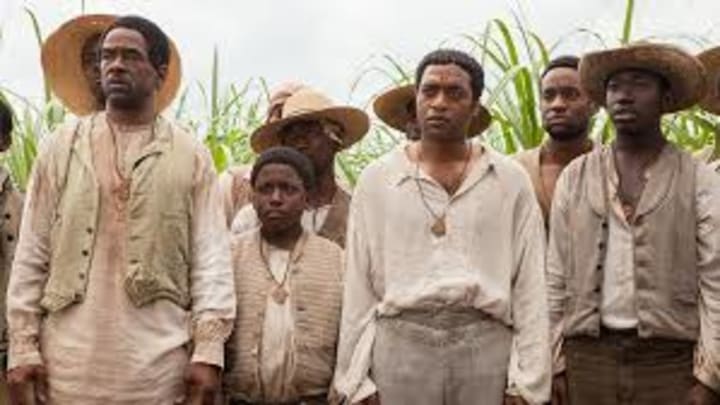
Paradoxically however, this film is quite beautiful. We are gifted examples of nature at work throughout, in ways that are often reminiscient of Terence Malick. The film's opening scene has the camera slowly creeping through long tobacco leaves, eventually revealing a line up of slave men who'll be tasked with cutting them. McQueen masterfully oscillates between beauty and iniquity, between the natural and unnatural, but he does so in ways that blend subtelty and potency. Single shots capture societal hierarchies just as much as individual characters symbolize entire struggles. It is master filmmaking throughout. Another standout moment comes when Solomon and a group of slaves are travelling through the woods and encounter a group of Native Americans. Once again it is a scene with no dialogue whatsoever, but it depicts an encounter of two groups of peoples, both having experienced ills at the hands of the same oppressor, coming together through a moment of mutual understanding.

Sex, education and religion are presented here as sub themes. Solomon's overseer, "Tibeats" played by Paul Dano (Little Miss Sunshine, There Will Be Blood, Prisoners) is an example of the hate that arises from many a racist, who is intellectually humbled by someone they out rank in the social order. Furthermore, we see ruthless plantation owner, Master Epps (played with every bit of complexity and malevolence required, by the great Michael Fassbender) being an example of how scripture was so often manipulated for individual purposes. A special mention must go to newcomer, Lupita Nyong'o's performance as field hand "Patsey", the object of Epps' twisted desire. It would be possible to indulge in an entire piece based upon the many powerful interplays between Epps, Patsey and "Mistress Epps", who is envious of her husband's overt affections towards their 'property'. It is yet another example as to why the film resonates; it has so much to explore outside of the narrative that can be deconstructed in a number of enlightening ways.
The gravitas of this film is further evidenced from the shock that reverberates, when watching it amongst a cinema full of people. Each person around you reacts to the brutality on screen in their own way. The discomfort that arises from experiencing it, goes some way to exemplify how far we've come in terms of legality and practice(s). After all, as the camera pans towards the sky early in the film, with Solomon chained and beaten in a Washington D.C den, we see the dim silhouette of The White House, which serves as a clear representation of change! In such a time, the thought of a black family ever living and presiding within that very building, would have been treated as the worst case of insanity. Yes indeed, there has been progression in terms of practices. The question remains however; just how far have we come in terms of attitudes? For raising such questions, along with offering an immense platform for important debates to spring from, in some way explains why 12 Years a Slave is more than just a film.
See the trailer here: 12 Years a Slave Trailer
About the Creator
Lev. Life. Style
I’m fascinated by culture’s ability to shape thought and behaviour. I value creativity as a means of aiding wellbeing and growth. Film, analysis, travel and meaningful discussion, are personal passions that I’m grateful to share.
Lev
Keep reading
More stories from Lev. Life. Style and writers in Critique and other communities.
Charming Classic - “Lincoln”
"Things which are equal to the same thing, are equal to each other." - Euclid Daniel Day-Lewis sits comfortably on a small list of on screen talents that transcends the category of 'actor'. It would be more fitting to refer to him as a unique specialist of human embodiment. In 'Lincoln', Steven Spielberg's excellent biopic, he literally becomes America's 16th President, a man of whom we are all aware of, but up until now I actually knew so little about. 'Lincoln' isn't a movie. It doesn't follow the trends of mass, modern cinema by relying upon thrills and spills. It is more like a piece of specialist theatre that has been captured on film purely for our benefit. If I am speaking of this with a sense of astounded austerity, it's only because I was genuinely moved by this film and it's not often I'm moved by anything to this level. It is a film that is deserving of being deconstructed, based on my honest response to it.
By Lev. Life. Style 9 months ago in Critique
Standing While Falling
Quotation from Friedrich Nietzsche "He who wrestles long with monsters should beware lest he himself become a monster. And if you gaze long into an abyss, the abyss also gazes into you. Man is not destroyed by suffering, but by the meaning he makes of it."
By LUCCIAN LAYTH10 days ago in Critique


Comments (1)
I think it's powerful how you learned about your heritage through things like Roots. It shows the impact of storytelling. And 12 Years a Slave really was honest. It made you feel the horror. Do you think more movies should focus on these important historical events to teach the younger generation? I also wonder how we can make sure this history isn't forgotten or distorted. Maybe we need more educational programs that use different mediums like film, just like you had. What are your thoughts on that?