

It’s 9 a.m., time for a morning snack: chia seeds with coconut milk, accompanied by a black lungo, in front of a terrific panorama of rolling countryside hills, caressed by the gentle, peach-colored light of the rising sun. And surely, with a good book in hand.
”
Perfectly timed, the other day I came across Truman Capote’s Breakfast at Tiffany’s in the village’s boîte à livres: a French edition with the original English text and vocabulary notes. I opened it at random page: “Travelling: implies she had no fixed residence.” Sounds a lot like me.
I took that as a sign and decided to take the book to read again. I had really adored it when I first became acquainted with it nearly twenty years ago. The story, imprinted with an unmistakable New York atmosphere — its brownstones, fire escapes, champagne parties, and a myriad of possibilities — filled me with a kind of light luminous sadness. I longed to be inside it and didn’t want it to end.
“Also, she had a cat and she played the guitar,” the narrator says about Holly Golightly, the heroine. As for me, I don’t play any musical instruments — not even a flûte à bec, as all French kids do — but I did have a cat too. I even used to say that home is where the cat is. Now my grey-blue-haired, purring beauty is gone, so I’m travelling, just like Holly.
My travels brought me to this charming French village, where I’m taking care of a friend’s cat, who, by a twist of fate, looks exactly like mine. The male version, which means he’s a touch more aggressive and hysterical, especially when he’s hungry.
My cat’s name was pretty funny: Piesept. There was some kind of French jeu de mots in it, but I wasn’t the one who came up with it. It was her previous mistress’s idea to call her that, and I’ve never changed it. Holly’s cat doesn’t have a name at all. “I don’t have any right to give him one,” she explains. “He’ll have to wait until he belongs to somebody. We just sort of picked each other up by the river one day; we don’t belong to each other. He’s independent, and so am I.”
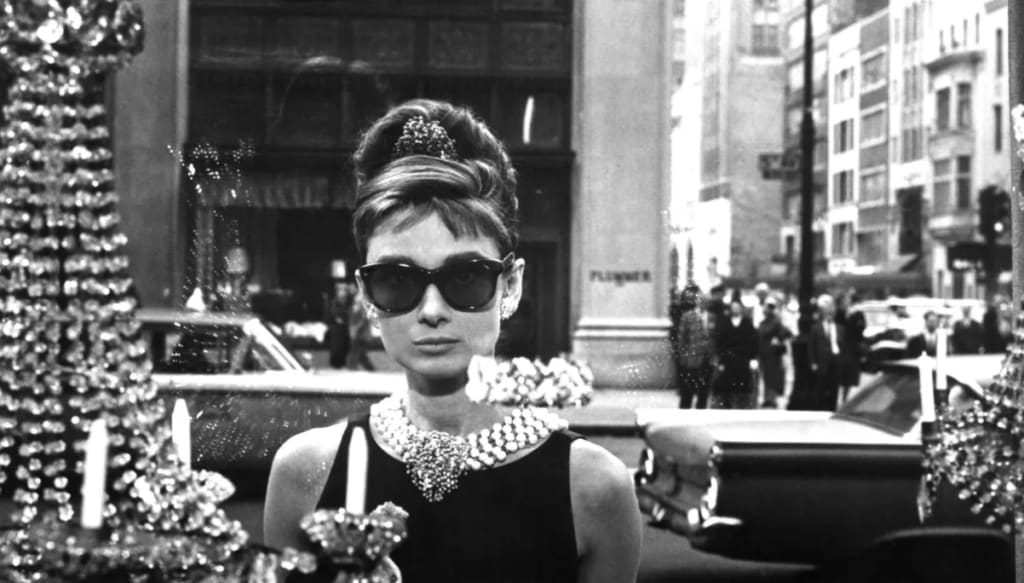
Breakfast at Tiffany’s was such a success that it was made into a movie. I’ve heard that Truman Capote originally had Marilyn Monroe in mind for Holly, but things happen as they do — and it always turns out even better than initially planned — so, finally, Audrey Hepburn was chosen to play her. Her performance became iconic and stands as her most well-known role. I haven’t seen the movie for years, yet as I immerse myself in the text, I can literally hear Audrey Hepburn’s voice speaking for Miss Golightly.
Audrey Hepburn is stunning, a mix of childish innocence and fashionable elegance, yet there’s one problem with the movie. In the book, Holly persists in being herself: wild, naïve, kind-hearted enfant terrible, constantly in search of adventure. In the end, she takes a plane to Brazil and actually disappears. It feels as though she escapes voluntarily and freely from the pages of the novel, impossible to confine within the narrative structure that fiction demands. In the film, however, this American-style happy ending traps her within the conventions of a simple romantic story. Apparently, the producers didn’t really understand the character… Yet, it’s often the same: no matter which film adaptation we take, the book is always richer and more subtle.
The most dramatically tense moment in the book comes when Holly tries to get rid of her no-name cat and tells it to “fuck off”, while it rubs against her leg in a filthy district full of garbage cans and rats under the heavy rain. “You are a bitch,” the narrator tells her, as she steps back into the cab and ordres it to go. And he’s definitely right. By the way, he also remains nameless throughout the book.
However, as the shock of loss passes, we begin to understand that when someone pushes you away, it’s not for lack of love. On the contrary, it is often done out of love and with the strong belief that you’ll find a better place. No matter how painful the situation, sometimes it’s the only thing one can do in the moment, and it’s surely for the best.
“I wanted to tell her about her cat. I had kept my promise; I had found him,” says the narrator in the last paragraph, sending shivers down my body and bringing my eyes close to tears. “Flanked by potted plants and framed by clean lace curtains, he was seated in the window of a warm-looking room: I wondered what his name was, for I was certain he had one now, certain he’d arrived somewhere he belonged.”
I remember once reading in Stephen King’s On Writing that he wondered how it was possible that Harper Lee had written only one book, To Kill a Mockingbird. It puzzled me too, until I realized that Truman Capote, Harper Lee’s closest friend, was similar: he wrote only two essential books, Breakfast at Tiffany’s and In Cold Blood. All right, he wrote other things as well, but honestly, can you name them without Googling? These two masterpieces seem to say everything, to express his entire inner truth.
This is not to diminish Stephen King’s talent as a prolific storyteller, but simply to note that some writers don’t need to be verbose or omnipresent to leave an indelible mark on readers. Sometimes, doing less means accomplishing far more.
About the Creator
Anastasia Tsarkova
Anastasia Tsarkova is a writer born in St. Petersburg and based in France, working in both English and French. Her novels, essays, and short fiction explore the human psyche and consciousness, with a focus on art, cinema, and pop culture.
Keep reading
More stories from Anastasia Tsarkova and writers in Critique and other communities.
On a Publisher’s Refusal
There was a day in my life, a kind of point of no return, when I lost everything: an apartment, a boyfriend, all my belongings, any clear vision of my future, and, icing on the cake, my bank account was in the red. By pure chance, a man I barely knew picked me up, and we set off on a road trip. We didn’t become a romantic couple by the end of the journey, as happens in movies: we just spent a month together, and then I was on my own again. That was when I decided to write about everything that had happened to me. Since I was no longer attached to anything in this world, my ability to write was the only thing still holding me up…
By Anastasia Tsarkova22 days ago in Critique
What Is the Difference Between Amusement and Art?
Human beings constantly produce objects, images, sounds and stories that attract attention and provoke reaction. Some of these experiences are described as amusement or entertainment, while others are called art. The distinction between the two has long occupied philosophers, critics and creators, yet the boundary remains uncertain. Both can delight, disturb, inspire or exhaust the human senses. Both are built from the same physical materials: pigment on canvas, vibrating air in music, words on a page, or moving light on a screen. The difference therefore cannot lie in the material itself. The same paint can form a masterpiece or a decorative poster; the same sequence of sounds can be a symphony or a jingle. The difference emerges from how humans use and experience these objects.
By Peter Ayolova day ago in Critique

Comments
There are no comments for this story
Be the first to respond and start the conversation.