
What Is the Difference Between Amusement and Art?
The difference is not absolute!

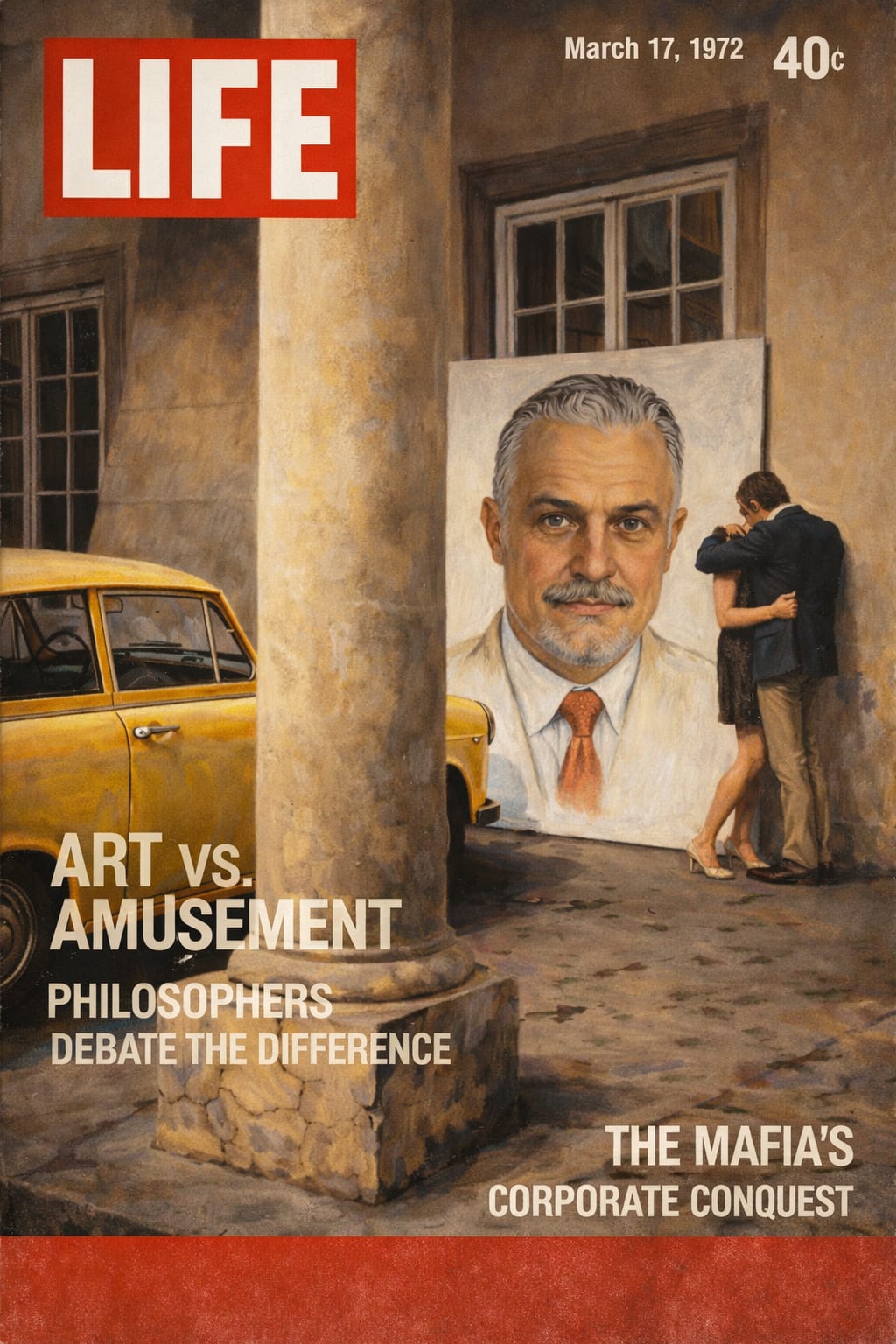
Human beings constantly produce objects, images, sounds and stories that attract attention and provoke reaction. Some of these experiences are described as amusement or entertainment, while others are called art. The distinction between the two has long occupied philosophers, critics and creators, yet the boundary remains uncertain. Both can delight, disturb, inspire or exhaust the human senses. Both are built from the same physical materials: pigment on canvas, vibrating air in music, words on a page, or moving light on a screen. The difference therefore cannot lie in the material itself. The same paint can form a masterpiece or a decorative poster; the same sequence of sounds can be a symphony or a jingle. The difference emerges from how humans use and experience these objects.
Amusement is primarily oriented toward immediate pleasure. Its purpose is to entertain the audience and provide a predictable emotional reward. Amusement does not ask much from the observer. It offers stimulation that is easy to consume and quickly understood. A comedy routine, a pop song designed for instant repetition, or a spectacle constructed to provoke laughter or excitement all operate according to this logic. The goal is satisfaction. The audience is the centre of gravity, and success is measured by how effectively the work produces enjoyment.
Art, by contrast, is usually associated with expression rather than satisfaction. Instead of merely pleasing an audience, it attempts to communicate a vision, a perception, or a question about human existence. Art may provide pleasure, but pleasure is not its only or even its primary function. It can disturb, irritate, or challenge the observer. Where amusement often confirms expectations, art frequently disrupts them. It calls attention to something that may otherwise remain invisible: an emotion, an idea, a tension in reality that ordinary perception tends to ignore.
This difference in intention shapes the emotional and intellectual impact of each form. Amusement often functions as distraction. After a day of work, many people seek entertainment precisely because it allows them to forget themselves for a while. The experience is brief and restorative. It provides a controlled escape from effort, tension, or responsibility. Amusement therefore operates within familiar patterns. Its pleasure depends on recognition and repetition. A joke works because the audience understands its structure; a pop song succeeds because its rhythm and melody follow expectations that listeners already know.
Art, however, rarely aims at distraction. Instead, it tends to intensify awareness. Rather than allowing the viewer to forget themselves, it often forces them to notice themselves more sharply. A painting may provoke unease, a novel may expose moral contradictions, a film may reveal aspects of life that are uncomfortable or difficult to articulate. The experience may even be unpleasant in the short term, yet memorable in the long term. Art frequently leaves a mark precisely because it interrupts the smooth flow of everyday perception.
Another distinction often invoked in aesthetics concerns time. Amusement usually belongs to its own historical moment. It is closely tied to fashion, cultural trends, and the immediate desires of a particular audience. Many forms of entertainment that once dominated popular culture vanish quickly when tastes change. A comedy that delighted millions ten years ago may feel outdated today. The success of amusement depends heavily on the present.
Art, by contrast, is often expected to survive beyond the moment of its creation. Works that continue to speak across generations are usually described as art rather than mere entertainment. Their themes, forms, or emotional depth allow them to resonate even when the cultural context has changed. A tragedy written centuries ago may still move audiences because it touches aspects of the human condition that remain recognisable. The durability of art is therefore not simply a matter of age; it reflects a deeper engagement with experiences that persist across time.
A further difference concerns the relationship between creator and audience. Amusement tends to be audience-centred. Its design begins with a question: what will people enjoy? Producers of entertainment carefully measure audience reactions and adjust their work accordingly. If the audience laughs, applauds, or pays for tickets, the work is considered successful. Entertainment industries are structured around this feedback loop. The value of the work is determined largely by reception.
Art is often more creator-centred. The act of making becomes central. A painter may pursue a particular form or colour combination regardless of whether anyone immediately appreciates it. A composer may experiment with sound structures that confuse or even repel listeners at first. In this sense, art does not necessarily depend on immediate approval. The work may acquire meaning or recognition long after its creation. The creative process itself becomes part of the value of the work.
Philosophers have approached this distinction in different ways. Some thinkers argue that art is fundamentally an expression of emotion. According to this view, the artist does not simply manufacture a reaction in the audience but clarifies a feeling that previously existed only in a vague or unconscious form. Through artistic creation, emotion becomes intelligible both to the creator and to others. Amusement, by contrast, produces predetermined reactions rather than exploring genuine emotional discovery.
Another perspective emphasises communication. Art can be understood as a form of transmission in which one individual shares an inner experience with others. When the transmission succeeds, the audience participates in the emotion or perception that gave rise to the work. Entertainment, in this interpretation, often imitates the outward forms of art without necessarily carrying such inner communication. It may simulate emotion rather than express it.
Yet the boundary between amusement and art is not stable. Many works contain elements of both. A film can entertain while simultaneously exploring complex ideas. A piece of music may offer immediate pleasure while also revealing intricate structure upon repeated listening. Popular culture repeatedly demonstrates that entertainment can evolve into art when its expressive dimension deepens or when its significance becomes visible over time.
The question of intention complicates the matter further. Suppose an artist produces a work primarily for profit. Does that transform the work into entertainment? Some aesthetic theories suggest that it does. If the creator’s goal is simply to provoke a predictable reaction that will sell, the work may be closer to craft or amusement than to art. The creator becomes a technician delivering a desired effect rather than an explorer discovering meaning through creation.
Other critics reject this emphasis on intention. They argue that the motives of the creator do not determine the nature of the work. A painting produced for commercial reasons may still generate powerful experiences for viewers. If it provokes reflection, emotion, or new perception, it functions as art regardless of the artist’s personal motives. In this view, the meaning of the work emerges through the encounter between object and observer rather than through the psychology of the creator.
A further complication arises from the nature of experience itself. Human attention is limited. When a person walks through a vast museum filled with thousands of paintings, only a small number of them can be experienced intensely. After a certain point the mind becomes saturated, and masterpieces begin to blur into visual noise. The capacity to perceive art is therefore not infinite. It depends on the biological limits of the observer. A painting that provokes deep reflection in one moment may appear as mere decoration when the viewer is exhausted.
This fact suggests that the distinction between art and amusement is partly situational. The same object may function differently depending on the state of the observer. A visitor who carefully studies a painting may experience it as art, while another who glances at it quickly may experience it as mere visual amusement. The object itself remains unchanged, but the experience shifts.
Social context also plays a role. Cultural institutions such as museums, galleries and theatres create rituals that encourage people to treat certain objects as art. Visitors walk slowly, speak quietly, and adopt gestures of contemplation. These behaviours reinforce the idea that the objects deserve a particular kind of attention. Without such conventions, the same objects might appear no different from countless other visual stimuli encountered in daily life.
Nevertheless, even if conventions shape perception, the experience itself cannot be entirely reduced to social ritual. Certain works repeatedly provoke strong reactions across different cultures and historical periods. People who have never met one another can encounter the same painting or piece of music and report similar feelings of intensity, recognition or disturbance. This recurring pattern suggests that art taps into aspects of human perception that are deeper than mere fashion.
The difference between amusement and art therefore lies less in the object itself than in the depth of engagement it invites. Amusement provides stimulation that is quickly consumed and easily replaced. Art tends to create experiences that linger, provoke thought, and alter perception. Amusement occupies time; art transforms the way time is experienced.
Both, however, remain part of the same human activity. People create, observe, and respond to patterns of sound, image and narrative in order to structure their experience of the world. Sometimes the result is brief entertainment. Sometimes it becomes a work that continues to resonate long after the moment of its creation. The difference between amusement and art is therefore not absolute. It emerges from the encounter between human attention, creative intention, and the unpredictable ways in which experience unfolds over time.
About the Creator
Peter Ayolov
Peter Ayolov’s key contribution to media theory is the development of the "Propaganda 2.0" or the "manufacture of dissent" model, which he details in his 2024 book, The Economic Policy of Online Media: Manufacture of Dissent.
Keep reading
More stories from Peter Ayolov and writers in Critique and other communities.
"The Shell in the Ghost, I Am Major"
In 2017, Hollywood did something predictable and scandalous at the same time: it remade the Japanese cyberpunk classic Ghost in the Shell and placed a blonde American star at its centre. The actress was Scarlett Johansson. Critics argued about cultural appropriation, about empire, about whether the United States had once again absorbed a foreign myth and refashioned it in its own image. Yet beyond the controversy, the American Ghost in the Shell remains a philosophically provocative film. It forces a simple but radical question: what is a human being made of?
By Peter Ayolov4 days ago in Critique
‘We have enough’: Godfrey renews call for Black entertainers to stop seeking white validation after BAFTAs, praises Image Awards
DEI must die. It’s been far too long for Foundational Black Americans (FBA) and tethers to come up and say things like #OscarsSoWhite. So what? NAACP Image awards are about RAH, Representation, Agency, and Honor. Black people have to stop crying about their snubs at award shows that often overlook them.
By Skyler Saunders3 days ago in Critique
Rachel Reviews: Lakefront Wolves by Joseph Deegan
Meet Finn. He's an 18 year old kid who has potential. He's bright with great school scores and he's also an athlete, a footballer of some prowess. He has it all going for him, it would seem, and yet, he's determined to send what could be a well-planned, stable existence firmly off the rails. He drinks, he smokes, he takes drugs, he has violent tendencies and he's in danger of losing not only his mind but all that he holds dear.
By Rachel Deeming6 days ago in BookClub




Comments
There are no comments for this story
Be the first to respond and start the conversation.