
Autotune Tears
The Hypocrisy of Artists in the Age of AI
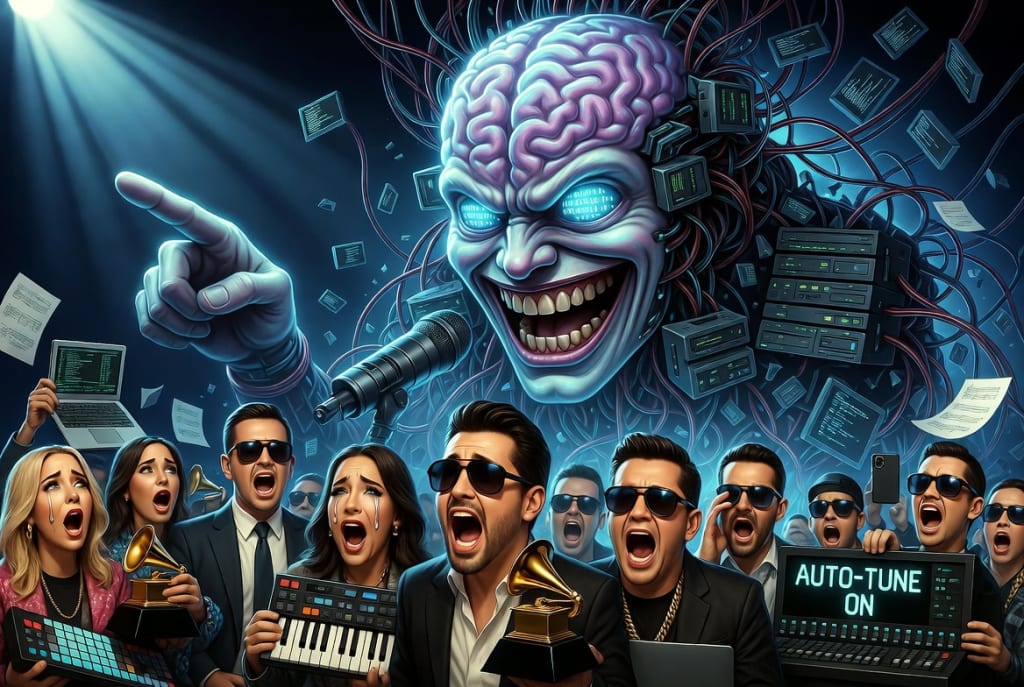
Digital Tears and Ghosts in the Studio
The script has become a seasonal awards-show classic: an established artist, face solemn and trophy in hand, uses their acceptance speech to denounce the latest technological heresy. Today, the monster is artificial intelligence (AI)—a soulless threat, a soul-less automaton poised to usurp human creativity and devalue artists’ livelihoods. Yet this moral panic is not new; it is merely the latest chapter in the music industry’s long, repetitive history of resisting progress—a predictable cycle of fear, rejection, and, inevitably, assimilation.
The central thesis of this analysis is that this loud opposition is profoundly hypocritical. The very artistic community now tearing its garments has spent decades embracing, refining, and profiting from an extensive arsenal of technological tools that alter, augment, and even fabricate musical “perfection.” From pitch correction to the creation of nonexistent sonic spaces, technology has served as the silent—and at times not-so-silent—partner to modern creativity.
So, before we join the chorus of lamentations, we must ask: If we were to step inside the studio of one of these so-called “pure” artists, what tools would we actually find?
1. The “Pure” Artist’s Toolbox: A Tour of Open Secrets
To dismantle the myth of the “unprocessed” artist, we need only examine the technological crutches that have long since become standard—and accepted—practice in music production. Far from being mere accessories, these tools form the very foundation of today’s commercial sound. This arsenal reveals that the “pure” recording is not a lost ideal but a marketing myth that never existed.
The Robotic Confession: The Legacy of Auto-Tune
Few technologies encapsulate this hypocrisy better than Auto-Tune. Its origin is deliciously ironic: Dr. Andy Hildebrand, a geophysicist, adapted seismic imaging technology—originally used to locate oil reserves—and applied it to the human voice. The result was software capable of pitch correction, an algorithm that could locate and “extract” the perfect note.
Auto-Tune has played a dual role in the industry:
The Industry’s Dirty Secret: Used subtly, it became the “plastic surgery” of vocals, smoothing imperfections and ensuring mathematical pitch perfection. Critics note that it functions as a “cash cow for producers,” enabling performers whom musically trained ears deem mediocre—or worse, utterly incapable of singing—to enjoy successful careers.
The Obvious Effect: Popularized by Cher in “Believe” and later by T-Pain, Auto-Tune evolved into an explicit creative effect: a robotic sonic signature that defined an era of pop and hip-hop.
In essence, Auto-Tune was the first widely adopted “AI” for the human voice—a tool designed to iron out the organic “imperfections” that, ironically, many artists now defend as the last bastion of humanity in music.
Beyond Pitch: The Alchemy of the Modern Studio
But the technological arsenal extends far beyond pitch correction. The modern studio is a laboratory where “natural” sound serves only as raw material for deep digital and analog alchemy.
Artificial Reverb: Before digital plug-ins, engineers created echo by routing sound into physical chambers. Soon, mechanical systems allowed them to fabricate acoustic environments that didn’t exist in reality. Plate reverb units—like the legendary EMT 140, whose dense echo graces Pink Floyd’s “Time”—used a vibrating metal sheet to produce a warm, cathedral-like ambience. Spring reverb, immortalized by dub pioneers like King Tubby, employed metal springs to generate a metallic, otherworldly echo. These are not “natural” sounds; they are sonic ghosts, impossible architectures built from springs and metal, giving voices the grandeur of cathedrals the singers never entered.
Compression: Compression is the benevolent tyrant of mixing—flattening a vocal’s dynamic range so no whisper goes unheard and no shout overloads the system, resulting in an unwavering, superhuman presence. The outcome is polished consistency, but also complete unnaturalness: a voice that never fluctuates, never breathes irregularly, never falters.
Editing and “Splicing”: Magnetic tape revolutionized music by enabling engineers to cut and paste fragments from different takes. Artists like Les Paul and Mary Ford pioneered editing and multitracking to construct “perfect” performances that never happened in a single take—building virtual ensembles of their own voices and instruments. This technique is the direct ancestor of modern digital production.
Sampling: Here, hypocrisy becomes flagrant. Sampling—the practice of lifting fragments from other artists’ recordings, often without permission—is a cornerstone of genres like hip-hop and industrial music. Functionally, it is identical to what AI models do: scraping existing data to create something new. Plainly put, it is “cultural theft disguised as innovation.” The industry built empires on this ethical precedent—the very precedent it now conveniently declares unacceptable for AI.
This toolbox proves that the notion of a “pure” recording is pure fiction. Yet technology’s influence on the very definition of art dates back to an even more fundamental invention.
2. The Ghost in the First Machine: How Technology Already Redefined “Art”
To grasp the historical naïveté of today’s panic, we must look beyond digital studios and return to the invention that forever changed what it means to be a “great singer”: the microphone. Its arrival didn’t merely alter how music was recorded—it wholly redefined vocal artistry itself.
In the pre-1920s acoustic recording era, the process was purely mechanical. Singers had to project their voices with lung-bursting force—almost shouting—into a large horn that funneled sound waves onto a diaphragm. Mix balance wasn’t achieved with faders but by physically repositioning musicians: louder players stood farther from the horn, quieter ones stepped closer. Cellos were often replaced with brass instruments; drums were substituted by a block of wood to avoid overloading the system.
The arrival of the electric microphone in the 1920s was revolutionary. Suddenly, singers no longer needed to shout. Technology could now capture subtle nuances and low-amplitude expressions. This gave rise to crooning—an intimate, conversational vocal style. Artists like Bing Crosby and Frank Sinatra became superstars not for vocal power, but for their ability to convey emotion and forge a sense of personal connection, as if whispering directly into the listener’s ear.
Yet this seismic shift was met not with open arms, but with fierce controversy from surprisingly diverse quarters:
The Catholic Church: Cardinal O’Connell of Boston publicly condemned crooning as “dangerous,” a corrupting influence on youth morality.
Voice Teachers: They feared the new style—requiring less lung development—would cause the “American chest” to shrink, physically weakening a generation.
The microphone’s history is irrefutable proof that technology does not merely capture art; it transforms it, redefines it, and creates new paradigms of what is considered valuable. The “belt singers” of the acoustic era gave way to the “crooners” of the electric age. Viewed through this lens, today’s AI panic appears less a defense of art, and more a reactionary defense of a technological status quo that is already obsolete.
3. The Luddite Fallacy: When Progress Sounds Like a False Alarm
Fear of job loss and artistic devaluation is not unique to music—it echoes every major technological leap in human history. Placing today’s debate in this broader context exposes the deeply conservative—and ultimately unsustainable—nature of resistance to change. The logic of halting progress to preserve old methods, if applied consistently, leads to absurd conclusions.
Consider these rhetorical questions:
Should we eat only artisan-baked bread and ban industrial bakeries to protect bakers’ livelihoods?
Should we abandon cars and return to horse-drawn carriages to save coachmen’s jobs?
Should medieval scribes have outlawed Gutenberg’s printing press to protect their “artistic vision” and years of painstaking labor?
The clearest historical parallel is the Industrial Revolution. The weavers who smashed mechanical looms—the original Luddites—weren’t irrational; they were defending their livelihoods against technology that rendered them obsolete. But did they weep with the same performative intensity as today’s artists? Unlikely—they lacked the luxury of sobbing on TikTok between gigs. Demanding that an entire field of development freeze in time to protect current practitioners is profoundly reactionary. While technological shifts undeniably displace jobs, they also create entirely new roles and possibilities. History proves that adaptation—not prohibition—is the only viable strategy.
Mocking this resistance, however, does not resolve the problem. Though often hypocritical, the panic conceals legitimate concerns that the industry ignores at its own peril.
4. The Real Debate We’re Avoiding
While moral panic over “artistic purity” is a dead end, it serves as a smokescreen, obscuring the crucial conversation the music industry must have. Setting aside rhetoric about the “soul” of music allows us to focus on the tangible, complex challenges AI poses.
The real debate is not about purity, but compensation and copyright. The core question is: How do we fairly compensate creators whose work is used to train AI models? Sampling cracked this Pandora’s box decades ago; AI has simply made it impossible to ignore. The industry must develop new licensing and revenue-sharing models that acknowledge the value of training data—rather than hiding behind a hypocritical defense of originality.
This leads to a deeper philosophical question: What constitutes “art”? Does it require the emotional intention of a human creator, or is it defined by the emotional response it evokes in an audience? A sunset has no human creator, yet it is universally regarded as beautiful and inspiring. If an AI-generated piece moves a listener, is it less valid than a human-written song that leaves its audience indifferent? The insistence that art must stem from human experience seems, at best, profoundly limited.
Ultimately, AI represents the ultimate fulfillment of Andy Warhol’s project: it doesn’t merely commodify art—it commodifies the creative act itself. AI tools democratize the ability to produce “good-enough” content, turning creation into an accessible utility. This not only challenges the artist’s labor—it calls into question the very idea that specialized technical skill is the gatekeeper to creative expression.
5. Conclusion: The Unstoppable Algorithm—and the Next Tantrum
The conclusion is as inevitable as technological progress itself. The image of artists mourning the rise of soulless machines, while standing on a stage built atop decades of technological artifice, is the perfect portrait of industry hypocrisy. The microphone granting intimacy, the multitrack enabling perfection, and Auto-Tune correcting flaws—all are ghosts in their own machine.
AI is not the end of music; it is simply the next tool. In principle, it is no different from the synthesizer, the sampler, or the drum machine. It will not “destroy” creativity—rather, it will transform it, spawning new genres and aesthetics we can barely imagine today. Just as the microphone birthed the crooner, AI will generate its own artistic archetypes.
Thus, we can predict with high confidence: many of the same artists now bitterly denouncing AI will be the first to adopt it as an indispensable creative tool—as soon as it becomes commercially viable. And they will do so just in time to co-write (with AI) a heartfelt ballad about the soulless threat of the next technology poised to disrupt their newly profitable workflow.
The cycle, it seems, is doomed to repeat—again and again.
About the Creator
Francisco Navarro
A passionate reader with a deep love for science and technology. I am captivated by the intricate mechanisms of the natural world and the endless possibilities that technological advancements offer.
Keep reading
More stories from Francisco Navarro and writers in Critique and other communities.
If Anyone Builds It, Everyone Dies
5 Disturbing Truths From the Book Claiming AI Will End Humanity Last year in Alameda, California, city officials halted a scientific experiment designed to combat global warming. The plan was to spray microscopic salt particles into the clouds to make them brighter and reflect more sunlight. Fearing unintended consequences for the regional ecosystem, they shut it down.
By Francisco Navarro5 months ago in Futurism
Completed Draft
When is a piece of writing finished? It’s a question with as many different answers as writers. For me, a work is finished when it can’t be improved anymore. Almost everything I have posted here is still in drafting (not draft; they’re posted). Even when I think a work is finished, I read it again, usually finding something I can improve or tighten.
By Harper Lewis3 days ago in Critique
Pearl
1980 something. we all hung out at Pearl and you and i were nothing special, or so i thought. i mean we all danced, drenched in our own sweat, our own saline solution of fear, too many beers, shots, laughter, tears, fucks in the bathroom and i don't know when we began to be afraid. do you?
By ROCK aka Andrea Polla (Simmons)3 days ago in Fiction


Comments
There are no comments for this story
Be the first to respond and start the conversation.