
Why Colombia is losing the cocaine war
Lives in the Jungle Caught in the Crossfire of Colombia's Drug War

Amidst the vast expanse of the Amazon rainforest in southern Colombia, there exists a plant of utmost significance - coca. Standing amidst these coca fields, I accompany the anti-narcotic police on their arduous mission to obliterate these plants that have fueled the global drug trade.
Coca, harvested by local farmers, undergoes a series of meticulous processes, being shredded, soaked in chemicals, and ultimately transformed into a paste. This paste then finds its way to cartels, who convert it into the notorious white powder known as cocaine, with a major portion ending up in the United States.
But beyond the realm of cartels and drug trafficking, there lies a poignant narrative about the families deeply entwined in cultivating this leaf in the heart of the Colombian jungle. These families bear the brunt of the cocaine economy and are ensnared in the crossfire of Colombia's relentless war on drugs.
During my time with the anti-narcotic police, we traverse the dense jungle in search of coca farms. After several attempts, we stumbled upon a coca farm managed by a family. To our surprise, there are no guns, no resistance - just a group of children playing. Next to their modest house stands a shed, wherein they diligently shred the leaves, which are now soaking in chemicals - the last step before they are sold to cartels. However, the police's intention is not to arrest them but to dismantle their operation.
We witness the devastation we cause, realizing that we have obliterated six months of this family's hard work - their primary source of income. It becomes apparent that these coca farms contribute significantly to a perilous cocaine industry, wreaking havoc on tens of thousands of lives annually.
The Colombian government has adopted two primary strategies to combat coca cultivation: aerially spraying chemical herbicides to annihilate the fields and deploying troops to manually destroy the crops. However, both methods have grave consequences, as the chemicals indiscriminately affect not only coca but also other crops and the rich biodiversity of the rainforest. Furthermore, the chemicals are potential sources of health risks for the residents of these areas. As a result, the Colombian government suspended the chemical dumping strategy in 2015, seeking alternative solutions.
In response, the government introduced the crop substitution program, offering financial incentives to farmers who voluntarily abandon coca cultivation and transition to legal crops such as oranges, pineapples, or yuca. I ventured into a community that was once a hub for coca production, now embracing this program. However, the transition was far from smooth, as the lack of infrastructure, security, and reliable markets hindered their efforts.
One family's success story growing passion fruit exemplified the potential of the crop substitution program. However, it became apparent that not all farmers possessed the resources or vast land to transition easily. The true solution lies in the government's commitment to invest in connecting these remote communities to the broader economic network, enabling legal economies to flourish.
In conclusion, the narrative of coca extends beyond drug trafficking and cartels; it encompasses the lives of struggling families ensnared in the web of the cocaine economy. Effective and lasting change can only come through holistic efforts to uplift these communities and provide them with sustainable alternatives. Until then, farmers will continue to be drawn to the only economy that sustains them.
As I reflect on my journey through Colombia - from the border regions to the heart of the jungle - I am filled with a deep appreciation for the lessons I have learned. The untold stories of these resilient communities, fighting to survive amidst adversity, have left an indelible mark on my understanding of this complex nation.
Every step of this expedition has broadened my horizons from the borders, where life intertwines across nations, to the intriguing tale of the hippos in Colombia, and the captivating world of a new musical genre. Additionally, the joyous experience of sampling delectable fruits in Bogota has been a delightful highlight of my journey.
Thank you for joining me on this incredible journey, and I look forward to discovering more captivating stories together in the future.
About the Creator
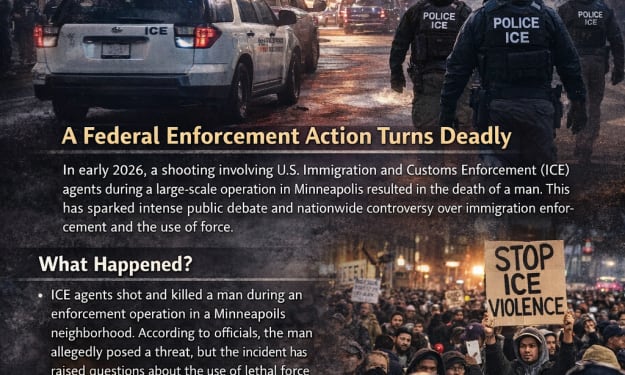
The ICE Shooting in Minneapolis A Closer Look at Federal Enforcement and Rising Tensions
The ICE Shooting in Minneapolis A Closer Look at Federal Enforcement and Rising Tensions In early 2026, Minneapolis found itself at the center of national attention following a shooting involving agents from U.S. Immigration and Customs Enforcement, widely known as ICE. The incident quickly moved beyond a single law enforcement encounter and became a symbol of broader debates surrounding immigration policy, federal authority, and the use of force in American cities. As details emerged, the shooting sparked intense public discussion, protests, and renewed scrutiny of federal operations carried out within local communities.
By America today about 23 hours ago in Criminal
Man Escaped Death Row, But He Could Not Escape Death: The Story of Troy Leon Gregg
The story of Troy Leon Gregg is one of the most haunting and ironic episodes in the history of the American criminal justice system. It is a narrative that seems almost fictional in its cruel symmetry: a man sentenced to die by the state escapes death row mere hours before his scheduled execution only to lose his life later that same night in a violent confrontation. Gregg’s story continues to resonate not only because of its dramatic events, but also because of the deeper questions it raises about fate, justice, violence, and the limits of human escape.Troy Leon Gregg was a death row inmate in the state of Georgia, convicted of serious crimes that ultimately led to a capital sentence. After years of legal proceedings and appeals, his execution date was set. For the prison system it was meant to be the final chapter in a long process. For Gregg, however the night before his execution would take an unexpected and shocking turn.
By Kure Garba6 days ago in Criminal



Comments