
Whispers in the Cell: The Murderer Who Painted Butterflies
How Art Became the Language of Redemption in the Life of a Convicted Killer
Introduction
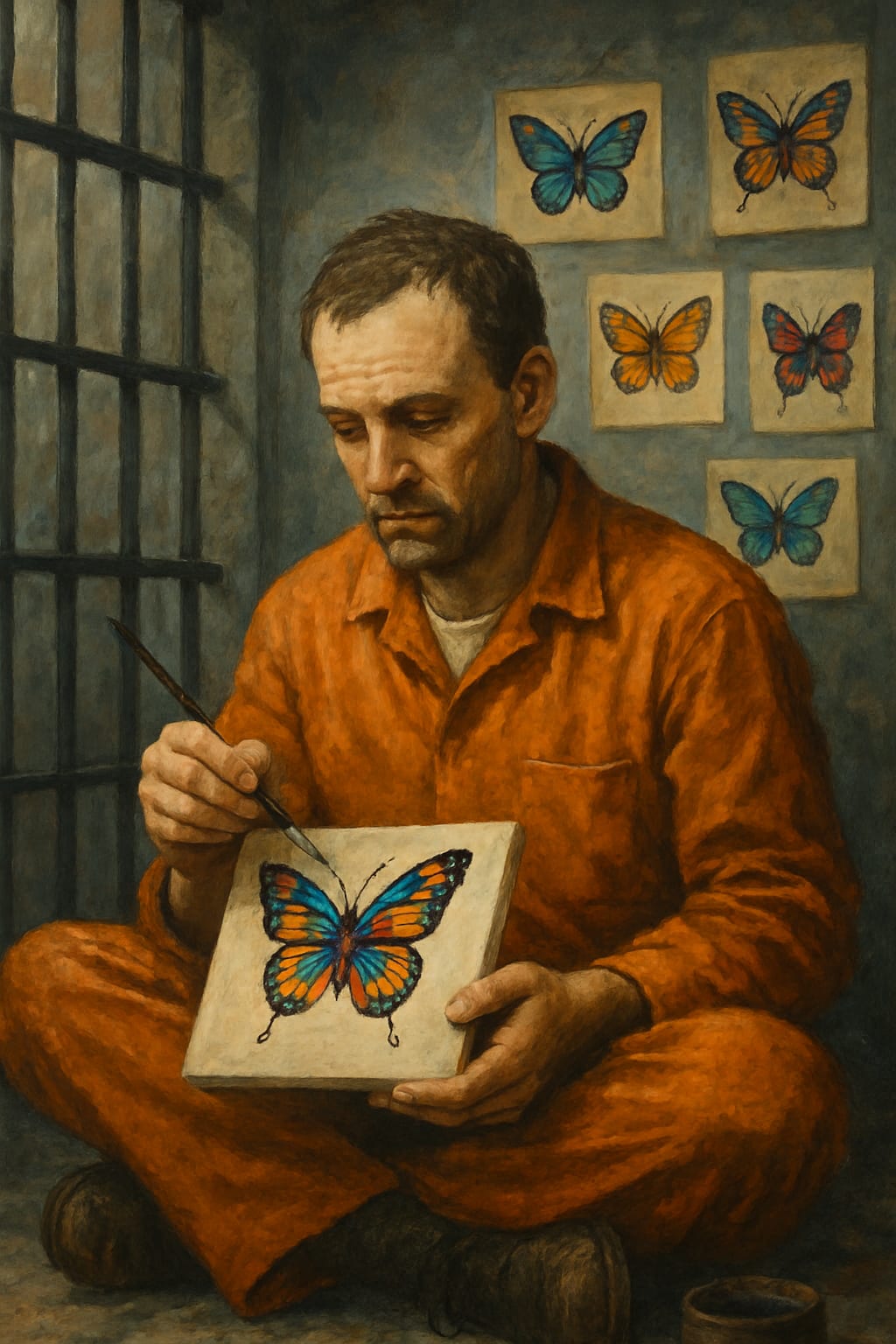
In the dim silence of a maximum-security prison cell, a man sits cross-legged on the floor, a small canvas balanced on his knees. Around him, instead of walls soaked in anger or despair, hang vibrant paintings—each one a delicate butterfly captured mid-flight, wings spread in intricate patterns of color. This man, known to the world as a murderer, is now quietly becoming something else entirely: an artist. His story is not one of innocence or forgiveness, but one of transformation. It is a tale that echoes through prison bars, art galleries, and the hearts of those who still believe that even the darkest souls can seek light.
“Whispers in the Cell: The Murderer Who Painted Butterflies” is a real-life narrative that blurs the lines between crime and creativity, punishment and purpose, evil and expression. This article explores the journey of a man once known for taking life, now known for capturing it—in the form of fragile butterflies painted with aching beauty.
The Crime That Silenced a Town
Years ago, in a small Midwestern town, the man—let’s call him Daniel, to protect the identities of the people involved—was convicted of a brutal murder. The crime shocked the community. A young woman had lost her life under violent circumstances, and Daniel, then in his late twenties, was arrested, tried, and sentenced to life in prison without parole.
There was no doubt of his guilt. The evidence was overwhelming, and Daniel never denied his actions. But the question that haunted many, especially the victim’s family, was why he did it. That question, like a heavy fog, hung over the courtroom and the town for years.
Daniel, once described as quiet but intelligent, showed no emotion during the trial. He entered prison as another name in the system, another story swallowed by steel doors and fluorescent lights.
The Unexpected Birth of an Artist
Years passed. Daniel remained silent, not just with the world but within himself. He rarely spoke to guards or other inmates. He declined all interview requests and never took part in prison programs.
But then, something shifted.
It began with a scrap of paper and a pencil stub. An inmate teaching a basic art class noticed Daniel sketching quietly during his free time. When the class ended, Daniel stayed behind and asked for more paper. What he produced in the following weeks stunned even the hardened prison staff.
He wasn’t drawing skulls or abstract shapes. He wasn’t scribbling violent scenes. He was drawing butterflies—delicate, precise, and somehow full of sorrow and hope at once.
Word spread. Guards started calling him “the Butterfly Guy.” Eventually, Daniel was allowed access to paints and canvas through a prison rehabilitation art program. His cell transformed into a tiny gallery. Each butterfly he painted was unique, bursting with color, carrying a haunting sense of fragility.
When asked why butterflies, Daniel answered simply, “Because they are born in darkness, and they don’t stay there.”
Art as Therapy and Expression
Psychologists and prison officials began paying attention. Daniel’s transformation wasn’t just a hobby—it was psychological healing in action. He started participating in art therapy sessions, opening up about his past, his guilt, and the unbearable weight of remorse he carried every day.
He didn’t paint for forgiveness. He painted because it was the only way he could speak anymore. The butterflies, to him, represented a part of himself that he thought had died—the part capable of gentleness, of seeing beauty, of choosing life.
A prison counselor described Daniel's case as “the most remarkable artistic rehabilitation I’ve ever witnessed.” She explained that painting helped Daniel confront his inner world, one he had buried under anger, trauma, and silence.
From Prison Walls to Public Eyes
Eventually, Daniel’s artwork caught the attention of an outside volunteer who worked with prison arts initiatives. With Daniel’s reluctant permission, a collection of his butterfly paintings was displayed anonymously at a small gallery under the title: “Wings of Regret.”
The response was overwhelming. Visitors were moved by the honesty and pain in the art. Some knew the story behind the paintings, others didn’t. But the art spoke for itself. It whispered stories of grief, change, and something many found unexpected—hope.
Profits from the show were donated to victim support charities, as Daniel requested. He refused to make a single cent from the paintings. “I took something priceless from someone,” he wrote in a letter, “I won’t take anything more.”
A Complicated Redemption
Daniel’s story sparked debates. Some saw it as a sign that people can change. Others believed it was an insult to the victim’s memory to allow a killer’s work to be admired.
And those opposing views are valid. Redemption, especially in cases of such deep harm, is never simple. Daniel has never asked for release or sympathy. He acknowledges that he deserves every day of his sentence. But he also believes that punishment should not be the end of one’s humanity.
In an essay published through a prison writing program, Daniel wrote, “If I can no longer live a free life, maybe I can live a useful one. If my art can bring peace to someone, or even just remind them to see beauty in broken places, then I’ve done something better than before.”
Conclusion: Wings Inside the Walls
The story of “Whispers in the Cell” is not a fairy tale. The man at its center is not a hero. But he is no longer only a villain. Through the quiet ritual of painting butterflies, Daniel found a way to speak the language of transformation.
His cell remains locked, but on its walls, butterflies fly.
This story invites us to wrestle with uncomfortable questions: Can someone guilty of great harm still contribute something meaningful? Can beauty emerge from deep pain? Should we accept the art, even if we cannot accept the artist?
There are no easy answers. But one thing is certain—the whispers in Daniel’s cell have become louder than silence. And they sound like the flutter of painted wings.
About the Creator
Idea hive
Article writer and enthusiast sharing insight and knowledge on nature, human behavior, technology, health and wellness, business, culture and society and personal development.
"I Lied, I Loved, I Let Go: A Confession Years in the Making"
Introduction: The Weight of an Unspoken Truth Some truths are not easy to tell. They sit in the heart like stones, heavy and unmoving. We carry them for years, hoping time will lighten the load. But it doesn’t. Instead, they grow heavier with silence. This is a story about one of those truths — a confession I’ve carried for too long. It is about a lie that changed everything, a love that felt real and raw, and the painful yet necessary act of letting go. Writing this is not about seeking forgiveness. It’s about finally finding freedom.
By Idea hive7 months ago in Confessions
Lured, Killed, Decapitated – A Jealous Husband’s Brutal Crime in the Woods
In a chilling case that unfolded in rural New Hampshire in September 2020 Britany Barron then 33 was found guilty of falsifying physical evidence connected to the brutal murder of her co-worker Jonathan Amerault. The crime involved her husband Armando Barron 32 at the time who became convinced she was having an affair with Amerault after discovering flirtatious messages on her phone. This jealousy-fueled rage led to a violent chain of events that ended in kidnapping, torture shooting, decapitation and attempts to conceal the body.The tragedy began on the night of September 19-20 2020 in Jaffrey New Hampshire where the Barrons lived. Armando reportedly abusive in the marriage confronted Britany over Snapchat exchanges with Amerault a 25-year-old attractive co-worker from Keene. Enraged, Armando allegedly used Britany's phone to lure Amerault to Annett Wayside Park (also known as Annett State Park) in Rindge New Hampshire—a secluded spot just north of the Massachusetts border—under the pretense of meeting her.
By Kure Garba7 days ago in Criminal


Comments
There are no comments for this story
Be the first to respond and start the conversation.