
Trump claims mantle of FDR’s first 100 days, but differences are stark
"While echoing Roosevelt's ambition, Trump's early presidency reveals contrasting priorities and approaches."
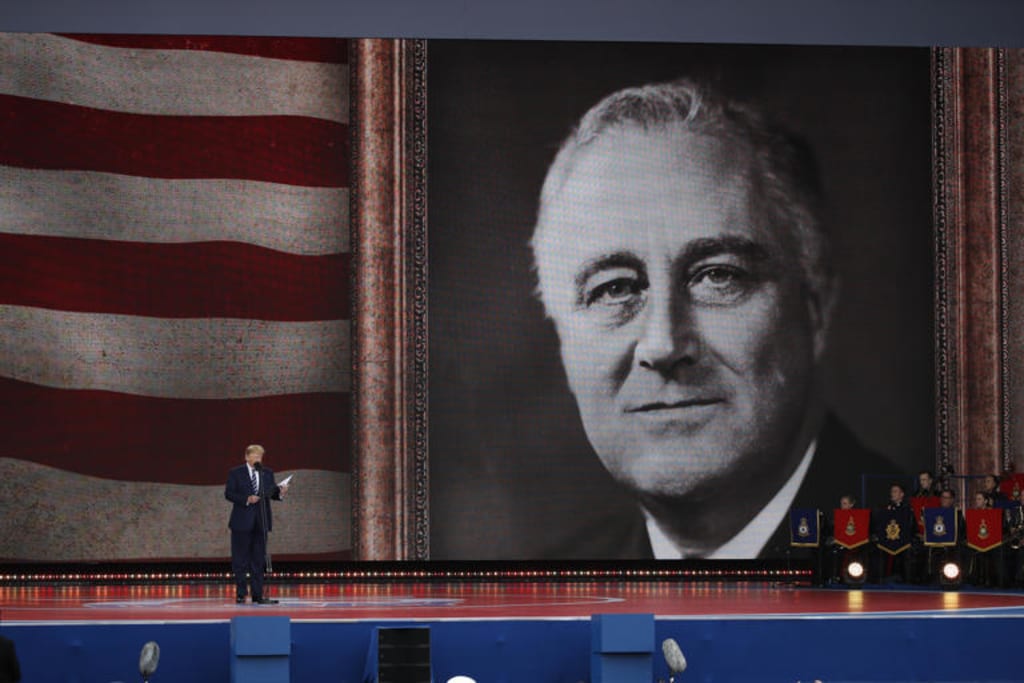
In early 2017, as President Donald Trump settled into the White House, he made frequent and bold comparisons between his presidency and that of Franklin Delano Roosevelt (FDR), especially regarding the landmark "First 100 Days" — a term that has become an enduring measure for presidential success. Trump, a master of branding and messaging, sought to position himself as a transformative figure on par with Roosevelt, whose early months in office during the Great Depression set a precedent for sweeping action and powerful executive leadership.
FDR's First 100 Days in 1933 were marked by a frenzied pace of legislative activity. Confronted with an economic catastrophe of unprecedented magnitude, Roosevelt acted quickly and decisively. In just over three months, he and his Democratic Congress passed 15 major pieces of legislation, reshaping the American financial system, providing relief for the unemployed, and restoring faith in the federal government. The New Deal policies launched during this period, including the Emergency Banking Act, the Agricultural Adjustment Act, and the Civilian Conservation Corps, represented a fundamental shift in the relationship between the American people and their government.
By contrast, Trump’s first 100 days were defined more by executive actions, regulatory rollbacks, and political turbulence than by major legislative achievements. While he signed a flurry of executive orders aimed at fulfilling campaign promises — from immigration restrictions (such as the controversial travel ban) to deregulation efforts — he struggled to push substantial legislation through a Republican-controlled Congress. His most ambitious early goal, repealing and replacing the Affordable Care Act (commonly known as Obamacare), stalled in the House of Representatives despite the GOP's majority.
Moreover, Trump’s approach to governance differed sharply from Roosevelt’s in tone and method. FDR was a consummate communicator, using his famous "Fireside Chats" to explain complex policies in simple, reassuring language that built public confidence. Trump, by contrast, often relied on combative tweets and campaign-style rallies, fostering a polarized and volatile political climate.
Policy-wise, the contrast between the two presidents was even more pronounced. FDR expanded the role of government dramatically, introducing social safety nets and regulatory frameworks designed to stabilize capitalism and protect the vulnerable. Trump’s early actions, conversely, aimed to shrink the federal government’s role in the economy and society, emphasizing deregulation, tax cuts, and border security. Where FDR sought to build new institutions to serve the public, Trump sought to dismantle many regulations and initiatives put in place by previous administrations, particularly those of Barack Obama.
Another key difference was the broader historical context each president faced. Roosevelt assumed office at a moment when Americans demanded radical action; the failures of previous leadership had created a rare political opening for bold experimentation. Trump entered office during a time of relative economic growth but deep cultural and political division. His promises to "drain the swamp" and shake up Washington resonated with many voters who felt alienated from the political establishment, but the urgency and unity that buoyed FDR were largely absent.
Despite these stark contrasts, Trump frequently cited the volume of actions taken in his early days as evidence of historic achievement. His administration released a 100-day action plan titled "Contract with the American Voter," listing promises on issues from ethics reform to infrastructure investment.
In sum, while Donald Trump eagerly embraced the symbolism of FDR’s First 100 Days — using it as a benchmark to frame his presidency as revolutionary — the comparison does not hold up under scrutiny. Roosevelt’s early presidency was characterized by coherent, systemic change crafted in response to existential national crises. Trump’s early tenure, in contrast, was marked by executive unilateralism, partisan division, and an uneven record of achievement. The differences between the two leaders highlight not only their contrasting visions of governance but also the vastly different political landscapes they navigated.
About the Creator
Keep reading
More stories from Md. Mominul Islam and writers in Criminal and other communities.
Trump Threatens to Suspend Habeas Corpus to Bypass Judges Blocking Deportations
When former President Donald Trump, who is now running for president again, threatened to suspend habeas corpus rights to circumvent judges who were preventing his administration's plans for rapid deportation, a significant constitutional dispute erupted in the United States in March 2025. Because it impacted the core of America's constitutional principles and the separation of powers, this daring move sparked concern among legal experts, civil rights advocates, and even members of the judiciary.
By Md. Mominul Islam9 months ago in Criminal
New Turquoise Alert Issued: Latest in Isabella Comas Case | Morning News Brief
In today’s Morning News Brief, we turn our focus to the developing case of Isabella Comas, a young girl whose disappearance has captured national attention. A new Turquoise Alert has been issued, signaling a critical update in the case. The alert system, designed to assist in the rapid recovery of missing minors, has brought renewed attention to the efforts surrounding Isabella’s whereabouts. As investigators continue to piece together details, the community remains on edge, hoping for a breakthrough.
By Salaar Jamali2 days ago in Criminal


Comments
There are no comments for this story
Be the first to respond and start the conversation.