
Top 5 Most Dangerous Prisoners Serving Time Inside USP Canaan
Costing $141 million to build, United States Penitentiary Canaan hold some of Pennsylvania’s most dangerous inmates, housed behind a double electric fence and some segregated in the prisons Special Housing Unit.

5 - Benjamin Arellano Felix

Benjamin Arellano Felix, known by the alias "El Min" or "El Señor," was once one of Mexico's most powerful drug lords, leading the notorious Tijuana Cartel also known as the Arellano-Felix Organization, or AFO.
For decades, he and his brothers commanded a violent empire that controlled a significant portion of the drug flow, particularly cocaine and marijuana, from Mexico into the United States.
His reign, marked by extreme violence, widespread corruption, and vast wealth, eventually culminated in his capture and incarceration, bringing a symbolic end to an era of cartel dominance.
Born on March 12, 1952, in Culiacán, Sinaloa, Mexico, Benjamin Arellano Felix, along with his six brothers and four sisters, inherited a burgeoning criminal enterprise in 1989 from their uncle, Miguel Ángel Félix Gallardo, a prominent figure in the Guadalajara Cartel.
The Arellano-Felix brothers quickly transformed their inheritance into a formidable organization, establishing their stronghold in Tijuana and Mexicali, strategically positioned border cities critical for drug trafficking into California.
Benjamin, often described as the "businessman" of the family, provided the strategic direction and management for the cartel's intricate operations.
The AFO became infamous for its ruthless tactics, including kidnappings, torture, beheadings, and assassinations, ensuring its control over trafficking routes and eliminating rivals.
They were also known for their elaborate bribery schemes, reportedly spending millions per week to corrupt Mexican politicians and law enforcement officials, which allowed them to operate with a degree of impunity for many years.
By 1998, the Arellano brothers were under indictment in the U.S. for drug trafficking, and Benjamin himself was sanctioned by the U.S.
Department of the Treasury under the Foreign Narcotics Kingpin Designation Act in 2000, effectively freezing any assets, he held in the U.S. and prohibiting U.S. citizens and companies from doing business with him.
One particularly high-profile incident that brought international scrutiny to the AFO was the 1993 murder of Cardinal Juan Jesús Posadas Ocampo, in which Benjamin was implicated.
Although he attempted to clear his name and adopted false identities, he continued to evade capture for years. The long and relentless pursuit of Benjamin Arellano Felix by U.S. and Mexican authorities eventually bore fruit.
A critical breakthrough came when U.S. DEA agents discovered that Benjamin's eldest daughter had a rare and recognizable facial deformity, a detail that provided a crucial "soft spot" for investigators. By tracing her, they were able to pinpoint her father's location.
On March 9, 2002, Benjamin Arellano Felix was arrested by the Mexican Army in Puebla, Mexico. At the time of his capture, there was a $2 million USD bounty on his head.
His arrest marked a significant victory in the ongoing fight against drug cartels and was a major blow to the Tijuana Cartel, which had long terrorized the U.S.-Mexico border region
Following his arrest, Benjamin Arellano Felix spent several years incarcerated in Mexico. After years of legal appeals, he was finally extradited to the United States on April 29, 2011, to face a myriad of charges related to drug trafficking in California.
On January 4, 2012, Benjamin Arellano Felix pleaded guilty in a U.S. District Court in San Diego to racketeering and conspiracy to launder money.
On April 2, 2012, he was sentenced to 25 years in federal prison by U.S. District Judge Larry A. Burns. The court also ordered him to forfeit $100 million in criminal proceeds.
During his sentencing, prosecutors argued that while Benjamin Arellano Felix may not have personally carried out all the violent acts, he was the ultimate decision-maker and orchestrator of the AFO's extensive criminal operations,
This included the importation of hundreds of tons of cocaine and marijuana, and the ordering of numerous kidnappings and murders.
Judge Burns denied Benjamin's request to credit the nine years he had already spent in Mexican custody toward his U.S. sentence, stating that the Mexican incarceration was for different crimes and under a different legal system.
He was more recently transferred to USP Lee with a projected release date of April 28, 2032.
4 – Steven Crea

Steven L. Crea, better known as "Stevie Wonder" or simply "Stevie," was a prominent figure within the notorious Lucchese crime family, one of New York City's infamous "Five Families" of La Cosa Nostra.
For decades, Crea rose through the ranks, primarily building his power base in the Bronx and specializing in labour racketeering within the lucrative construction industry.
His criminal career, marked by a history of illicit dealings and ultimately a conviction for murder and racketeering, culminated in a life sentence, effectively ending his long association with the Mafia.
Born on July 18, 1947, Steven Crea grew up in the Bronx, a borough with deep ties to organized crime. He began his ascent in the late 1970s, establishing himself in the construction "rehab" industry.
Early on, Crea forged a close working relationship with Vincent DiNapoli, a "made" member of the Genovese crime family, engaging in projects funded by the Department of Housing and Urban Development through the South East Bronx Community Organization.
These early ventures allowed Crea's drywall companies to secure millions of dollars in construction contracts, laying the groundwork for his future illicit enterprises.
By the early 1980s, Crea was formally inducted into the Lucchese crime family under then-boss Anthony Corallo. When DiNapoli was imprisoned in 1983, Crea took full control of their construction business with SEBCO, further solidifying his position.
His rise continued in 1990 when Victor Amuso, the Lucchese family boss, promoted Crea to captain of a Bronx-based crew. Crea quickly distinguished himself as a specialist in labour racketeering, gaining control over various unions, including Carpenter's Local 608 and Local 282 of the Cement and Concrete Workers Union.
This control allowed him to extort New York City contractors, reportedly adding a "mob tax" that increased construction costs by as much as 5%. He also held a "no-show" job at Inner City Drywall, one of the city's largest drywall contractors, a common tactic for siphoning funds from legitimate businesses.
In 1993, while imprisoned, Vic Amuso elevated Crea to the influential position of underboss of the Lucchese family.
This promotion shifted the family's power centre back to the Bronx and Upper Manhattan crews, a move that angered the Brooklyn faction led by former underboss Anthony Casso, who even plotted to murder Crea. However, these plots were thwarted by indictments that imprisoned Casso's loyalists.
Crea's criminal activities were not without legal repercussions, though he managed to evade severe sentences for a considerable period. In 1985, he was convicted of conspiracy to murder a man he believed had assaulted his wife, but this conviction was overturned in 1987.
In 2000, Crea, along with other Lucchese figures, was indicted on racketeering charges, specifically related to his long-standing control over the construction industry through threats, extortion, and bribery.
#This extensive scheme, which involved bid-rigging and inflating costs, reportedly added millions of dollars to construction projects throughout New York City. In 2004, Crea pleaded guilty to corruption charges and was sentenced to 34 months in prison.
Despite his previous incarceration, Crea returned to a leadership role within the Lucchese family upon his release. From 2000 until his arrest in 2017, he continued to help lead the Lucchese Family, profiting from a wide array of crimes across New York City, Westchester, Long Island, and New Jersey.
The turning point came with a sweeping indictment in May 2017, which charged Crea and 18 other members and associates of the Lucchese family with racketeering, murder, narcotics, and firearms offenses.
The indictment highlighted their involvement in violent acts, including three attempted murders and multiple assaults, as well as drug trafficking and various fraud schemes.
The most serious charge against Crea was his role in the 2013 murder of Michael Meldish.
Meldish, a long-time organized crime associate whose gang had worked for the Lucchese and other crime families, had fallen out of favour after refusing to collect debts owed to then-acting boss Matthew Madonna.
After a six-week jury trial, Steven Crea, Matthew Madonna, Christopher Londonio, and Terrence Caldwell were convicted on November 15, 2019, of murder, racketeering conspiracy, and other felonies.
Crea was found guilty of racketeering conspiracy, murder in aid of racketeering, conspiracy to commit murder in aid of racketeering, and aiding and abetting the use of a firearm to commit murder.
On August 27, 2020, Steven Crea, at 73 years old, was sentenced to life in federal prison by U.S. District Judge Cathy Seibel. He was also ordered to pay a $400,000 fine and forfeit $1 million in criminal proceeds.
Crea was the last of the dozen "made men" arrested in the 2017 takedown to be sentenced, marking a significant victory for federal prosecutors in their efforts to dismantle the Lucchese family's leadership.
3 - Chhun Yasith

Born in Cambodia, Chhun Yasith experienced the profound upheaval of his country's history, including the brutal Khmer Rouge regime and the subsequent Vietnamese invasion.
He fled Cambodia in the early 1980s, eventually emigrating to the United States in 1982, where he established a new life as a tax accountant in Long Beach, California.
Despite his new life, Chhun remained deeply engaged with Cambodian politics. In 1988, he returned to Cambodia and joined the Sam Rainsy Party, an opposition movement advocating for democratic change.
However, his disillusionment grew as he came to believe that non-violent opposition was ineffective against the entrenched government of Prime Minister Hun Sen, a former Khmer Rouge commander who had come to power after a 1997 coup.
Driven by this conviction, in 1998, Chhun Yasith founded the Cambodian Freedom Fighters (CFF), a paramilitary group dedicated to the violent overthrow of Hun Sen's government.
#Operating from a base in Thailand, Chhun, though physically in the U.S. for much of the time, directed the group's activities, fundraising, and planning.
The CFF began with a series of small-scale "popcorn" attacks, described as low-level terrorist actions targeting civilian areas, which resulted in injuries to civilians and the deaths of at least two innocent bystanders, these actions were a precursor to their more ambitious plan, dubbed "Operation Volcano."
On November 24, 2000, Chhun Yasith orchestrated "Operation Volcano," a major assault on the Cambodian capital of Phnom Penh.
Around 200 CFF members, armed with AK-47 rifles, grenades, and rockets, attacked key government buildings, including the Ministry of Defense, the Council of Ministers, and a military headquarters facility.
The attack resulted in several deaths, including Cambodian police officers and civilians, and left more than a dozen severely injured.
Evidence presented during Chhun's later trial revealed the extreme nature of his intentions. Documents contained handwritten notations by Chhun expressing his desire to "tear Hun Sen apart," "cut their necks," and "send them to hell soon."
His military plans instructed rebels to "look for surviving enem[ies] very carefully [and] take prisoners or shoot to kill on the spot."
Following the failed coup, dozens of CFF members were arrested and jailed in Cambodia.
The Cambodian government tried Chhun in absentia, and on June 22, 2001, the Cambodian Criminal Court found him guilty and sentenced him to life in prison for conspiring to commit terrorism. An international Interpol warrant was issued for his arrest.
Despite the Cambodian conviction, Chhun Yasith remained in the United States, continuing to advocate for his cause. However, U.S. authorities, upholding principles of international neutrality and the prevention of violent acts against foreign governments, began their own investigation.
In June 2005, Chhun Yasith was indicted in the U.S. on charges related to his role in the 2000 attack. He was arrested at his home in Long Beach, California.
The charges against him included conspiracy to kill in a foreign country, conspiracy to destroy property in a foreign country, conspiracy to violate the Neutrality Act and conspiracy to use a weapon of mass destruction.
In addition to these charges, Chhun Yasith and his wife, Pech Sras, were also indicted on charges of running a fraudulent tax-preparation business in Long Beach, targeting members of the Cambodian community on welfare.
After a 10-day trial in a U.S. federal court in Los Angeles, Chhun Yasith was convicted by a jury on April 17, 2008, of all four felony counts related to the coup attempt.
Prosecutors emphasized that the U.S. cannot allow its citizens or residents to plan and execute violent attacks against foreign governments, as such actions have broad international and political ramifications.
On June 22, 2010, Chhun Yasith was sentenced by U.S. District Judge Dean D. Pregerson to life in federal prison without the possibility of parole.
The court found sufficient evidence to conclude that Chhun had the intent to murder his enemies and rejected his pleas for leniency, specifically noting that his actions led to the deaths of innocent people.
The conviction and sentence were upheld by the 9th Circuit Court of Appeals in 2014.
2 – Charles Carneglia

Carneglia grew up in Queens, New York, and, along with his brother John Carneglia, became deeply embedded in the criminal underworld.
The brothers operated a junkyard in East New York, Brooklyn, which reportedly served as a hub for various illicit activities, including drug trafficking, disassembling stolen cars, and, most chillingly, as a clandestine burial ground for mob victims.
It was alleged that John Carneglia would even remove jewellery from corpses before dissolving them in acid, keeping the items as macabre trophies.
Charles Carneglia's reputation for violence and his willingness to commit unspeakable acts quickly caught the attention of John Gotti, a rising star within the Gambino family. During the 1970s, Carneglia became a trusted confidante and a key member of Gotti's inner circle of hitmen.
In 1976, Gelb, a Brooklyn Criminal Court officer, was murdered just four days before he was scheduled to testify against Carneglia in a gun case.
Gelb had previously arrested Carneglia for weapons possession after a struggle. Prosecutors alleged Carneglia's direct involvement in Gelb's assassination.
Carneglia was later convicted of stabbing Michael Cotillo, a Gambino associate, during a dispute between two rival factions of the Gambino family outside a Queens diner.
Another particularly notorious case involved John Favara, a neighbour of John Gotti, who accidentally hit and killed Gotti's 12-year-old son, Frank, with his car.
Federal court papers filed by prosecutors alleged that Carneglia was involved in Favara's abduction and murder, with his body subsequently dissolved in acid. Favara's remains have never been found.
Beyond these murders, Carneglia was involved in other murders and a vast racketeering conspiracy that included drug trafficking, specifically marijuana and cocaine, robbery, kidnapping, and securities fraud.
His long association with the Gambino family meant he participated in their wide-ranging criminal enterprises that exerted a corrosive influence on industries and communities in New York City.
The long arm of the law finally caught up with Charles Carneglia on February 7, 2008, when he was arrested as part of a massive 62-defendant takedown of the Gambino family. This extensive operation targeted the very top echelons of the syndicate, including its acting boss, underboss, and consigliere.
Carneglia's trial commenced, and after a six-week federal jury trial in Brooklyn, he was convicted on March 17, 2009, of racketeering conspiracy, which included the predicate acts of four murders, murder conspiracy, felony murder, robbery, kidnapping, drug trafficking, and securities fraud.
A crucial piece of evidence against him came from Kevin McMahon, an individual whom John Carneglia had unofficially adopted as a child and who later became a Gambino associate under Charles's supervision. McMahon turned government witness and provided critical testimony.
On September 17, 2009, Charles Carneglia was sentenced by U.S. District Judge Jack B. Weinstein to life imprisonment and ordered to pay a fine of $500,000.
During the sentencing, Judge Weinstein also acknowledged that the government had proven Carneglia's involvement in the 1976 murder of Albert Gelb, though the jury had not reached a unanimous verdict on that specific charge.
1 - Frank James

On April 12, 2022, at approximately 8:24 AM EDT, Frank Robert James, then 62 years old, boarded a northbound N train in Sunset Park, Brooklyn.
Dressed in a reflective orange jacket and a yellow hard hat, seemingly disguised as an MTA worker, James executed a pre-meditated assault.
As the train approached the 36th Street station, he donned a gas mask, deployed two smoke grenades into the crowded carriage, and then opened fire with a 9mm Glock pistol.
He fired at least 32 rounds, striking 10 individuals and causing widespread panic. The train, momentarily stalled between stations, trapped the victims, making them even more vulnerable.
While no one was killed by the gunfire, dozens more suffered injuries from smoke inhalation, falls, and the sheer terror of the event.
Investigations later revealed that James had meticulously planned the attack for years. He had purchased smoke bombs, disguises, firearms, and ammunition, and had even conducted practice runs and scouted the location.
His motives, as evidenced by his rambling and often hateful videos posted online, appeared to be rooted in extremist views, including those linked to Black supremacy, and grievances against perceived societal failures and individuals.
Following the attack, James calmly fled the scene, changing his clothing to evade detection. The NYPD, FBI, and other law enforcement agencies launched a massive, city-wide manhunt, utilizing surveillance footage, witness accounts, and a key to a rented U-Haul van found at the scene that was linked to James.
The search intensified for over 30 hours, with the public urged to provide any information. In an unexpected turn, Frank James himself ultimately called the NYPD Crime Stoppers hotline on April 13, 2022, to turn himself in. He was apprehended in Manhattan's East Village.
Frank James was charged in federal court in Brooklyn with committing a terrorist attack on a mass transportation system and discharging a firearm during the commission of a crime of violence.
Initially, he pleaded not guilty. However, on January 3, 2023, James reversed course and pleaded guilty to all 11 counts of a superseding indictment.
This included 10 counts of committing a terrorist attack or other violence against a mass transportation vehicle (one for each gunshot victim) and one count of discharging a firearm in furtherance of his violent attack.
On October 5, 2023, Frank James was sentenced by U.S. District Judge William F. Kuntz II to 10 concurrent life sentences in prison, plus an additional 10 years to run consecutively for the firearms charge.
The court's decision effectively ensures that James will spend the remainder of his life in federal prison without the possibility of parole.
During the sentencing, prosecutors emphasized the cold, calculated nature of the attack, highlighting that James had aimed for "centre mass" and only stopped firing when his gun jammed.
Several victims delivered powerful impact statements, recounting their enduring physical and psychological trauma. While James offered a contrite apology, he also criticized the country's mental health system, which his defence attorneys had cited as a factor in his actions.
Judge Kuntz, however, was unwavering, declaring James's actions "pure evil."
Thanks for watching, we have loads more true crime videos publishing every Saturday, don’t forget to check out the playlist if you fancy a binge and throw a like on the video to help us reach more true crime enthusiasts.
This article was originally published at https://www.networth25.com
About the Creator
Vidello Productions
My name is William Jackson, a YouTube content creator and crypto enthusiast with over 161,000 subscribers and I make videos that are focused on the billionaire lifestyle and crime.
Content consists of top list videos.
Keep reading
More stories from Vidello Productions and writers in Criminal and other communities.
10 Most Dangerous Prisoners Held at Fort Leavenworth Disciplinary Barracks Prison
10 – Dwight Loving Dwight Jeffrey Loving, a former U.S. Army private, became one of the most notable figures in modern military justice after his conviction and death sentence for the brutal murders of two taxi drivers in 1988.
By Vidello Productions6 months ago in Criminal
Was His Abduction Caused by His Support for the Palestinian Cause or the Theft of Oil?
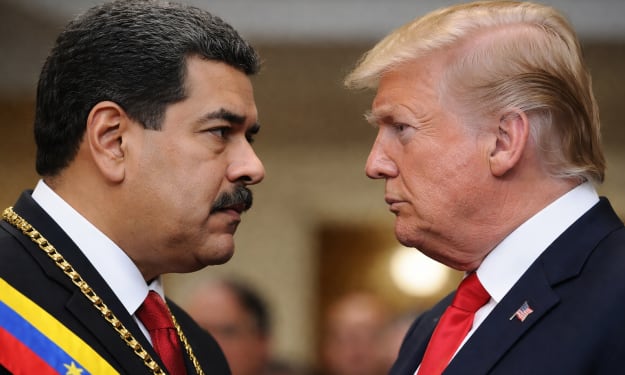
Was His Abduction Caused by His Support for the Palestinian Cause or the Theft of Oil?** The controversy surrounding the alleged targeting or attempted abduction of Venezuela’s president has sparked intense debate across political and media circles. At the center of this debate lies a critical question: was he targeted because of his outspoken support for the Palestinian cause, or was the real motive an effort to seize control of Venezuela’s vast oil wealth? To understand this issue, it is necessary to examine how ideology and economic interests intersect in modern geopolitics.
By America today 7 days ago in Criminal
Geronimo Bank Robbery
There is a little town in Oklahoma called Geronimo. Just like the Indian Warrior. Yes, I know. I either find ones I cannot pronounce, or I find ones that sound like they were made up for a 1970’s cop show. I can assure you that Geronimo is a real town. Just a little southeast of Lawton, Oklahoma. Oklahoma is rich in these little towns and odd histories.
By Cassie Moore5 days ago in Criminal



Comments
There are no comments for this story
Be the first to respond and start the conversation.