
Top 10 Most Dangerous Prisoners Ever Held At Alcatraz Jail
One of the most feared prisons in California, Alcatraz penitentiary was almost escape proof and housed only the most dangerous inmates.

10 - Robert Stroud

Infamously known as the "Birdman of Alcatraz," Stroud is by far the most famous inmate on the island prison.
In 1909, at age 19, he was convicted of manslaughter for killing a bartender in Alaska during a dispute involving his mistress. He was sentenced to 12 years at McNeil Island Federal Penitentiary in Washington State.
Stroud's violent behavior continued in prison, leading to his transfer to Leavenworth Federal Penitentiary in Kansas in 1912. There, in 1916, after being denied a visit with his brother, he stabbed and killed a prison guard in front of numerous inmates.
He was convicted of first-degree murder and sentenced to death. However, after appeals from his mother, President Woodrow Wilson commuted his sentence in 1920 to life imprisonment in solitary confinement.
While in solitary confinement at Leavenworth, Stroud discovered a nest with injured sparrows in the prison yard. He began caring for birds, eventually raising nearly 300 canaries in his cell.
He conducted extensive research on bird diseases, writing and publishing two significant works, Diseases of Canaries and Stroud's Digest on the Diseases of Birds.
His contributions to avian pathology were recognized by ornithologists and farmers alike, however, in 1942, prison officials discovered that Stroud had been using some of his bird-related equipment to produce alcohol.
As a result, he was transferred to Alcatraz Federal Penitentiary, where regulations prohibited him from keeping birds. He spent six years in segregation in D Block and eleven years in the prison hospital.
Despite the restrictions, Stroud continued his intellectual pursuits, authoring manuscripts on the U.S. prison system, and, in 1959, Stroud was transferred to the Medical Center for Federal Prisoners in Springfield, Missouri, due to declining health.
He died there on November 21, 1963, at the age of 73.
9 - Roy Gardner
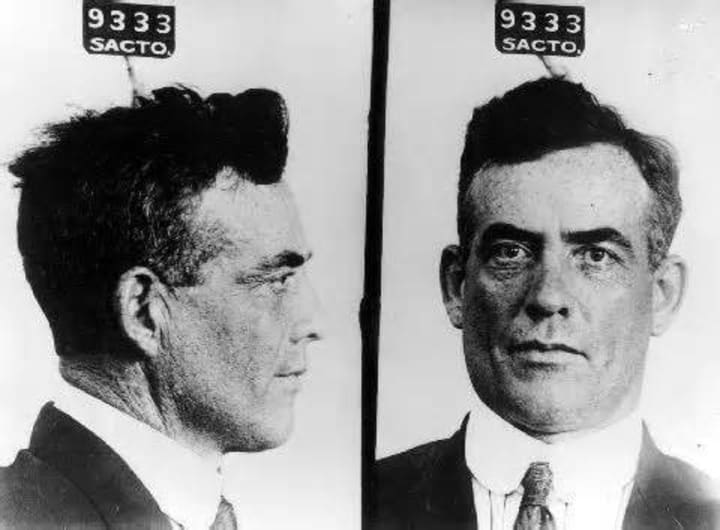
Born in Trenton, Missouri, Gardner spent his early years in Colorado Springs. His criminal activities began in Mexico during the Mexican Revolution, where he smuggled arms to revolutionary forces.
After being captured and sentenced to death, he escaped from a Mexican prison in 1909 when criminal career escalated in the United States.
He became infamous for robbing U.S. mail trains, and, in 1920, he stole $80,000 from a mail truck in San Diego, marking the beginning of his series of high profile robberies.
Gardner's ability to escape custody earned him the nickname "King of the Escape Artists." In 1920, while being transported to McNeil Island Federal Penitentiary, he overpowered U.S. marshals, handcuffed them, and escaped.
He was recaptured in 1921 after a nationwide manhunt but by 1921, Gardner escaped from McNeil Island during a prison baseball game.
He and two other inmates crawled through a hole in the fence and fled, though one was shot and killed during the escape.
Gardner was transferred to Alcatraz Federal Penitentiary in 1934, where he joined other notorious criminals like Al Capone. Despite his reputation, Gardner was not known for violence and was considered a model inmate.
He worked in the prison's mat shop and even planned an escape with fellow inmate Ralph Roe, though it was never executed.
During his time at Alcatraz, Gardner authored an autobiography titled "Hellcatraz," detailing his criminal activities and experiences in prison.
Gardner was released from Alcatraz in 1938 after a successful appeal for clemency. He attempted to transition into civilian life, working in various jobs and even participating in a film about his life. However, his past continued to haunt him and he eventually died from cyanide poisoning in 1940.
8 - James ‘Whitey’ Bulger

One of the most notorious American criminals of the late 20th century, James ‘Whitey’ Bulger infamous for his long reign as a Boston crime boss and his decades-long fugitive status.
Bulger led the Winter Hill Gang in Boston, dominating organized crime through the 1970s and 1980s, with his criminal enterprises including drug trafficking, extortion, money laundering, racketeering, and multiple murders.
Bulger was implicated in at least 19 murders, though the actual number may be higher and he was also an FBI informant for years, which helped him evade prosecution while eliminating rivals and expanding his power.
After being tipped off about a pending indictment in 1994, Bulger went on the run and evaded capture for 16 years, becoming one of the FBI’s Ten Most Wanted Fugitives.
He was finally caught in 2011 in Santa Monica, California, living under a false identity.
Bulger was incarcerated in multiple high-security federal prisons, including the United States Penitentiary, Hazelton and was moved to Alcatraz briefly in 1959 where he took part in weightlifting and took advantage of educational opportunities afforded to inmates.
He completed various correspondence courses including typing, bookkeeping, and business law, becoming a voracious reader, devouring numerous books on poetry, politics, and military history.
He was transferred to Leavenworth Federal Penitentiary and, in 1963, to Lewisburg Federal Penitentiary, however after his release he would not see a prison cell again for 46 years.
He was eventually convicted of 32 counts of racketeering and firearms possession in 2013, layer being sentenced to was sentenced to two terms of life imprisonment, plus five years.
Bulger entered the Coleman II United States Penitentiary in Sumterville, Florida in 2014, was transferred to the Federal Transfer Center in Oklahoma City and a few days later to the Federal Penitentiary in West Virginia.
Bulger was transferred from the Federal Transfer Center in Oklahoma City to United States Penitentiary, Hazelton, in West Virginia on October 29, 2018 but was attacked by multiple inmates and found dead.
7 - Arthur ‘Doc’ Barker

Involved in numerous high-profile crimes including bank robberies, kidnappings, and murders, Arthur ‘Doc’ Barker was part of the Barker-Karpis Gang.
Barker took part in some of the most audacious kidnappings of the era, including the 1933 kidnapping of Edward Bremer, for which the gang collected a ransom of $200,000.
Barker was linked to multiple violent robberies and several murders during his criminal career and gang’s violent activities made them one of the FBI’s most wanted during the early 1930s.
Arthur Barker was first imprisoned in the early 1930s but repeatedly escaped from jail until his final capture.
After being captured again in 1935, he was sent to Alcatraz, which had just opened as a federal penitentiary in 1934 designed to hold the most dangerous criminals.
Barker’s time at Alcatraz was marked by his involvement in an escape attempt in 1939 when Barker and fellow inmates attempted to overpower guards.
The plan failed, and Barker was fatally shot by prison guards during the incident and saw Barker die on January 13, 1939, during the failed escape attempt.
Barker’s criminal legacy is tied to the violent crime wave of the Great Depression era and the early rise of the FBI’s efforts to combat organized crime.
6 - Frank Lee Morris

Best known as the mastermind behind the most famous escape attempt from Alcatraz Federal Penitentiary, an attempt that remains shrouded in mystery to this day, Morris had a long criminal history.
Some of his crimes included burglary, bank robbery, and narcotics possession while he was known for being highly intelligent, with an IQ reportedly above 130.
After multiple prison escapes and recaptures, he was eventually sent to Alcatraz in 1960 due to his high flight risk.
While serving time at Alcatraz, Morris teamed up with Clarence and John Anglin, two brothers who were also inmates.
Over the course of 6 months, the trio secretly dug through the walls of their cells using makeshift tools like spoons and a drill fashioned from a vacuum cleaner motor.
They created lifelike dummy heads to place in their beds to fool the guards amd on June 11th, 1962, they escaped through a hole in the back wall of their cells, climbed to the roof, made their way to the shoreline, and launched a makeshift raft made of stolen raincoats.
The official FBI report concluded that they most likely drowned in San Francisco Bay, but their bodies were never found.
In 1979, the FBI handed the case over to the U.S. Marshals Service, which still considers it an open fugitive case, yet, over the years, there have been alleged sightings, mysterious letters, and reports suggesting at least one of them may have survived.
He remains a legendary figure in American criminal history and prison folklore with the escape often cited as one of the greatest prison breaks of all time.
5 - John Anglin

John Anglin, originally from Donalsonville, Georgia, grew up in a poor family and began robbing banks with his brother Clarence during the 1950s.
The Anglin brothers were known for their non-violent bank robberies, often targeting closed banks at night to avoid harming anyone.
In 1958, they were caught and sentenced to 20 years in federal prison, but, after multiple escape attempts from other institutions, the brothers were transferred to Alcatraz—the most secure prison in the U.S. at the time.
There, he reunited with Clarence and met Frank Morris and the three began planning an elaborate escape over the course of six months.
After the escape, no one knows for sure if they survived, yet, a 2015 History Channel documentary showed age-progressed photos suggesting the Anglin brothers might have survived and fled to Brazil.
Today, John Anglin remains one of the most enigmatic and fascinating figures in American prison lore.
4 - Clarence Anglin

Clarence Anglin, originally from Georgia and raised in Florida, began robbing banks in the 1950s with his brother John.
Captured in 1956 during a failed robbery, several escape attempts from other facilities saw him and brother John eventually transferred to Alcatraz.
Alcatraz was designed to house the most dangerous and escape-prone prisoners in the U.S, but Clarence immediatley began devising an elaborate plan to break free.
The escape plan involved Digging through the ventilation grates in their cells using sharpened spoons and homemade drills.
Hiding the holes with cardboard and paint, creating lifelike dummy heads made from soap, toilet paper, and real hair to fool guards while constructing a raft and life vests out of over 50 raincoats.
One of the largest manhunts in U.S. history was launched after the escape attempt appeared to have suceeded, yet no bodies were ever found.
The U.S. Marshals Service still lists Clarence Anglin as a fugitive.
3 - Alvin Karpis

One of the most notorious American gangsters of the 1930s and a key figure in the Barker–Karpis Gang, which was responsible for a spree of robberies, kidnappings, and killings during the Great Depression, Karpis was feared as being the longest-serving inmate on Alcatraz.
Karpis began his criminal career in his teens, engaging in car theft and burglary before teaming up with the Barker family, including Ma Barker and her sons, to form the Barker–Karpis Gang in the early 1930's.
The gang gained national notoriety for Robbing banks and trains across multiple states, while kidnapping wealthy businessmen for ransom, including William Hamm and Edward Bremer, both of whom were released after large ransoms were paid.
Karpis was known for his intelligence, ruthlessness, and planning skills, often taking the lead in organizing the gang’s operations and was linked to at least 10 murders, including law enforcement officials and informants.
Karpis was designated Public Enemy #1 by the FBI in 1936—the only person ever captured personally by J. Edgar Hoover, the FBI’s director at the time.
On May 1, 1936, Karpis was arrested in New Orleans without a single shot being fired. His capture marked the end of the violent era of Depression-era outlaws like Dillinger, Bonnie and Clyde, and Baby Face Nelson.
After his conviction for kidnapping, Karpis was sentenced to life in federal prison and transferred to Alcatraz in 1936.
While imprisoned, he was considered a high-risk, but model inmate. He reportedly taught himself to play the guitar, and even gave guitar lessons to a young Charles Manson in the early 1960s.
When Alcatraz closed in 1963, Karpis was moved to other federal prisons and was paroled in 1969 having spent more than 30 years in prison.
After release, he was deported to Canada, then later settled in Spain, where he lived quietly and wrote his memoirs before passing away of natural causes in 1979.
2 - George ‘Machine Gun’ Kelly

Another one of the most infamous gangsters of the 1930s, his violent nickname and reputation were well known, but his most well-known crime was actually a kidnapping and not a string of murders.
Kelly started his criminal career as a bootlegger during Prohibition and eventually escalated to bank robbery and kidnapping.
He acquired the nickname "Machine Gun" after reportedly using a Thompson submachine gun during robberies, though some say the nickname was mostly hype pushed by his wife, Kathryn Kelly, to boost his criminal persona.
His most infamous crime was the 1933 kidnapping of oil tycoon Charles Urschel in Oklahoma City and the gang demanded and received a $200,000 ransom.
Urschel cleverly left behind clues during captivity, such as fingerprints and background noise, which helped the FBI locate the kidnappers.
Kelly and his wife were arrested on September 26, 1933, in Memphis, Tennessee and allegedly shouted, "Don’t shoot, G-Men!"—a phrase that helped popularize the term "G-Man" or "government man" for FBI agents.
Both George and Kathryn were tried and convicted in federal court. George received a life sentence for kidnapping.
In 1934, Kelly was sent to Alcatraz, becoming one of its first and most famous inmates, yet, despite his tough nickname, guards and inmates viewed Kelly as non-violent and mild-mannered in prison.
He served 17 years at Alcatraz, where he worked in the prison laundry and was considered a model prisoner, later transferred to Leavenworth Penitentiary in Kansas.
George "Machine Gun" Kelly died of a heart attack on July 18, 1954, inside Leavenworth, at the age of 59.
1 - Al Capone

Considered to be the most famous gangster in American history, Capone, also known as “Scarface,” was widely associated with brutal gang violence and organized crime in Chicago during the Prohibition era.
Al Capone rose to power in the 1920s as the head of the Chicago Outfit, a powerful criminal organization involved in bootlegging, illegal gambling, prostitution rings, murder-for-hire and gang warfare.
Capone was ultimately imprisoned not for murder or racketeering—but for tax evasion, yet, is widely believed to have ordered the St. Valentine’s Day Massacre in 1929 which saw seven members of a rival gang were gunned down in broad daylight.
Despite his violent reign, law enforcement couldn’t directly connect him to violent crimes due to a lack of witnesses and evidence.
After years of investigations, the federal government charged Capone with income tax evasion in 1931.
He was found guilty on five counts and sentenced to 11 years in federal prison, fined $50,000, and ordered to pay court costs and back taxes.
He began serving time in Atlanta U.S. Penitentiary in 1932, but was later moved due to corruption and special treatment.
In 1934, Capone was transferred to Alcatraz, shortly after it opened, to prevent him from using his influence to manipulate the prison system.
He became inmate AZ-85 and the isolated location, strict rules, and highly controlled environment made it impossible for Capone to maintain his criminal empire.
While there, he worked in the laundry room and suffered from neurosyphilis, which caused a rapid decline in his mental and physical health.
By 1938, Capone’s health had deteriorated significantly; he was confused, erratic, and no longer considered a threat before he was transferred to Terminal Island Prison in California in 1939 and released in 1940.
After release, he lived quietly at his Florida estate and died in 1947 at the age of 48 from complications of syphilis and a stroke, with his life today the subject of countless books, documentaries, and films.
We have loads more great true crime videos in our playlist on this page, you can also check out our recommended video above and subscribe for more true criome videos published weekly.
About the Creator
Vidello Productions
My name is William Jackson, a YouTube content creator and crypto enthusiast with over 161,000 subscribers and I make videos that are focused on the billionaire lifestyle and crime.
Content consists of top list videos.
Keep reading
More stories from Vidello Productions and writers in Criminal and other communities.
25 Most Dangerous Prisons Inside Africa
Number 25 - Chikurubi Max Prison Chronic water supply shortages, lack of consistent electricity and cells that are infested with lice and other vermin, Zimbabwe's Chikurubi Maximum Security Prison is widely known for its horrific conditions.
By Vidello Productions3 months ago in Criminal
Tensions at Sea: The Russian Oil Tanker Seized by the United States in 2026
Tensions at Sea: The Russian Oil Tanker Seized by the United States in 2026 In early 2026, a Russian-flagged oil tanker was seized by the United States in the North Atlantic, attracting global attention. The vessel, originally called *Bella 1* and later renamed *Marinera*, had been monitored for weeks as it attempted to evade U.S. sanctions enforcement. This event has raised questions about international maritime law, geopolitical tensions, and the enforcement of economic restrictions on oil shipments.
By America today 5 days ago in Criminal


Comments
There are no comments for this story
Be the first to respond and start the conversation.