
Title: Blood Oath: The Rise and Fall of Salvatore Ricci
Subtitle: When loyalty turns into betrayal, even family becomes a weapon.

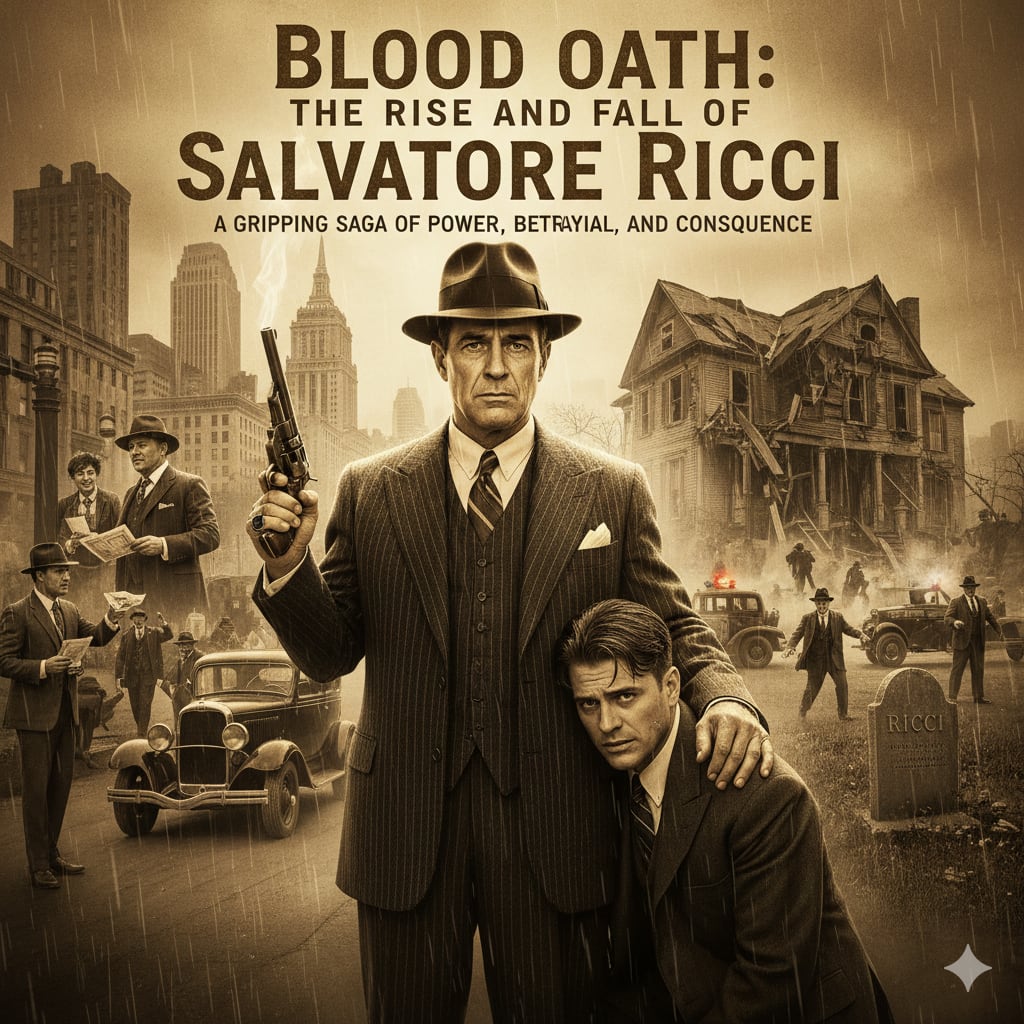
The story of Salvatore Ricci, known across the underworld as “The Gentleman Butcher,” began in the narrow alleys of Palermo, Sicily. Born in 1954 to a humble fisherman and a devout mother, Salvatore’s childhood was marked by hunger, silence, and the sound of waves breaking against the docks. His father dreamed of an honest life, but honesty didn’t feed a family of six. By sixteen, Salvatore had already learned that survival demanded compromise — and in Sicily, compromise meant the Mafia.
He started small, carrying messages and crates for local bosses who smuggled contraband along the Italian coast. Salvatore’s quiet confidence drew attention. Unlike the loud, reckless boys chasing quick cash, he was calculated, observant. He remembered every face, every debt, and every favor. That memory — and his patience — became his greatest weapon.
By his early twenties, Ricci had transformed from an errand boy into a trusted enforcer for Don Vittorio Bianchi, Palermo’s most respected godfather. He wore pressed suits, spoke softly, and always kept his word. His charm disarmed enemies before his pistol ever needed to. But beneath that elegance was a man who understood the brutal mathematics of power — fear plus respect equaled control.
When Don Bianchi died in 1983, the city erupted in violence. Rival families carved up territories like vultures. Businesses burned, and bodies piled up in the streets. But Salvatore saw what others missed — chaos could be controlled. Within weeks, he orchestrated a series of strikes against his rivals, hitting warehouses, money houses, and safe zones simultaneously. Palermo woke one morning to blood on every corner, and only one man still standing. Newspapers called it “The Red Dawn.”
From that day, Salvatore Ricci became Don Ricci, ruler of the Palermo syndicate. He rebuilt the shattered city, not through terror, but order. He demanded loyalty — and rewarded it richly. His men called him Il Padre, the father. He paid for their children’s education, funded their weddings, and ensured no widow went hungry. To the poor, he was both protector and punisher. To the government, a ghost too powerful to touch.
Under his leadership, Ricci’s influence stretched beyond Italy. He partnered with Marseille cartels, smuggled goods through Buenos Aires, and laundered millions through construction and restaurant businesses in New York. Politicians attended his daughter’s wedding, priests blessed his ventures, and law enforcement turned away — often after a quiet visit from one of his “lawyers.”
But time erodes even the strongest empires. Salvatore’s greatest weakness was family — especially his nephew, Marco Ricci. Marco had grown up idolizing his uncle but envied the throne he believed was rightfully his. Unlike Salvatore, he lacked patience. He wanted the crown, the power, and the fear — now.
In 1994, Marco made a deal with the Naples syndicate to overthrow his uncle. He promised them control of Palermo’s docks in exchange for their muscle. The betrayal was as swift as it was brutal. One stormy night, Salvatore’s convoy was ambushed outside the city. Bullets ripped through the black Mercedes convoy, killing three of his closest guards. Salvatore, bleeding from the shoulder, escaped into the hills. For two years, he disappeared. The city whispered his name like a curse.
The police assumed he was dead. His enemies celebrated. But in truth, Ricci had gone underground, living quietly in a farmhouse outside Messina. He watched his empire crumble and his nephew take the throne he had once built with loyalty and fear.
In 1996, an anonymous tip led police to his hideout. They found him sitting by a window, staring at the sunset. When they cuffed him, he didn’t resist. “I built a kingdom on blood,” he said softly, “and blood is how it ends.”
Salvatore Ricci was sentenced to life imprisonment. Behind bars, he never complained. He wrote a memoir for his grandson, not about crime, but about wisdom. “Power,” he wrote, “is not what you take. It’s what you can control without losing your soul.”
Years later, Marco Ricci was found dead in Naples — shot twice in the back, execution-style. No one claimed responsibility, but the underworld knew the truth. Even behind bars, the Don still spoke, and his will was obeyed.
When Salvatore died in 2018, Palermo fell silent. No gunfire, no deals, no debts — just mourning for the man who ruled with both heart and iron. His funeral was attended by hundreds, but no one spoke his name aloud. They didn’t have to. His legend already had.
About the Creator
shakir hamid
A passionate writer sharing well-researched true stories, real-life events, and thought-provoking content. My work focuses on clarity, depth, and storytelling that keeps readers informed and engaged.
Keep reading
More stories from shakir hamid and writers in Criminal and other communities.
Beyond the Screen: The Legend of the Lost Server
When an Online World Became More Than a Game For many gamers, video games are not just entertainment—they are entire worlds, rich with friendships, rivalries, and memories that feel as real as life itself. Few stories capture this better than the legend of the “Lost Server,” a true tale from the early days of online multiplayer gaming that shows how digital spaces can create bonds stronger than reality.
By shakir hamid5 months ago in Criminal
She Killed Her Sister When She Gave The Teen's Virginity to Her Boyfriend
Any person who can rape and kill an innocent member of their family is truly depraved. One who later admits they enjoyed it is truly demonic. Yet, a woman who took her criminal behavior to the depths of depravity is not even behind bars.
By Criminal Matters8 days ago in Criminal



Comments
There are no comments for this story
Be the first to respond and start the conversation.