
The Social Media Murderer: How a Serial Killer Used Likes and Comments to Hunt Victims
A chilling tale of how one man turned social media into his weapon of choice for stalking and killing his unsuspecting victims.

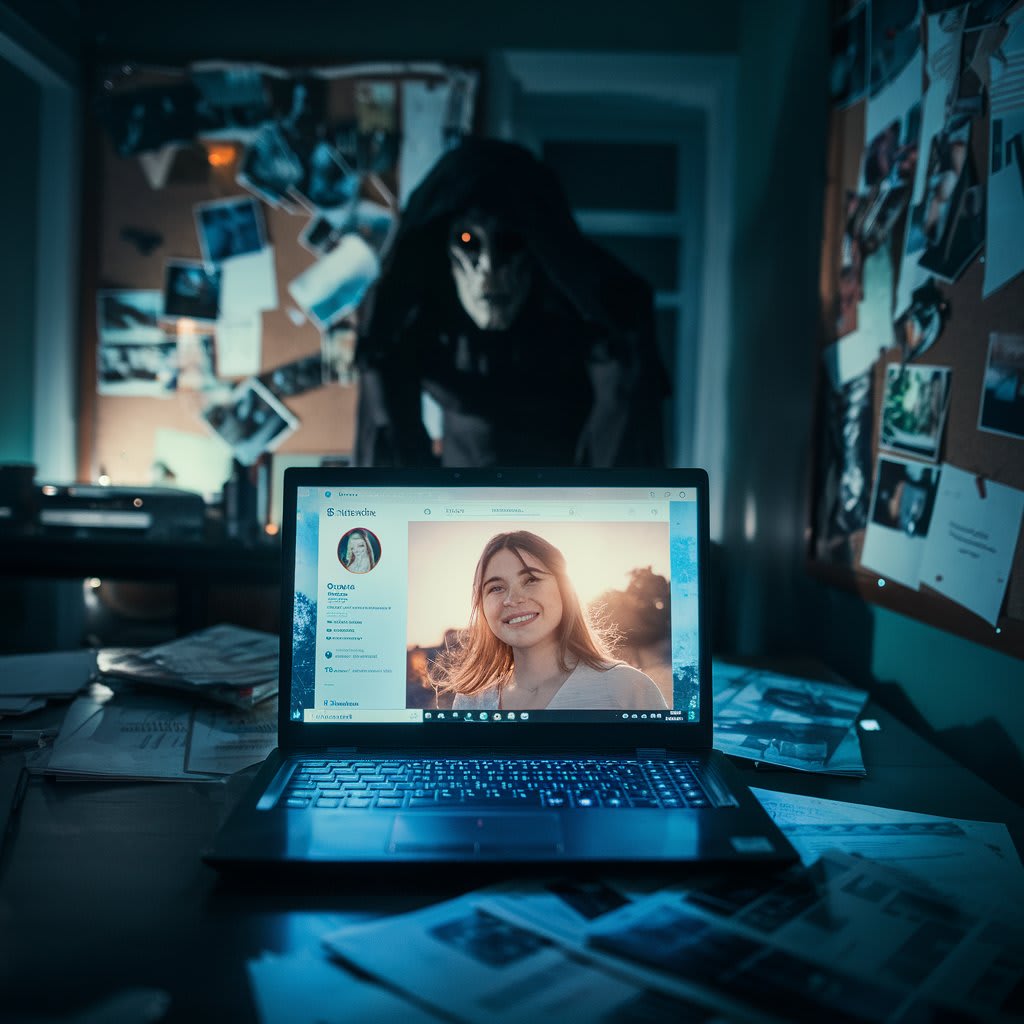
The Social Media Murderer: How a Serial Killer Used Likes and Comments to Hunt Victims
The first time anyone noticed the pattern, it was too late.
Sara Winters, a 22-year-old college student, was found lifeless in her small apartment, her phone still clutched in her hand. On the screen was her Instagram profile, frozen on her last post—a bright, sunlit selfie captioned, “Chasing dreams, one day at a time!” The comments were full of the usual mix of emojis and compliments, but one stood out: “Beautiful smile. You deserve the world. 🌹”
At first glance, it seemed innocent. Just another stranger on the internet. But as detectives combed through Sara's online activity, they discovered something chilling. That same comment—word for word—had appeared under posts of three other women. All three were now dead.
Detective Clara Mills sat in her cramped office, staring at a whiteboard covered in photos and timelines. Each victim was young, active on social media, and seemingly unrelated. But the online footprints told a different story.
“They’re not random,” Clara said, gesturing to her partner, Detective Nate Harris. “He’s choosing them. Liking their posts, commenting... It’s a game to him.”
Nate leaned back in his chair, rubbing his temples. “But how does he find them? There’s no geographical connection, no shared interests. Just social media.”
Clara frowned. That was the key. Social media. It wasn’t just a tool for the killer—it was his hunting ground.
Two days later, another body was discovered. Emily Chen, 27, a yoga instructor and avid travel blogger, was found in her studio. The same comment glowed on her latest post: “Beautiful smile. You deserve the world. 🌹”
This time, Clara noticed something new. The killer’s Instagram account, @TrulyYours1987, had liked every single post Emily had made in the last six months. The account was private, with no profile picture and only a cryptic bio: “Admiring beauty from afar.”
“Gotcha,” Clara muttered.
Tracking the account proved harder than expected. The IP address led to a series of proxies, masking the killer’s true location. But Clara wasn’t one to give up. She started analyzing the patterns: the type of posts the killer liked, the victims he targeted, and the timing of his comments.
“He’s picking women who share personal details,” Clara explained during a team briefing. “Posts about their routines, locations, even small habits. He’s using their own content to stalk them.”
Nate nodded. “He’s not just watching. He’s studying them.”
Clara decided to set a trap.
She created a fake Instagram profile: a bubbly, travel-loving woman named “Sophia Gray.” The account was carefully curated—pictures of coffee shops, yoga sessions, and scenic sunsets, all paired with hashtags that would attract someone like @TrulyYours1987.
Within days, the account received a notification. A like. Then another. And another.
Finally, the comment appeared: “Beautiful smile. You deserve the world. 🌹”
Clara’s heart raced.
With the help of the cybercrimes unit, they traced the killer’s activity in real time. He made one mistake: logging into a public Wi-Fi network at a coffee shop to leave the comment. Clara and Nate rushed to the location, a small café tucked away in the city’s quieter streets.
Inside, a man in his late 30s sat in the corner, typing on a laptop. He looked unassuming—average build, plain clothes, a face you’d forget in a crowd. But when Clara glanced at his screen, she saw Sophia’s profile staring back at her.
“Excuse me,” Clara said, her voice steady but firm. “Mind if we ask you a few questions?”
The man’s eyes darted to the door, but Nate blocked his path.
“You’ve been leaving some interesting comments,” Clara said, holding up her phone with the screenshot.
His face paled.
The man, whose real name was Daniel Harper, confessed during interrogation. He admitted to following his victims online for weeks, sometimes months, before making his move. He knew their favorite coffee shops, jogging routes, and even the playlists they loved—all from their social media posts.
“It wasn’t hard,” Daniel said, his voice devoid of remorse. “People share everything. They think likes and comments are harmless. But it’s an invitation.”
The case sent shockwaves through the city, a grim reminder of the dangers lurking behind digital screens. Clara’s fake profile became a cautionary tale, and platforms began implementing stricter privacy settings.
But Clara knew one thing for sure: the internet never forgets, and there would always be another Daniel Harper out there, waiting to turn a like into something deadly.
And the next time you scroll through your feed, remember this: someone might be watching.
About the Creator
Keep reading
More stories from writers in Criminal and other communities.
Inside the House of Skulls: The Full Timeline of the Jonathan Gerlach Investigation
INVESTIGATION TARGET: JONATHAN C. GERLACH INCIDENT LOCATION: 100 WASHINGTON AVENUE, EPHRATA PA CHARGES: ABUSE OF CORPSE (x100), THEFT, DESECRATION STATUS: INCARCERATED ($1M BAIL) KEYWORDS: #HouseOfSkulls #JonathanGerlach #EphrataCrime #MountMoriah
By Sunshine Firecrackera day ago in Criminal
Don’t Ask. Don’t Tell. Until Someone Lives To Tell.
By an independent investigative researcher ⸻ A note to the reader This article relies exclusively on public records, court filings, sworn testimony, and contemporaneous reporting. It does not allege criminal coordination beyond what has been established in court. Its purpose is to examine patterns, parallels, and institutional blind spots that emerge when timelines are placed side by side. Patterns are not accusations. But patterns ignored become policy.
By SunshineChristinaabout 21 hours ago in Criminal
Wild Card Weekend Recap: What Happens Now?
I think I figured out why I love Wild Card Weekend so much. It's because it's the first playoff anything of the calendar year. The NFL season starts in the fall, and once upon a time, the champion was crowned either on or slightly before New Year's. The evolution of the NFL schedule has resulted in the playoffs starting just into the New Year, and currently, the final week of the season falls on the first weekend of the New Year, with Wild Card Weekend coming a week after that. So yes, chronologically, the NFL's Wild Card Weekend serves as the first playoff anything of the calendar year.
By Clyde E. Dawkins6 days ago in Unbalanced


Comments
There are no comments for this story
Be the first to respond and start the conversation.