
The Shadow Banker: Michele Sindona’s Deadly Game
The Italian financier who blended the worlds of high finance, the Vatican, and the Mafia — until his empire of lies collapsed

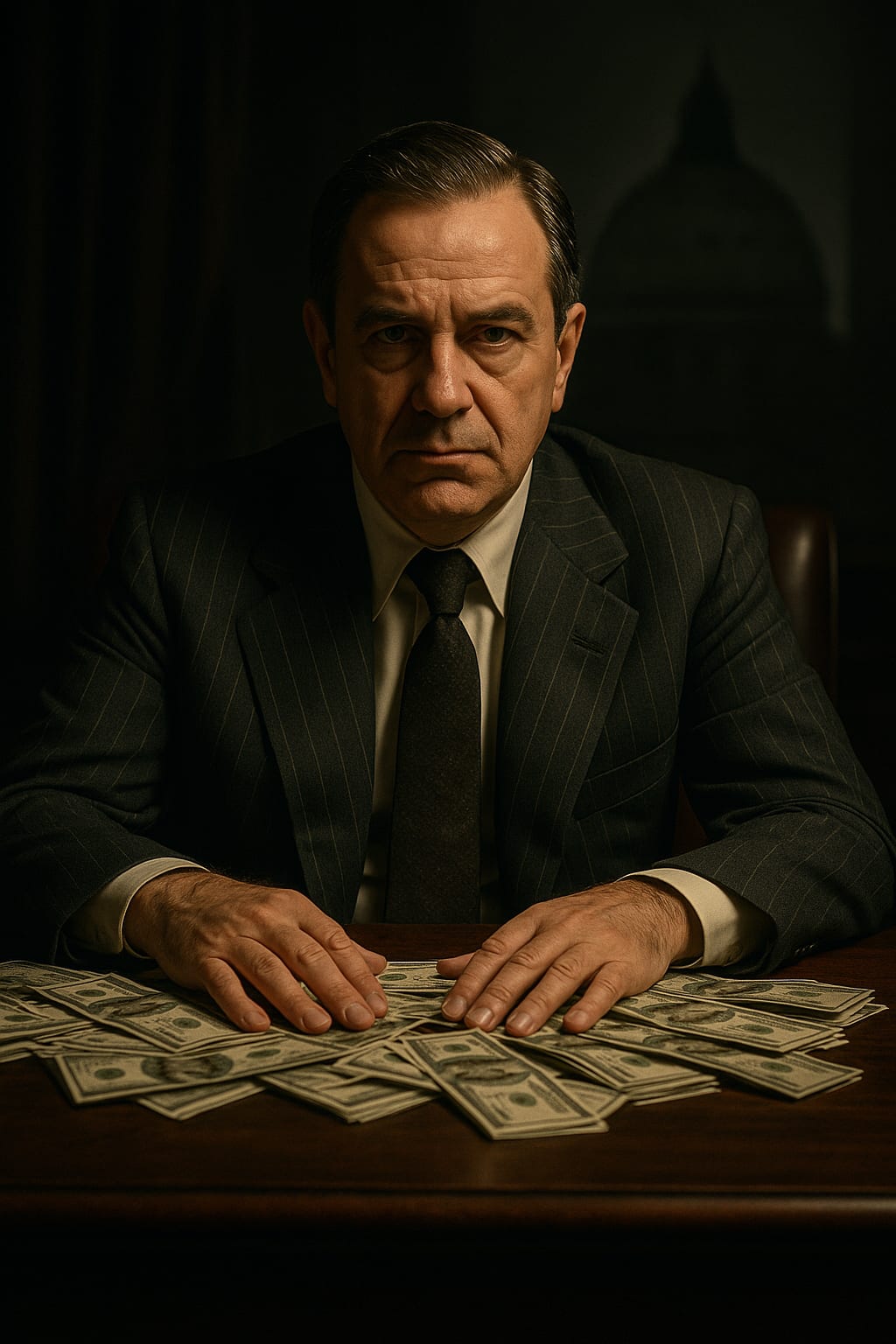
In post-war Italy, money was the new weapon of power. As gangsters traded guns for bank accounts, one man learned to turn both into tools of control — Michele Sindona, the banker who became known as “The Shark.”
Born in the small Sicilian town of Patti in 1920, Sindona grew up during Mussolini’s fascist regime. He was intelligent, ambitious, and utterly without conscience. After World War II, while Italy struggled to rebuild, Sindona saw opportunity — not in construction or politics, but in money laundering for the Sicilian Mafia.
He quickly became the financial wizard for Cosa Nostra’s wealth. While most mobsters hid in shadows, Sindona wore fine suits, smoked expensive cigars, and dined with politicians and priests. His genius lay in making dirty money look clean — transforming mafia profits from heroin trafficking and extortion into legitimate investments through a web of offshore banks and shell companies.
By the late 1960s, he had gained control of several major Italian banks, and his influence reached into the Vatican Bank itself. The Holy See, seeking ways to manage its secret funds, found Sindona’s financial wizardry useful. In return, the Mafia protected him — a devil’s alliance between church and crime.
He became close to Archbishop Paul Marcinkus, head of the Vatican Bank, and began channeling funds through the Vatican’s accounts into overseas investments. Meanwhile, his connections with powerful Italian politicians, including future Prime Minister Giulio Andreotti, gave him near immunity.
But Sindona wanted more. He dreamed of being not just a banker, but a power broker — the invisible hand guiding Italy’s destiny.
When the Italian government started tightening banking laws in the early 1970s, Sindona transferred billions to the United States, purchasing Franklin National Bank in New York. For a while, he was celebrated as an international success story — the Sicilian who conquered Wall Street.
But behind the luxury offices and glass skyscrapers, his empire was collapsing. His banks were nothing more than a giant pyramid of fraud, built on false accounting, illegal transfers, and mafia-backed money. By 1974, Franklin National Bank crashed spectacularly — at that time, one of the biggest bank failures in American history.
The scandal sent shockwaves across the financial world. Italian authorities began investigating Sindona’s complex network of companies and discovered that he had been laundering drug money for the Gambino family and other mafia clans. The Vatican cut ties, politicians distanced themselves, and Sindona fled to the U.S., claiming political persecution.
But the walls were closing in.
In 1979, Italian banker Giorgio Ambrosoli, who had been investigating Sindona’s fraud, was gunned down outside his home. The hitman was traced back to Sindona’s associates — a direct mafia-style execution ordered to silence the truth.
Within months, Sindona was arrested in New York for fraud and conspiracy. Desperate to escape, he staged a fake kidnapping, claiming he had been abducted by communist terrorists. The truth later emerged — he had arranged the “kidnapping” himself to avoid extradition.
The stunt failed. He was extradited to Italy and sentenced to life imprisonment for ordering Ambrosoli’s murder.
In prison, Sindona remained defiant. He insisted that he had acted as a “patriot,” protecting Italy from communist influence by financing secret operations through the Vatican. But everyone knew the truth: it had never been about ideology — only about money and power.
Then, in 1986, as he sat in a high-security prison near Voghera, Sindona was served his morning coffee. Moments later, he collapsed, writhing in agony. The autopsy confirmed cyanide poisoning.
He had been murdered — or perhaps, some say, he took his own life to escape disgrace. To this day, no one knows for sure.
What is certain is that Michele Sindona’s death symbolized the collapse of a dark alliance between the Mafia, the Vatican, and political power — a web of corruption that changed Italy forever.
Moral / Reflection:
Power built on deceit cannot last. Michele Sindona tried to be both a banker and a gangster, but in the end, the money he worshiped became the poison that killed him.
About the Creator
shakir hamid
A passionate writer sharing well-researched true stories, real-life events, and thought-provoking content. My work focuses on clarity, depth, and storytelling that keeps readers informed and engaged.
Keep reading
More stories from shakir hamid and writers in Criminal and other communities.
The Gentleman of the Underworld: Vito Genovese’s Ruthless Empire
n the early 1900s, when the streets of New York City echoed with the dreams of immigrants searching for a better life, a young man named Vito Genovese arrived from a small Italian village near Naples. Unlike most who sought honest work, Genovese came with a different ambition—to rule the streets.
By shakir hamid5 months ago in Criminal
The Silence Behind Room 307
M Mehran The rain fell heavily over the quiet town of Ravenshade, turning the narrow streets into rivers of shimmering reflections. Most people had already gone home, locking their doors against the stormy night. But inside the old Hawthorne Hotel, the lights of Room 307 still glowed faintly. That room would soon become the center of one of the most chilling criminal mysteries the town had ever known. A Crime That Shocked the Town At 11:42 PM, the hotel receptionist heard a loud crash echo from the third floor. At first, she assumed a guest had dropped something. But minutes later, a terrified scream shattered the silence. When the police arrived, they found the door to Room 307 half open. Inside, the scene was disturbing. A wealthy businessman named Daniel Mercer lay lifeless on the floor beside a broken glass table. The room looked untouched—no signs of forced entry, no robbery, no struggle. Yet Mercer was clearly murdered. Detective Aaron Cole, a veteran investigator known for solving impossible cases, stepped into the room carefully. Years of experience had taught him that the smallest detail could expose the biggest lie. But this case felt different from the beginning. The Impossible Mystery The first strange detail was the door. It had been locked from the inside. The second strange detail was the window. Closed. Sealed. Impossible for anyone to escape through. This meant one thing: whoever killed Mercer had either vanished into thin air… or was still in the hotel. Cole began questioning the staff and guests. Mercer had checked in earlier that evening, arriving alone and carrying only a black leather briefcase. According to hotel records, he had ordered dinner to his room and made two phone calls. After that, nothing. But one witness changed everything. A young waitress named Clara said she saw someone leaving the hallway near Room 307 shortly before the scream. “A man in a gray coat,” she told police. “Tall. Wearing a hat. I didn’t see his face.” The problem? No guest registered at the hotel matched that description. A Secret Hidden in Plain Sight Detective Cole examined Mercer’s belongings carefully. Inside the briefcase were documents related to a major financial investigation. Mercer had been working with authorities to expose a massive corporate fraud operation involving millions of dollars. Someone powerful clearly had a reason to silence him. But how did the killer enter and leave the locked room? That question haunted Cole. Until he noticed something unusual. The bathroom mirror. It wasn’t aligned with the wall like normal hotel mirrors. When Cole touched its edge, it shifted slightly. Behind it was a hidden service panel used by hotel maintenance workers decades ago. A narrow passage ran between the walls of the building. Suddenly, the “impossible crime” wasn’t impossible anymore. The Killer Revealed The passage led to a storage room on the same floor. Inside, detectives discovered a gray coat hanging on a hook. And inside the pocket was a hotel keycard. The card belonged to Victor Hale—the hotel’s night manager. When police confronted him, Hale tried to stay calm. But the evidence was overwhelming. Hale had once worked for the same corporation Mercer was investigating. If Mercer exposed the fraud scheme, several powerful executives—and their accomplices—would face prison. Hale was paid to ensure that never happened. Using the old maintenance passage, he entered Mercer’s room through the hidden panel, confronted him, and killed him before escaping back through the wall. He then locked the door from the inside using a simple wire trick through the gap under the door. A perfect crime. Or so he thought. Justice in the Darkness When Hale finally confessed, he revealed something chilling. Mercer had refused to stay silent even when threatened. “He said the truth was worth dying for,” Hale admitted quietly. The investigation that followed exposed the entire fraud network Mercer had been trying to reveal. Several high-ranking executives were arrested, and millions of dollars in stolen funds were recovered. But for Detective Cole, the victory felt incomplete. Mercer had paid the ultimate price. The Lesson Behind the Crime Criminal cases like the Room 307 murder remind us that crime is rarely random. Behind every shocking act lies a chain of decisions, secrets, and motives. Sometimes the truth hides in shadows. Sometimes it hides behind a mirror. But as Detective Cole often said: “Every crime leaves a whisper of the truth. You just have to listen carefully.” And in the silent hallway of the Hawthorne Hotel, the whisper of justice had finally been heard.
By Muhammad Mehran6 days ago in Criminal
Pandora’s Burden
“My brother warned me to not accept gifts from the one who commissioned you,” said Epimetheus to the woman clad in silvery raiments standing at the entrance to the temple. Her silver tiara and the silver rings on her fingers and toes glinted in the firelight cast by torches set on either side of the doorway. Lingering in the shadows, beyond the reach of the flames as she was, he could not tell what she held in her hands. At first what appeared to be a box was perhaps a funerary urn, or maybe merely an apple.
By J. Otis Haasa day ago in Fiction


Comments
There are no comments for this story
Be the first to respond and start the conversation.