
The Sea Tube
The Trans Atlantic Train

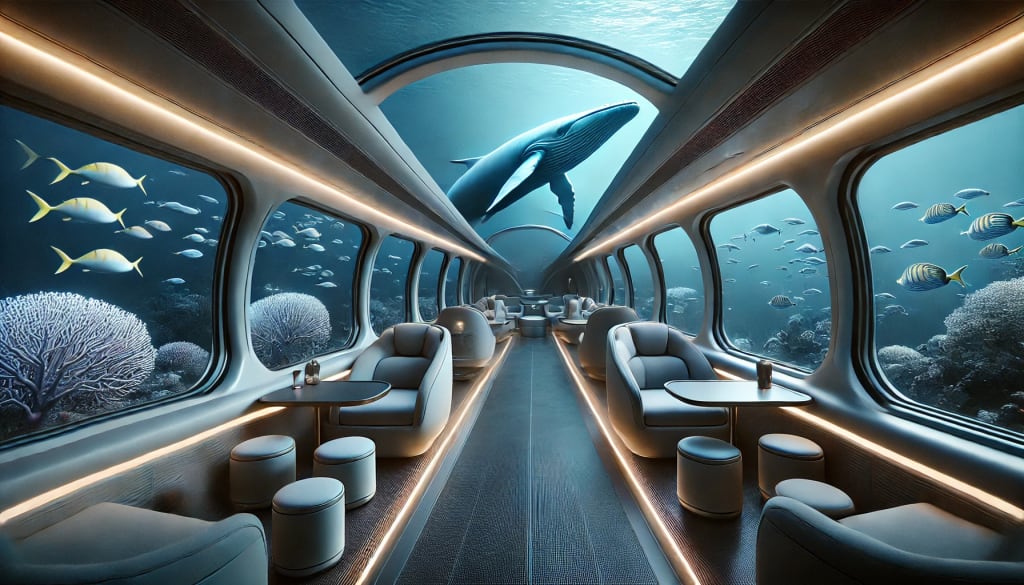
The Trans Atlantic Tube
Sam Blankenship leaned back in his plush seat in the observation car of the Sovereign-class train, a marvel of modern engineering slicing through the Atlantic in its shimmering underwater tube. The hum of the train was barely perceptible, a soothing vibration that melded with the faint symphony of the deep ocean outside. Schools of iridescent fish darted past, their shimmering scales catching the light from the train’s external floodlamps. In the distance, a pod of whales glided gracefully, their massive forms momentarily casting fleeting shadows on the glass walls of the tube.
The observation car was a sanctuary of understated luxury, with sleek leather seats and tables of polished black glass. Above, a vaulted ceiling of translucent panels emitted a soft, golden glow, imitating a perpetual sunset. Sam’s reflection wavered faintly in the glass before him, merging with the endless blue expanse of the ocean.
He tapped the edge of the table three times, and a soft chime answered, signaling the attention of the onboard AI.
“Twenty-year-old scotch. Neat,” he said, his voice steady but tired.
“Right away, Mr. Blankenship,” replied a smooth, genderless voice as a holographic menu flickered briefly in the air before him, confirming his selection.
Sam barely acknowledged it. His focus was on the undulating world outside. A silver barracuda streaked past, its sleek body a flash of menace in the otherwise serene underwater vista. The whales, now closer, arced slowly through the water, their tails stirring a languid current that rippled against the tube.
“Beautiful, isn’t it?” a passenger across the car remarked, breaking the gentle silence.
Sam turned his head slightly, meeting the stranger’s gaze with a faint smile. “It always is,” he replied. But his voice carried the weight of someone who had seen too much to be easily moved by beauty anymore.
The scotch arrived moments later, delivered by a robotic arm that slid silently out of the table. The glass was perfectly weighted, the amber liquid catching the golden light from above. Sam swirled it once, watching as the liquid clung to the sides, then took a slow sip.
As he placed the glass down, his eyes caught something in the distance—an unusual shadow moving against the current, dark and deliberate. It vanished as quickly as it had appeared, swallowed by the deep.
Sam frowned slightly but shook it off. Shadows had a way of playing tricks on tired eyes. And yet, as he took another sip of scotch, the nagging thought lingered: in a world this vast, what else might be watching from the depths?
The train surged forward, its sleek form cutting through the ocean like a needle through silk, and Sam Blankenship settled into his seat, waiting for the storm he knew would come.
Sam Blankenship’s illness was a cruel irony for a man who had once been a picture of vitality. Diagnosed with Reissner’s Syndrome, a rare degenerative disease that calcified blood vessels and starved organs of oxygen, his body had become a battlefield of pain and fragility. The syndrome worked insidiously, leaving his skin sallow and his movements slow. His hands, once steady and confident, now trembled faintly as he raised the glass of scotch to his lips.
The only thing keeping him alive was the Atherion Biopurifier, a state-of-the-art device implanted into his chest. It was a marvel of medical science—a sleek, black composite casing no larger than a paperback book, visible as a faint bulge beneath his finely tailored shirt. Tubes as thin as capillaries snaked from the device into his veins, constantly filtering his blood. Inside, a microprocessor monitored his oxygen levels, toxin buildup, and overall cardiovascular health. Every few minutes, the device emitted a soft, rhythmic hum—a sound Sam had learned to ignore but could never forget.
The Biopurifier worked by extracting impurities from his blood and infusing it with a synthetic compound designed to mimic the body’s natural healing processes. It kept his organs functioning, but at a cost. The device wasn’t perfect—its filtration process left him constantly fatigued, and its reliance on high-energy nanotechnology meant he had to recharge it daily through a discreet port near his collarbone.
The machine was his lifeline and his prison. Without it now, death would come within minutes, swift and merciless. With it, he lingered in a liminal state between survival and surrender, tied to a device that extended his life but could not restore his vigor.
Despite the machine’s precision, Sam had come to mistrust it. Lately, there had been unexplained glitches—a brief stutter in its hum, a sudden dip in his oxygen saturation. The doctors assured him it was nothing to worry about, but Sam knew better. Machines could fail. People could tamper with them. And when you were a man like Sam Blankenship, with enemies as vast as the Atlantic and secrets as deep, every failure felt like a death sentence waiting to happen.
The rhythmic hum of the Atherion Biopurifier in Sam’s chest faltered for the third time that day, and this time, it didn’t recover. A low, warning chime emanated from the device, the sound a quiet but urgent whisper of mortality. Sam’s eyes narrowed as he sat up straighter in his seat, the weight of his condition pressing down heavier than ever.
He excused himself from the observation car, ignoring the curious glances of nearby passengers, and made his way toward his private cabin. Each step was deliberate and strained, his breath shallow. He cursed under his breath. The Biopurifier was his lifeline, and he couldn’t afford even the smallest malfunction.
Inside his cabin, the room was dimly lit, the soft hum of the train barely masking the faint beeping of the medical console mounted on the wall. The charging port for his device waited, recessed into a sleek panel near the desk. Sam shrugged off his jacket, revealing the access port just beneath his collarbone, and reached for the charging cable.
The cable was supposed to be indestructible—a Kevlar-shielded lifeline designed to withstand anything short of an industrial shredder. But as Sam plugged it into the port, the Biopurifier let out a sharp, distressed buzz, and the panel displayed a flickering red error message: Connection Failed. Power Unavailable.
Sam frowned and yanked the cable out. Examining it closely, his heart sank. The Kevlar sheath had been expertly severed, the copper wires inside cleanly sliced. Whoever had done this knew exactly what they were doing.
“No, no, no,” he muttered, scrambling to retrieve the spare cable from the drawer. But as he pulled it free, the same severed edges mocked him. Panic set in, his chest tightening as the Biopurifier let out another warning chime, louder this time.
He pressed the manual override button on the device, desperate to force it into emergency mode, but the machine’s hum dwindled to silence. His legs gave out, and he collapsed to the floor, clutching at his chest.
The last thing Sam saw was the reflection of his pale, ashen face in the polished cabin mirror. The hum of the train continued, steady and indifferent, as the Atherion Biopurifier failed completely, leaving him alone in the vast, uncaring depths of the ocean.
The Sovereign-class train glided into Atlantica Port, the glittering hub suspended in the middle of the Atlantic. The underwater platform is a marvel of engineering, its walls a luminous blend of steel and glass, revealing the deep blue expanse outside. As the train docks, it unloads its cargo while passengers disembark to explore the sprawling casino and duty-free shopping complex, a floating haven of luxury and vice.
Inside the train, chaos brews. Sam Blankenship, the legendary CEO of a mega-corporation, has been found dead in his private cabin, the Atherion Biopurifier in his chest deliberately sabotaged. The train’s AI security system locks down his cabin as word spreads through the corridors like wildfire: it wasn’t a natural death. It was murder
As the train pulls into Atlantica Port, passengers are ushered into the gleaming casino and shopping complex. Investigators, led by a determined and astute detective, seize the three-hour layover to conduct interviews and search for evidence.
The stakes were high. In the international waters surrounding the port, jurisdiction becomes murky, and if the suspects escape during the layover, they may never be brought to justice.
As the investigation begins, clues were hidden in plain sight, alliances were tested, and amidst the glittering halls of luxury, dark truths were about to surface.
Detective Elara Quinn was not the kind of investigator one would expect to find on a luxury underwater train. She was tall and lean, her presence sharp and focused, like a blade honed for a single purpose. Her dark brown hair, flecked with strands of premature silver, was swept back into a no-nonsense ponytail, emphasizing her angular features. Her piercing hazel eyes seemed to absorb every detail around her, missing nothing.
Elara’s clothing was practical yet subtly stylish—a tailored gray blazer over a fitted turtleneck and slacks, with low-heeled boots that suggested she was ready to move at a moment’s notice. A small badge clipped to her belt bore the emblem of the Global Maritime Investigation Bureau, a specialized agency tasked with enforcing laws in international waters.
She carried herself with the air of someone who had spent years in the field—confident, controlled, and just a touch weary. Her left wrist bore a sleek smartwatch, constantly pinging updates from her team, and a discreet holster on her hip carried a sidearm, though she rarely had to use it. She preferred words and wits over bullets, a trait that had earned her the respect of peers and grudging admiration from suspects.
Her reputation preceded her. Known for solving the Volcanic Ridge Cargo Heist and exposing corruption in the Nordic Pipeline Scandal, Elara had a knack for untangling the most complex cases. Her methods were unconventional—eschewing bureaucratic norms and cutting through red tape like a scalpel—but they worked.
Beneath her composed exterior, Elara harbored a fierce sense of justice, tempered by an understanding of human frailty. She didn’t see criminals as monsters, just as people with motives, flaws, and stories. This empathy, paired with her relentless determination, often made her the most dangerous person in any room.
On the Sovereign, Elara blended in at first, observing quietly from the background. She sipped a black coffee in the observation car as the train docked at Atlantica Port, her eyes fixed on the cascading marine life outside the transparent tube walls. But when the news of Sam Blankenship’s death reached her, she immediately shifted gears.
The hum of the port, the glittering casino, the bustling duty-free shop—none of it distracted her as she began to weave together the threads of motive, opportunity, and evidence. To Elara, the Sovereign wasn’t just a train. It was now a locked-room mystery, a pressure cooker of secrets and lies. And she intended to get to the bottom of it before the suspects could escape into the abyss.
The search for the cutter began with meticulous scrutiny of the crime scene. Sam Blankenship’s private cabin was sealed off by the train’s AI, the door flashing red with a digital lockout. Inside, the investigators combed through every detail, their focus narrowing to the machine that had kept Sam alive—the Atherion Biopurifier—and the severed Kevlar-reinforced charging cable.
Detective Elara Quinn knelt by the machine, her gloved fingers tracing the clean, sharp edges of the severed cable. “This wasn’t accidental,” she murmured. “The cut’s too precise. Someone wanted this to fail at exactly the wrong moment.”
She directed her team to sweep the cabin for tools or fragments left behind. A faint smudge of grease near the baseboard hinted that the culprit might have used a small, portable cutting device—something compact enough to conceal on a train but powerful enough to slice through Kevlar and copper wiring.
“Check the passenger quarters,” she instructed. “If they’re carrying tools that match, they’re not getting off this train.”
The breakthrough came as they searched the maintenance compartment near the casino level. Among cleaning supplies and spare parts, an officer found a fiber-optic cutter tucked behind a shelf. It was sleek and modern, with laser precision—a device designed for industrial work, not personal travel.
Elara inspected it carefully. The blade bore traces of copper and synthetic fibers, matching the material of Sam’s charging cable. The tool’s handle had a faint smear of oil identical to the smudge found in the cabin.
“Fingerprint it,” she ordered, handing it to her tech specialist.
The team worked quickly, dusting the cutter and running prints through the train’s passenger database. Within minutes, a match came through: Veronica Crane, Sam’s ambitious second-in-command.
“She knew exactly what she was doing,” Elara muttered. “But we’ll need more than this. She’s too smart to let this be her only mistake.”
The discovery of the cutter was only the beginning. It tied Veronica to the crime, but Elara knew she needed to unravel the motive and expose the chain of events leading to Sam’s death. As the train continued its journey, the stakes only grew higher, with time running out before the suspects could slip into the anonymity of international waters.
The casino on the Sovereign was a dazzling spectacle of modern decadence. Neon lights in shades of deep blue and gold reflected off polished glass walls, and the faint sound of spinning roulette wheels, clinking poker chips, and slot machines dinging at a pay off, blended with the murmur of passengers indulging in their fleeting escape from reality. The soft hum of the train’s engines reminded everyone that they were hurtling through the depths of the Atlantic, even as the artificial glow mimicked a luxury resort.
Detective Elara Quinn found Veronica Crane seated at a high-stakes poker table, her demeanor calm and collected. She wore an elegant black dress that shimmered like oil on water, her diamond bracelet catching the light with every subtle movement. Her face betrayed nothing but confidence, as if she were holding all the winning cards—literally and figuratively.
Elara approached with quiet authority, her sharp hazel eyes fixed on Veronica. The crowd at the table fell silent as the detective leaned in, her voice low but firm. “Ms. Crane, we need to talk.”
Veronica looked up slowly, her expression one of mild amusement. “Detective Quinn,” she said smoothly, folding her cards and sliding her chair back. “What can I do for you?”
Elara gestured toward a quiet corner of the casino, away from prying eyes. Veronica followed, her movements languid, as though she were indulging the detective out of sheer boredom. They settled at a small table beneath a shimmering chandelier, the soft clink of slot machines filling the silence.
“I found the cutter,” Elara began, her tone steely. “The one used to sever Mr. Blankenship’s life support. It has traces of copper and Kevlar, just like his charging cable. And your fingerprints are all over it.”
Veronica arched a perfectly sculpted brow, a faint smile playing at her lips. “Impressive work, Detective. But I’m afraid you’re wasting your time.”
“Am I?” Elara asked, leaning forward. “Because from where I’m sitting, it looks like you had the motive, the means, and the opportunity. You knew about his condition, his dependence on that machine. You knew exactly what you were doing.”
Veronica’s smile widened, but it didn’t reach her eyes. “Let’s say, hypothetically, that I did. What can you do about it, Detective? We’re in international waters. Unless you plan to drag me to shore yourself, there’s not a jurisdiction in the world that can touch me right now.”
Elara’s jaw tightened, but she kept her composure. “Is that why you’ve arranged for a private boat to pick you up at the next stop? To slip away before anyone can hold you accountable?”
Veronica’s eyes gleamed with defiance. “The way I see it, I’m a free woman. I’ve already alerted my attorneys. By the time anyone figures out what to do, I’ll be long gone. Good luck catching me.”
Elara stared at her for a long moment, her mind racing. Veronica was right—her legal position was tenuous at best, but Elara wasn’t one to let a technicality stand in her way.
“You’re forgetting something,” she said finally, her voice cold and cutting, “You’re not just running from the law. You’re running from the truth, and sooner or later, it catches up with you.”
About the Creator
Mark Stigers
One year after my birth sputnik was launched, making me a space child. I did a hitch in the Navy as a electronics tech. I worked for Hughes Aircraft Company for quite a while. I currently live in the Saguaro forest in Tucson Arizona
Keep reading
More stories from Mark Stigers and writers in Criminal and other communities.
Convicted Murderer Escaped Prison 50 Years Ago
It is shocking to know that prison inmates had such freedom in the old days. Lester Eubanks should be in prison right now. He, instead, walked away from an inmate program 50 years ago and hasn't been seen since. By all appearances, he lived a normal life during this time. He worked, dated women, and hung out with friends. He maintained contact with his dad, Mose, until his death. He even attended his funeral. Why did Eubanks go to prison, and how did he elude authorities for so long?
By Criminal Mattersa day ago in Criminal
Ten Days of Marriage, A Lifetime Lost: A Wake-Up Call Against Greed, Dowry, and Domestic Violence
Ten Days of Marriage, A Lifetime Lost: A Wake-Up Call Against Greed, Dowry, and Domestic Violence a relationship that only lasted ten days. A young woman who had visions of the future as she entered her new residence. After that, a shocking end: her husband killed her with a broken piece of glass following an argument about money, property, and a car.
By Farida Kabir3 days ago in Criminal
Cassie and Johnny
I’m the kind of dame you notice. I’m no femme fatale, but you can’t ignore me, at least not until I warn you about what’s coming, then everybody ignores me. Hell, they usually blame me afterwards and give Johnny all the credit for saving the day, but my Johnny couldn’t save a seat at the movies without my help. Sure, he’s brawny, but brainy? Not so much. Like that time I asked him to spot me five bucks, and he said he didn’t see it anywhere on me, and believe you me, he looked but good.
By Harper Lewis6 days ago in Critique



Comments
There are no comments for this story
Be the first to respond and start the conversation.