
The Man Who Locked Himself In: The Impossible Murder of Room 1046
A hotel room, a silent victim, and a crime scene that seemed to erase its own footprints — this remains one of the strangest locked-room murders in American history.

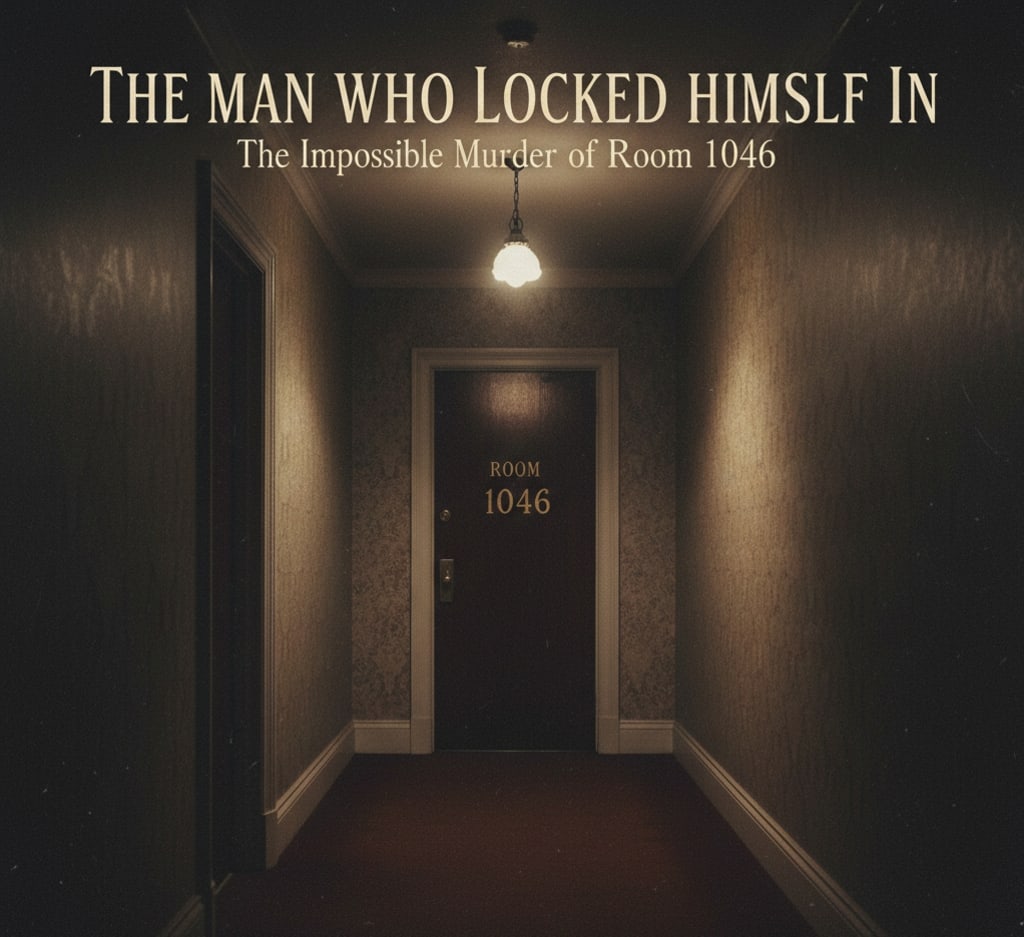
There are murders that frighten you because they are violent. And then there are murders that frighten you because they make no sense at all. The case of Room 1046 sits firmly in the second category — a story built of contradictions, shadows, unanswered questions, and a victim whose own identity was a mystery.
The year was 1935. The place: the President Hotel in Kansas City, Missouri. A tall building, busy enough to feel alive but quiet enough for travelers to disappear in the flow of guests. People checked in. People checked out. Nothing unusual.
Until a man calling himself Roland T. Owen walked through the lobby doors and changed the hotel’s history forever.
A Man With No Story
He arrived with almost nothing:
A comb. A toothbrush. A hairbrush.
No luggage.
No real address.
A name that felt like a pseudonym from the moment he spoke it.
Witnesses described him as polite but tense, like someone carrying a weight he didn’t want to explain. He requested an interior room — one with no window view — and the clerk handed him the key to Room 1046.
That was the last normal moment in the entire case.
From here on, the story bends into angles that don’t fit.
The First Strange Signs
Housekeeping entered his room later and found something odd:
Owen was sitting in the dark.
All the lights were off, the blinds drawn tight, as if the outside world was an enemy.
He seemed nervous. Distracted.
He spoke quietly, almost carefully, as if someone else was listening.
A maid later recalled his words:
“Don’t lock the door — I’m expecting someone.”
That sentence became a puzzle piece no one could place.
Who was he waiting for?
Why in the dark?
Why in a nearly empty hotel?
The Phone Calls, the Voices, the Fear
In the next 24 hours, staff noticed more odd behavior:
• Owen kept the room completely dark.
• He barely left his bed.
• He spoke to someone on the phone in a low, worried voice.
• He mentioned a man named “Don” — a name that would become the ghost of the investigation.
Witnesses heard fragments like:
“I’ll be there tomorrow… I knew that…”
“Don, don’t put it off, let’s settle it.”
Settle what?
Money? Threats? Blackmail? Something darker?
No one knows.
But the fear in his voice stayed with every witness who heard it.
The Night Everything Broke
By the second night, the hotel staff noticed the door to Room 1046 locked from the outside — which meant someone had left. But Owen was still inside.
That detail alone makes the case feel impossible.
How does a man stay inside a locked room… without locking it?
Was he hiding from someone?
Was someone locking him in?
Or was someone entering and exiting quietly, with a key that should not have existed?
The answer never came.
The Discovery: A Room of Shadows and Blood
On the morning of January 4th, a bellboy approached Room 1046 to deliver a message. The door was still locked. He knocked. A weak voice answered:
“Come in.”
But the door was locked — from the inside this time.
When the bellboy reminded the man he couldn’t enter, the voice simply replied:
“Turn on the lights.”
It made no sense.
Finally, worried, staff fetched a master key.
And when the door opened, the scene inside looked like something from a nightmare.
Owen was on his knees, naked, drenched in blood, his hands bound, his head wounded. The telephone had been ripped from the wall. Towels, sheets, and the carpet were soaked red.
Yet he was still alive.
Barely.
When asked who did this, he whispered something that still haunts police files:
“Nobody did this… I fell… against the bathtub.”
A man with stab wounds and bindings was trying to protect someone — or something.
Minutes later, he collapsed.
By that afternoon, Roland T. Owen was dead.
A Murder With No Murderer
The autopsy revealed clear torture:
multiple stab wounds, fractured skull, strangulation marks.
This wasn’t an accident.
This wasn’t self-inflicted.
This wasn’t a robbery — no valuables were missing.
This was a deliberate attack.
Yet:
• No weapon was found.
• No fingerprints.
• No bloody knife.
• No forced entry.
• No eyewitnesses.
• No motive.
Room 1046 had been cleaned of logic.
The Mystery of His Identity
Even his name unraveled.
“Roland T. Owen” didn’t exist.
Months later, a woman came forward and identified him as Artemis Ogletree, a young man from Birmingham, Alabama — a man who had disappeared and whose life was already tangled in strange relationships.
Rumors swirled about a jealous lover.
A dangerous companion.
A controlling older man.
A criminal network.
But nothing connected cleanly.
The Phone Call at the Funeral
The story should have ended with his burial.
It didn’t.
Before the funeral, the local newspaper received a mysterious call. The voice on the line said Artemis had gotten into trouble with “a woman.” Then the caller insisted the murder was “justice.”
He refused to give his name.
He hung up.
Police could never trace the voice.
Somewhere, someone knew exactly how Artemis died — and why — but preferred to leave the truth sealed shut.
Why Room 1046 Still Haunts Investigators
The case has everything a mystery needs:
A false identity.
A terrified man.
A locked room.
A vanished killer.
A cryptic phone call.
A victim who protected someone even while dying.
Detectives later admitted the crime felt “personal,” as if Owen knew his attacker. Maybe he loved them. Maybe he feared them. Perhaps both.
The impossibility of the room remains the heart of it:
How does a man get tortured for hours in a hotel room without anyone hearing?
How does the attacker enter and exit without being seen?
How does the room lock itself again?
These questions float in the case like dust caught in a beam of light — visible yet unreachable.
A Mystery That Refuses to Close
Almost ninety years have passed.
The hotel stands.
The hallway still exists.
Room 1046 has been renumbered, remodeled, repainted. But its story sits underneath every layer like a permanent stain.
What happened in that room wasn’t just a murder — it was a disappearing act performed on truth itself.
The case lives on because it touches that unsettling human fear:
the idea that someone can be hurt, hunted, and erased inside a crowded building…
and the world will never know how.
The locked door kept more than a killer out.
It kept the truth in — and sealed it away forever.
About the Creator
The Insight Ledger
Writing about what moves us, breaks us, and makes us human — psychology, love, fear, and the endless maze of thought.
Keep reading
More stories from The Insight Ledger and writers in Criminal and other communities.
The Silent Twins: A Bond So Deep It Terrified Everyone Who Tried to Break It
There are mysteries made of missing people, strange footprints, or odd camera footage. Then there are mysteries like that of June and Jennifer Gibbons — two girls who never disappeared, never hid, never ran… yet remained unreadable, unreachable, and ultimately unexplainable. Their story feels less like true crime and more like a psychological ghost story written in real time.
By The Insight Ledger about a month ago in Criminal
Inside the 2001 Scottsdale Family Murders
On April 10 2001 a quiet neighborhood in Scottsdale, Arizona, became the scene of one of the most disturbing family murder cases in modern American history. What initially appeared to be a tragic house fire quickly unraveled into a calculated act of violence that left three people dead and one man missing—a mystery that remains unresolved more than two decades later.In the early hours of the morning, Scottsdale firefighters and police were dispatched to the home of Robert and Mary Fisher after reports of a massive fire and explosion. The blast was later determined to have been caused by natural gas that had accumulated inside the house before ignition. Flames engulfed the structure, suggesting at first glance a devastating accident. However, once firefighters extinguished the blaze and investigators entered the home, the reality proved far more sinister.
By Kure Garbaa day ago in Criminal
Miss Persephone's Manual to a Seemingly Ordinary Life
Miss Persephone was found at the dining table, her blue eyes swollen, her tears arriving and retreating like the tides of the ocean. Earlier that day, her family had visited her in the retirement home where she had lived for eight years. It was her eightieth birthday.
By Imola Tóth4 days ago in Fiction



Comments (1)
Nice