
The Girl Who Uploaded Her Escape
A runaway, a hidden town, and the final video that should never have existed

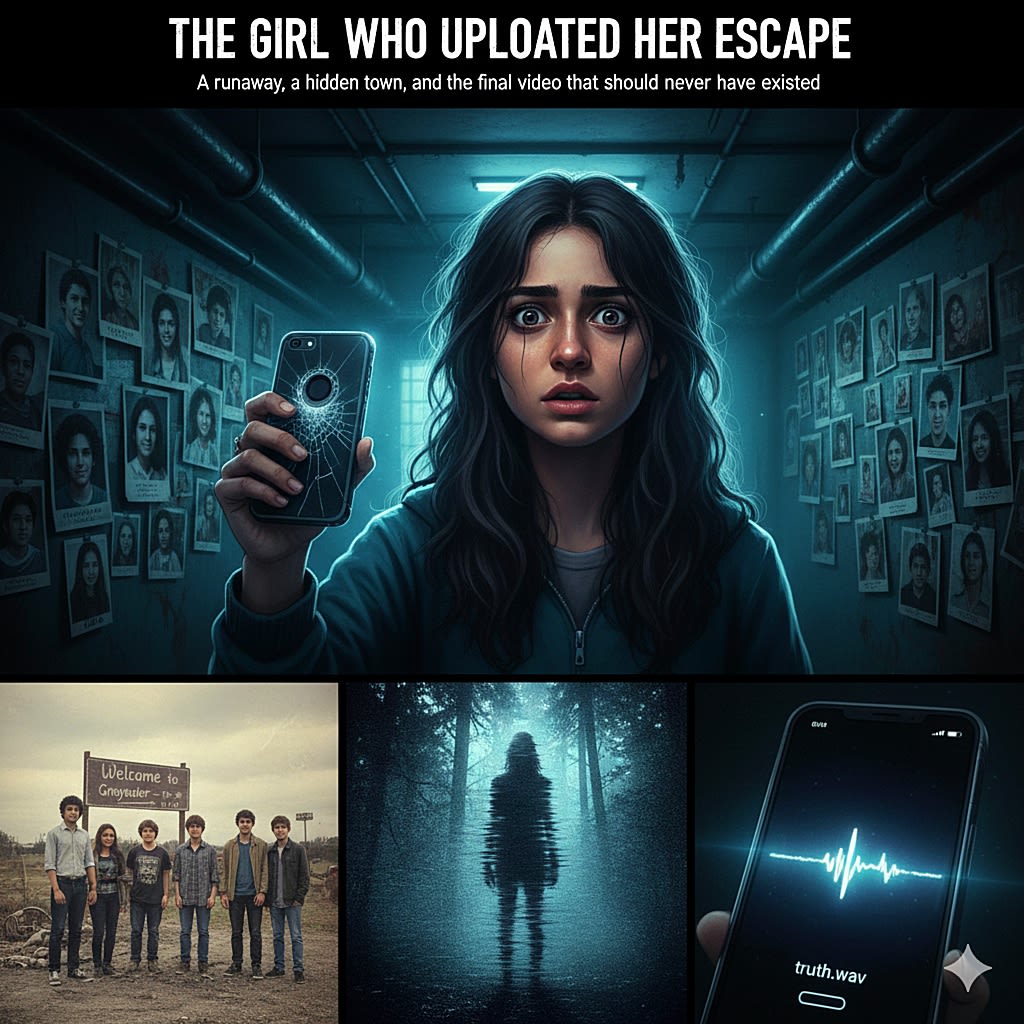
Mira Khan had always believed that the internet was a place where people pretended to be themselves. Profiles were masks, timelines were half-truths, and comments were echoes of strangers. But on the night she decided to disappear, Mira made a choice no one expected from a girl who avoided attention: she began recording everything.
Not for fame.
Not for safety.
But to leave behind a trail that couldn’t be erased.
Her first upload was a seven-second clip posted at 1:13 a.m., filmed in the dark. Only her voice was clear:
“If they find this before they find me… tell my brother I tried.”
Most people ignored the clip. The ones who didn’t thought it was storytelling or some viral stunt. No one guessed that Mira was already gone from her city.
The Escape Begins
Two hours earlier, Mira had been sitting in her apartment, shaking hands pressed against a sealed envelope addressed to her. Inside was a printed photograph—grainy, edited, old enough to look washed-out. It showed a group of five teenagers standing in a rural junkyard. Four were strangers. The fifth was Mira herself, younger, terrified, and unmistakably visible.
The problem was simple:
Mira had never been to that junkyard.
She had never met the other four people.
And she had no memory of ever standing for that photo.
Yet the timestamp burned at the bottom corner: 2014.
She was ten.
Someone had edited her into a past she did not belong to. Or worse—someone remembered a version of her life she didn’t.
An hour later she packed a backpack, withdrew whatever money she could, and slipped out.
She didn’t call anyone. She didn’t leave a note.
She only opened her camera.
The Uploads
Her second video appeared four hours after the first. Mira was in a bus station, light flickering above her head. Her eyes were swollen as if she had been crying for hours.
“If someone sends you a memory that isn’t yours,” she whispered, “does it belong to you or to them?”
The comments flooded now.
Some confused.
Some intrigued.
Some frightened.
A few users tried to track her location from posters on the wall behind her, but she kept moving. Every upload was from a new place: a highway restroom, an empty diner, the edge of a gas station parking lot. She never said who she was running from, but in one video she turned suddenly, staring over her shoulder, and the camera shook violently.
People paused, zoomed in, screenshot the frame.
Behind her, blurred by motion, was a human figure—too tall to be normal, too thin to be healthy, and standing completely still.
The video went viral.
The Hidden Town
Three days later, she uploaded her longest recording. It started with her walking along a cracked road disappearing into a forest. A broken wooden sign appeared in the corner of the frame:
“Welcome to Greywater – Pop. 214”
Yet the sign looked decades old, untouched, forgotten by maps and officials.
Mira’s narration was low but steady.
“I followed the back of the photo. It was printed on special stock, the kind used by ID programs. The stains matched chemicals from old film labs. So I looked for towns with abandoned processing shops. Greywater has one… or had.”
She lifted the camera toward a row of collapsed metal sheds.
“That junkyard from the photo was here. Or used to be.”
The stillness of the place made the video unsettling. There were no birds, no wind, no insects. Just empty land. The comments exploded with theories:
The town is cursed.
Digital memory experiments.
This is AI footage.
This is a missing person in real time.
At the end of the video, Mira found a small warehouse door half-open. She pushed it gently with her foot. The screen went black.
The internet waited for her next upload.
It didn’t come for twenty-one hours.
The File Named “truth.wav”
Her next post wasn’t a video. It was an audio file titled truth.wav.
In the recording, Mira’s breathing was rough. She spoke in fragments.
“There were photos inside… thousands… not just of me… all children… staged, posed… someone was creating entire childhoods…”
A clatter, like a chair falling.
“They weren’t editing. They were restoring. They were putting memories back… memories that were removed.”
Then she whispered a sentence that made everyone who heard it freeze.
“I think they want to return me to a life I never lived.”
The audio ended abruptly.
Within an hour, the recording was deleted by the platform automatically for “violating safety policies.”
People re-uploaded copies. Those copies vanished within minutes.
Someone didn’t want the file circulating.
The Final Video
Two days later she posted again.
This time the video didn’t start with her breathing or running.
It showed her sitting inside what looked like an underground room. Pipes ran across the ceiling. Her hair was messy, her clothes dirty, but her eyes were focused and strangely calm.
“I found the people from the original photo.”
She pointed the camera to a wall covered in pinned images—faces of teenagers, their expressions frozen in unease.
“They’re alive. They’re older now. They’re here. They don’t leave the facility. They said the photo wasn’t fake. I was there. I just don’t remember it. I was part of a… program.”
She didn’t say what program. She didn’t say who ran it.
She only said:
“They want me to stay. They said if I leave again, things will become difficult for my family. So this is my last chance to say something.”
Mira leaned closer to the camera.
“If anyone is watching this… don’t let people rewrite your past. Even if the past is painful. Even if you don’t remember everything. A life you don’t recall is still yours. Not theirs.”
Behind her, a door slammed.
She flinched but didn’t stop recording.
“I’m going to leave now. If this goes online, it means I made it to the server room. If it doesn’t… then I’m still here.”
The video cut to static.
That was the last anyone saw of her.
The Aftermath
Her account was wiped clean within hours.
Her videos were mirrored by fans and investigators, but many versions were corrupted, frames missing, audio glitched.
Authorities claimed no such town named Greywater existed.
Maps showed no abandoned film lab.
The population sign from the video didn’t match any registered municipality.
Yet offline explorers—urban adventurers, digital detectives, abandoned-town enthusiasts—claimed they found tire marks on a road similar to the one in her footage. Some said they saw the warehouse door. Others swore they heard noise inside.
No one found Mira.
But the most disturbing clue surfaced three months later.
A user searching for old archives of lost communities found a photograph in a government database. It was dated 2014. The image showed the same junkyard from Mira's first mysterious photo. The same teenagers. The same background.
Only this time, Mira wasn’t in it.
There was no trace of her silhouette at all.
It was as if she had never stood there… and had been added later… or removed earlier.
Or both.
The Upload That Should Not Exist
Six months after her disappearance, a single video appeared on her old account.
Her username.
Her profile picture.
Her banner.
Everything restored.
The video was three seconds long.
A road at night.
Headlights approaching.
And Mira’s voice in a whisper:
“I’m not done yet.”
The clip vanished after ten minutes.
Screenshots were blurry.
The URL became inaccessible.
No one could confirm whether Mira herself uploaded it…
or whether someone else wanted the world to think she did.
And so the mystery still floats in the digital dark, a fragment of a life bent between two realities—the one she remembered, and the one that tried to claim her.
Stories about her continue to grow, because people fear what she discovered:
Sometimes the internet doesn’t just keep your memories.
Sometimes it creates new ones…
and waits for you to catch up.
About the Creator
AngelFace
✨ “I share mysteries 🔍, stories 📖, and the wonders of the modern world 🌍 — all in a way that keeps you hooked!”
The Cemetery of the Living”: The Harsh Reality Inside El Salvador’s Infamous Prison
For many migrants deported from the United States during the administration of **Donald Trump**, the journey did not end when their plane touched down in their home countries. For some, particularly those sent back to **El Salvador**, the ordeal had only just begun. Many deportees—suspected of gang connections or criminal activity—found themselves locked inside some of the most notorious prisons in Central America, facilities critics have described as nothing less than a “cemetery of the living.”
By Irshad Abbasi 6 days ago in Criminal
Former DOJ Officials Break Silence on Kiernan Major Case
Through a swarm of vehicle and body doubles, elaborate disguises, sophisticated misdirection, and all-around flawless tradecraft, two senior U.S. Justice Department officials out of the Washington D.C. office met with our investigative team in a Los Angeles area home to blow the whistle on what they called "one of the most dishonest and disgraceful" cases they had ever reviewed. Our four-hour interview still feels as though it was much stranger than fiction—surrounded ostensibly by hundreds of security personnel who blocked all traffic to and from the property and implemented a stunning variety of physical and technical expertise to draw attention of potential emergency personnel and bystanders elsewhere, our team was in total awe of the immense and rather imposing capabilities of this security team. We often were unable to even focus on the interviews as we struggled to grasp whether this was reality or possibly figment of our imagination. In spite of our childish fascination, our team was able to gather a fresh and highly credible perspective that raises grave concerns about the 2022 federal indictment of Kiernan Major and many of those allegedly involved in it.
By Charlie A. Millerabout 20 hours ago in Criminal
Early March 2026: 4 Goals Accomplished
It's early March and I've now accomplished my 4th writing goal for the year of 2026. Before diving into the behind-the-scenes of it... why not tell you up front what that accomplishment was? I was published in a 2nd publication for this year. Published in Helix Literary Magazine out of Central Connecticut State University. You can read it for free right now!
By Stephen Kramer Avitabile7 days ago in Writers



Comments
There are no comments for this story
Be the first to respond and start the conversation.