
The Girl Who Refused to Die
The Bone-Chilling True Story of Survival, Resilience, and the Unbreakable Human Spirit


In the grim annals of true crime, there are stories that chill the bone, and then there are stories that redefine the very essence of human resilience. The story of Mary Vincent is both. It is a harrowing descent into the darkest depths of human cruelty, followed by an ascent fueled by a will to live that defied every law of medicine, logic, and fate.
A Desperate Escape into the Unknown
The year was 1978. Fifteen-year-old Mary Vincent was a girl caught in the suffocating crossfire of her parents' volatile and violent relationship. Seeking a sanctuary the world had yet to offer her, she made a snap decision—the kind born of youthful desperation and the naive belief that anywhere was better than home. With dreams of becoming a professional dancer in Los Angeles, she stood on the edge of a dusty highway in Bakersfield, California, sticking her thumb out to the passing world.
She was 400 miles away from her dream, with no money, a small suitcase, and a heart full of fragile hope. After many cars ignored her, a small blue van pulled over. Behind the wheel sat Lawrence Singleton, a man in his fifties who projected an aura of grandfatherly kindness. He spoke softly, claiming he was headed exactly where she needed to go. Mary, relieved to be off the road, climbed in, unaware that she had just stepped into a mobile chamber of horrors.
The Mask of Sanity Slips
For the first few hours, the journey was mundane. They shared small talk, and Mary even felt safe enough to drift off to sleep. But as she woke, the sunlight was fading, and the van was veering off-path toward the desolate stretches of Nevada. Sensing a shift in the atmosphere, Mary grabbed a sharp object she found nearby and demanded he return to the main road. Singleton, a master manipulator, feigned a humble apology, claiming he had simply lost his way in the twilight.
The moment she lowered her guard to tie her shoelaces, the monster emerged. Singleton struck her with a savage force that plunged her into immediate unconsciousness. What followed was a blur of unspeakable, prolonged trauma. He assaulted her repeatedly, bound her hands behind her back, and forced alcohol down her throat to keep her in a terrified, semi-conscious stupor.
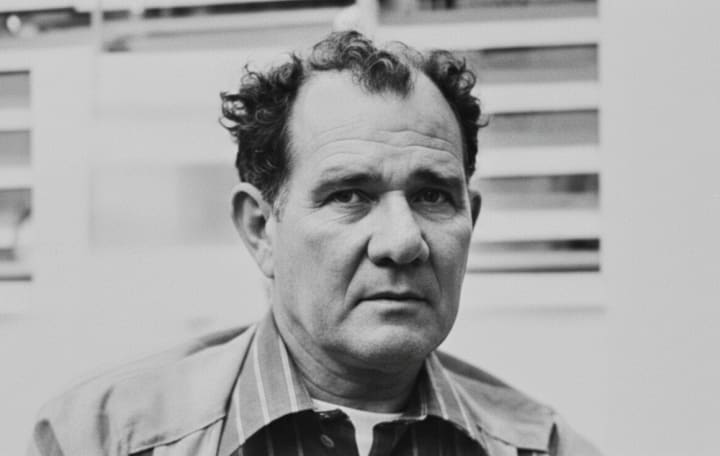
The Mutilation in the Desert
In a remote, silent area of the Del Puerto Canyon, Singleton offered her a cruel, deceptive bargain: "If you want your freedom, get out and lie on the ground." Mary obeyed, her mind clinging to the instinct of survival. But Singleton didn't intend to let his witness walk away; he wanted to erase her from existence.
He emerged from the back of the van wielding a small, sharp hatchet. As Mary’s screams echoed against the canyon walls, he pinned her down. With clinical, detached coldness, he hacked off her right arm at the forearm, then her left. His intent was meticulously evil: to leave her to bleed out in the dirt, naked and anonymous, with no fingerprints left to identify her remains once the scavengers found her. He dragged her broken frame to a concrete culvert and tossed her over the edge. His final words were a taunt: "There, now you’re free."
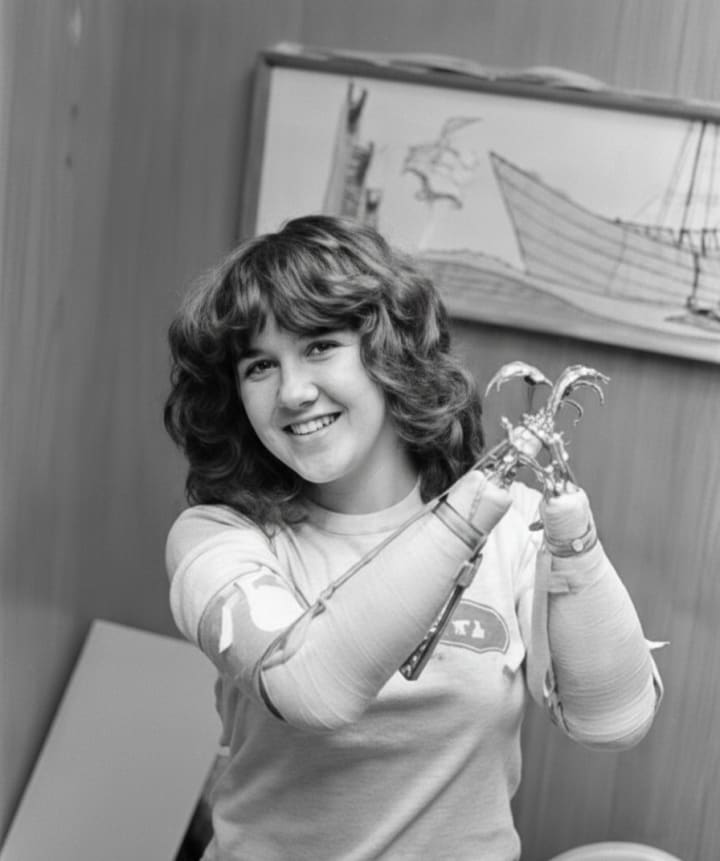
Three Miles of Pure Willpower
Mary Vincent did not die. Against all biological odds, the freezing night air caused her blood vessels to constrict—a phenomenon known as vasoconstriction—which miraculously slowed her hemorrhage. She woke up in the pitch black of the culvert, staring at the raw stumps where her hands had been. Most would have surrendered to the encroaching darkness. Mary chose to fight.
Using her elbows and heels, she clawed her way out of the concrete tomb. For three agonizing miles, she trudged through the wilderness, holding her bleeding limbs upright toward the sky to keep the life from leaking out of her. When she finally reached the highway at dawn, she was a specter of pure horror—naked, covered in dust, and drenched in blood. Several cars sped past, the drivers paralyzed by the sight of her. Finally, a compassionate couple pulled over, wrapped her in blankets, and raced her to the hospital.
The Long Road to Reclaiming Life
The physical recovery was a marathon of pain. Surgeons performed revolutionary procedures, using skin and bone from her legs to repair what was left of her arms. Yet, the mental scars were even deeper. Mary eventually married and had two children, but the trauma of 1978 was a constant shadow. She faced divorce, grinding poverty, and bankruptcy, as employers were often hesitant to hire a woman with her specific disability.
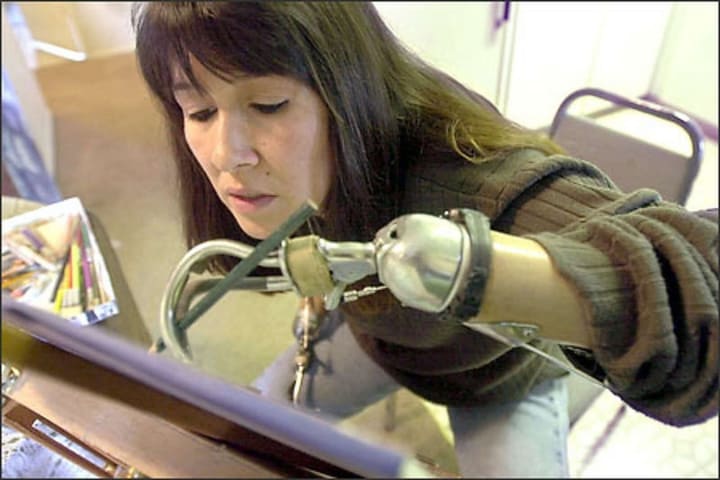
However, the birth of her sons provided a new anchor for her soul. She discovered a dormant, powerful talent for art. Using prosthetic limbs, she taught herself to draw and paint with incredible precision. Her art became her sanctuary and eventually her triumph.
Her vibrant, emotive paintings began to sell for thousands of dollars, and she became a fierce advocate for victims' rights. She famously stated that she wanted the world to know her for the artist she is, not the victim she was.
A Failure of the System
The tragedy of Mary’s story is compounded by the staggering failure of the justice system. Lawrence Singleton was sentenced to 14 years but was released after serving only eight for "good behavior." This "model prisoner" was unleashed back into a society he had already terrorized.
Years later in Florida, the monster struck again, brutally murdering Roxanne Hayes, a mother of three. This time, he was sentenced to death, but he cheated the executioner, dying of natural causes in prison in 2001. Investigators believe his victim count may have been much higher, involving many unsolved disappearances.
The Legacy of a Warrior
Mary Vincent’s story serves as a permanent testament to the fact that the human spirit is infinitely harder to break than the human body. She was left for dead in a desert ditch, but she rose, she walked, and she eventually soared. She didn't just survive a monstrous crime; she conquered a destiny that was meant to end in a silent canyon.
About the Creator
Keep reading
More stories from Mayar Younes and writers in Criminal and other communities.
The Sole Survivor: A Silent Scream in the Face of Death
The most heart-wrenching stories often begin in places where safety should be guaranteed: at home. In 1987, the lives of Saye Rivazfar, her younger sister Sara, and their brother Arash took a dark turn following the divorce of their parents, Patricia and Ahmad. While their father, of Iranian descent, settled in New York, the three children remained with their mother in Pensacola, Florida.
By Mayar Younes3 days ago in Criminal
Trump, Obama, and the “Apes” Controversy: A Political Storm That Shook American Discourse
**Trump, Obama, and the “Apes” Controversy: A Political Storm That Shook American Discourse** A new wave of controversy has swept through American politics after a video circulated online showing former President Barack Obama and former First Lady Michelle Obama depicted as apes. The clip, which was briefly shared from an account associated with former President Donald Trump, immediately ignited outrage, debate, and intense media attention. Even though the video was quickly removed, the incident reopened deep conversations about race, political rhetoric, and the power of imagery in modern politics.
By America today 3 days ago in Criminal
The Mystery of the Silent Thief
Detective Ravi had seen many cases in his ten years on the force, but the theft at the Grand Market was unlike anything he had ever encountered. Valuable items had gone missing from multiple shops overnight, but there were no signs of forced entry, no fingerprints, and no witnesses. The town was in panic, and the shopkeepers demanded answers.
By Sudais Zakwan3 days ago in Criminal
Field of the Fallen
Sunlight danced softly across the frost-crusted fields, making the little blades of grass sparkle like emeralds. The faraway chirrup of a songbird was the only disruption to the quiet of the morning. An icy chill, the last vestige of the dying winter, clung to the air, settling in a thick white mist at the far side of the open field. The heavy stench of decay hung in that mist, punctuation by the sharp tang of freshly spilled blood.
By A. J. Schoenfeld7 days ago in Fiction



Comments
There are no comments for this story
Be the first to respond and start the conversation.