
The Fall of El Chapo: The Man Who Built a Drug Empire Beneath the Earth
From humble beginnings in Mexico’s mountains to the world’s most notorious kingpin — the rise, reign, and downfall of Joaquín “El Chapo” Guzmán.

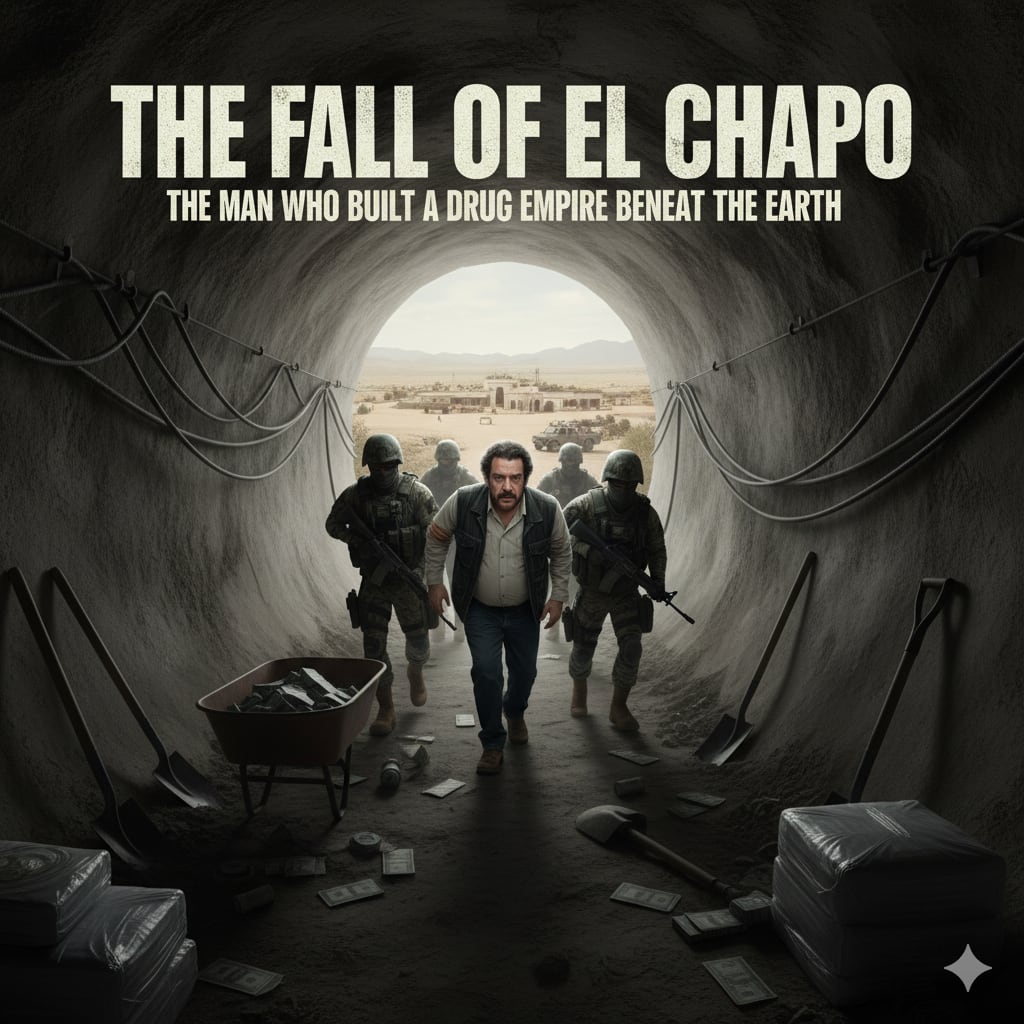
Deep in the rugged mountains of Sinaloa, Mexico, a boy named Joaquín Guzmán Loera was born in 1957 into poverty. His father was a poor farmer who sometimes grew opium poppies to survive. From a young age, Joaquín learned two truths: power came from money, and money came from risk.
By his teens, he was already working for local smugglers, guiding marijuana and cocaine shipments through mountain passes. Small, quick, and sharp-minded, he earned a nickname that would follow him forever — “El Chapo,” meaning “Shorty.”
But behind his small stature was an enormous ambition.
The Rise of a Cartel Legend
During the 1980s, the Mexican drug trade was shifting. The death of Colombian kingpins like Pablo Escobar opened a gap in global supply chains. Guzmán, working under Miguel Ángel Félix Gallardo (the godfather of the Guadalajara Cartel), saw an opportunity.
When Gallardo’s organization fractured, El Chapo founded his own group — the Sinaloa Cartel — and began smuggling cocaine and heroin directly into the United States.
His secret? Innovation.
El Chapo understood logistics better than anyone. While other traffickers used risky border crossings, he built tunnels — deep, air-conditioned underground routes stretching for miles beneath the U.S.-Mexico border. These tunnels changed the game.
Authorities called it “the most advanced smuggling system in the world.”
At its peak, the Sinaloa Cartel was estimated to control 25–40% of the global drug trade, earning billions every year. Guzmán’s empire spanned continents — from South America’s jungles to U.S. cities, from Europe to Australia.
The Myth of El Chapo
El Chapo wasn’t just a drug lord — he was a legend. To some in Sinaloa, he was a Robin Hood figure who built roads, schools, and gave money to poor villagers. To others, he was a ruthless killer responsible for thousands of deaths.
He kept his enemies close — and buried those who betrayed him. His network of loyalty was bound by fear and wealth. He bribed police, judges, and even top government officials.
The cartel’s reach was so vast that in some parts of Mexico, his name was whispered more than the president’s.
The Great Escapes
El Chapo became famous not only for his empire but for his escapes.
In 1993, he was arrested in Guatemala and sentenced to 20 years in a Mexican prison. Yet even behind bars, his influence grew. Guards treated him like royalty. In 2001, after eight years, he escaped — hidden inside a laundry cart, pushed out by bribed guards.
For over a decade, he lived freely, protected by locals who saw him as a benefactor. His wealth and power only expanded.
In 2014, authorities captured him again. The world celebrated — but El Chapo had other plans. A year later, he escaped through a mile-long tunnel dug directly into his prison shower. The tunnel was equipped with lights, air, and a modified motorcycle rail system.
It was one of the most daring prison breaks in modern history.
The Empire Crumbles
But the walls were closing in. The DEA, Interpol, and Mexican Marines intensified their hunt. His communications were intercepted, and betrayal crept within his circle.
In 2016, during a dramatic raid in Los Mochis, Sinaloa, El Chapo was finally captured for the last time. He was extradited to the United States, where he faced multiple charges — including murder, drug trafficking, and money laundering.
In 2019, a U.S. court sentenced him to life in prison plus 30 years. Today, he sits in ADX Florence, the most secure prison in America — a concrete fortress for the world’s most dangerous criminals.
Legacy of a Kingpin
Yet El Chapo’s story doesn’t end there. His sons — known as “Los Chapitos” — have continued to run parts of the Sinaloa Cartel. New alliances, new enemies, and new wars rage across Mexico.
His empire adapted, evolving into a digital, decentralized crime machine.
Some call him a symbol of Mexico’s corruption; others see him as a warning of what desperation and ambition can create. What began in the dusty fields of Sinaloa became a global empire of death and power — and its shadow still haunts the world today.
El Chapo’s tunnels may be sealed, but the world he built beneath them still lives — unseen, unstoppable, and dangerously alive.
About the Creator
shakir hamid
A passionate writer sharing well-researched true stories, real-life events, and thought-provoking content. My work focuses on clarity, depth, and storytelling that keeps readers informed and engaged.
Keep reading
More stories from shakir hamid and writers in Criminal and other communities.
The Ghost of Moscow: The Billion-Dollar Crimes of Semion Mogilevich
In the dark corridors of global finance, where politics, business, and organized crime intersect, one name has lingered for decades — Semion Mogilevich. To most, he’s invisible. To law enforcement, he’s the “Boss of Bosses.” To those who crossed him, he’s the ghost who always wins.
By shakir hamid5 months ago in Criminal
I Think My Mirror Is Alive
The Mirror I Found at a Flea Market It started with a mirror I probably should never have bought. Last summer, while wandering through a crowded flea market, I noticed it leaning against a wooden table. It was old—far older than anything else around it. The frame was dark wood, carved with strange patterns that looked almost like twisted vines or claw marks.
By The Glitch Archive5 days ago in Criminal


Comments
There are no comments for this story
Be the first to respond and start the conversation.