
The Epstein Files – Part 4: Politics, Power, and the Battle Over the Truth
Associations, Allegations, and the Ongoing Fight to Release the Full Epstein Records

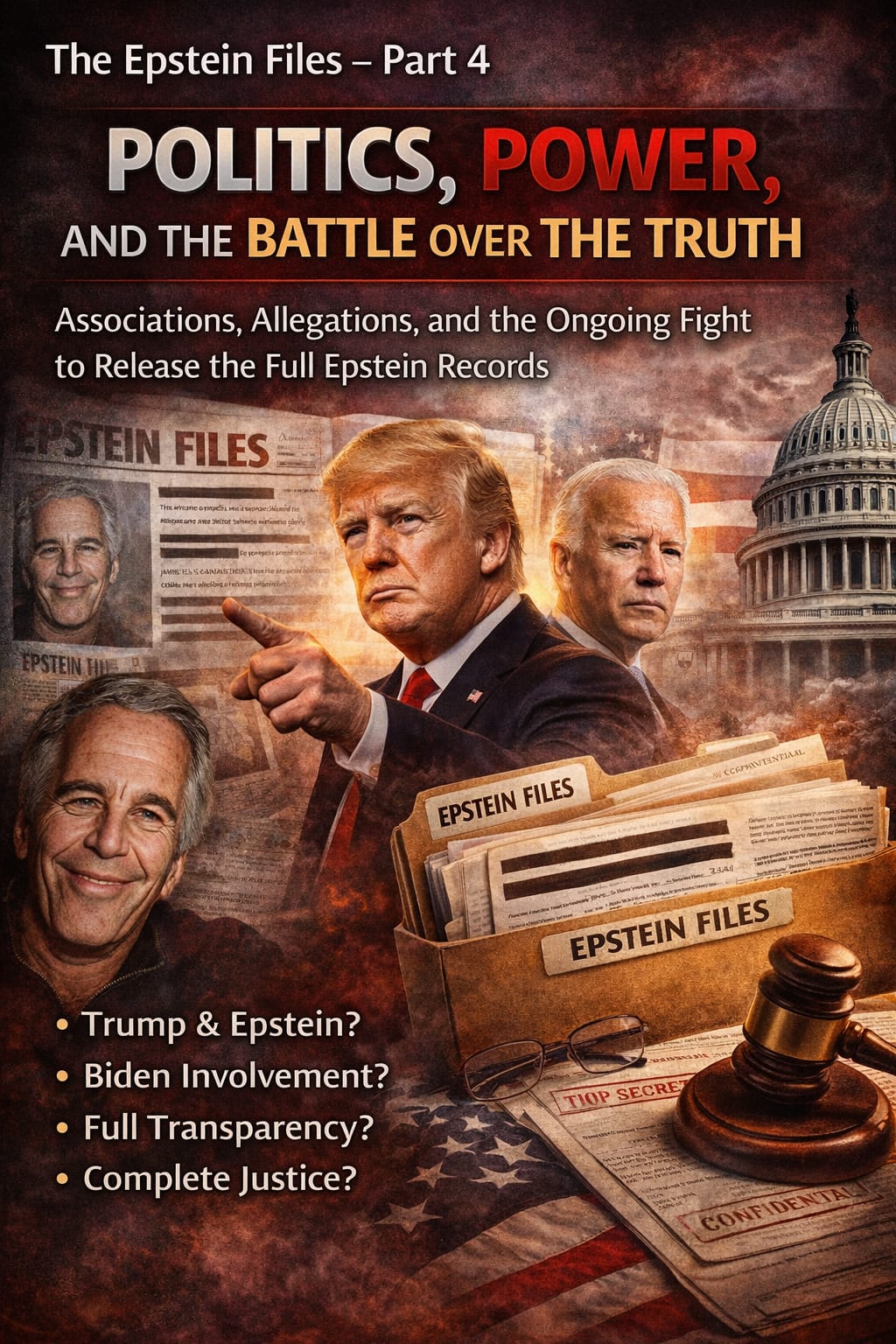
The Epstein case has never been just about one man.
It became a story about power, privilege, politics — and the question millions continue to ask:
Who knew what?
In Part 3, we explored how Jeffrey Epstein’s arrest in 2019 reignited global outrage, and how his sudden death inside a New York jail cell fueled conspiracy theories across the political spectrum.
Now, in Part 4, we look at one of the most debated aspects of the entire scandal: Epstein’s connections to powerful political figures — especially former President Donald Trump — and the controversy surrounding the release of the so-called “Epstein Files.”
________________________________________
The Trump–Epstein Relationship: What Is Documented?
Donald Trump and Jeffrey Epstein moved in similar elite social circles during the 1980s and 1990s, particularly in New York and Palm Beach.
Public records show:
• They attended some of the same social events.
• They were photographed together at parties.
• Trump once described Epstein in a 2002 magazine quote as someone who “likes beautiful women as much as I do, and many of them are on the younger side.”
Trump has also publicly stated that he later cut ties with Epstein and banned him from Mar-a-Lago years before Epstein’s 2019 arrest.
While photos and documented social interactions exist, no court has convicted Trump of criminal wrongdoing related to Epstein’s trafficking case.
However, their past association remains heavily scrutinized, particularly given the explosive nature of Epstein’s crimes.
________________________________________
Allegations and Claims: Separating Fact from Assertion
Over the years, various individuals have made allegations involving high-profile figures who attended parties or events where Epstein was present.
For example:
• Former model Stacey Williams alleged in interviews that during the early 1990s she had an uncomfortable encounter involving Trump while she was in Epstein’s social circle.
• Other accusers have described events at gatherings attended by wealthy or politically connected individuals.
It is important to note:
• These allegations have not resulted in criminal convictions against Trump.
• Many claims have been reported in media but remain legally disputed or unproven in court.
Because of the high-profile nature of the case, public discussion often blends documented facts, sworn testimony, speculation, and online rumor — making it critical to distinguish verified legal outcomes from allegations.
________________________________________
The Push to Release the “Epstein Files”
After Epstein’s death in 2019, public pressure to release all related documents intensified.
Many Americans — across political lines — demanded transparency.
Supporters of Donald Trump, in particular, believed that releasing sealed files would expose political rivals. Meanwhile, critics believed documents might reveal uncomfortable truths about powerful elites across parties.
During the 2024 U.S. presidential campaign, Trump publicly stated that he supported transparency regarding Epstein-related records.
When he returned to office in January 2025, anticipation grew.
Would all documents finally be declassified?
________________________________________
November 2025: A Rare Bipartisan Moment
In November 2025, amid growing public pressure, a bill was introduced in Congress requiring the Justice Department to release remaining Epstein-related files within 30 days.
It was a rare moment in American politics:
Republicans and Democrats both supported greater disclosure.
Unlike parliamentary systems such as India’s — where party leadership can compel members to vote along party lines — members of the U.S. Congress have greater freedom to vote independently.
The bill passed with bipartisan support.
Public expectations skyrocketed.
Many believed the full truth was finally about to surface.
________________________________________
December 19: The Document Release
When the Justice Department released documents on December 19, 2025, thousands of pages became public.
However, a significant portion of the material was heavily redacted.
Large sections were blacked out.
Names were withheld.
Sensitive details were obscured.
Officials stated that redactions were necessary to:
• Protect ongoing investigations
• Safeguard victims’ privacy
• Comply with federal privacy laws
For some Americans, the release felt incomplete.
For others, it was proof that transparency had limits.
________________________________________
What the Documents Revealed
Among the released materials were:
• Flight logs from Epstein’s private jet
• Email communications
• Contact book entries
• Interview summaries
Donald Trump’s name appeared in certain documents, including references to social interactions and historical flight records.
Some reports referenced past travel on Epstein’s aircraft — though these claims have been debated and clarified in different contexts over the years.
Importantly:
Being named in Epstein-related documents does not equate to criminal involvement. Many individuals whose names appear in contact lists or flight logs have not been charged with any crime.
Still, the public reaction was intense.
Supporters and critics interpreted the documents through sharply different political lenses.
________________________________________
The Conspiracy Theories Return
With redactions covering major portions of the files, speculation surged once again.
Online discussions reignited claims that:
• Powerful figures were being protected
• Critical evidence was withheld
• Epstein’s death prevented a wider exposure of elites
Even a reported tip received by the FBI in 2020 resurfaced in public debate — though no confirmed legal action resulted from it.
Social media amplified partial information, screenshots, and excerpts, often without full legal context.
The phrase “Epstein Files” became less about a single criminal case and more about broader distrust in institutions.
________________________________________
Why This Story Continues to Divide America
The Epstein case sits at the intersection of:
• Wealth and power
• Media influence
• Political polarization
• Institutional trust
For Trump supporters, some believed document releases would damage political opponents.
For Trump critics, some believed the files could implicate members of his social circle.
For victims, the focus remains justice and accountability — not partisan politics.
The tragedy is that Epstein’s death prevented a full public trial.
No cross-examinations.
No complete testimony under oath.
No courtroom exposure of every potential connection.
That absence created a vacuum.
And in a vacuum, speculation grows.
________________________________________
The Larger Issue: Transparency vs. Privacy
The debate over the Epstein Files also raises complex legal questions:
• Should all names in investigative documents be public?
• How do authorities protect victims while ensuring transparency?
• At what point does public interest outweigh personal privacy?
Governments must balance disclosure with due process.
But in high-profile cases involving elite figures, every redaction becomes suspicious in the eyes of the public.
________________________________________
The Unfinished Chapter
Years after Epstein’s death, the story refuses to disappear.
Civil lawsuits continue.
Court records are still being unsealed gradually.
Journalists continue investigating.
Political rhetoric continues evolving.
But one reality remains unchanged:
The full courtroom truth — tested through trial — never happened.
And because it never happened, questions continue to echo.
________________________________________
Final Thoughts
The Epstein Files are no longer just about Jeffrey Epstein.
They represent a deeper public anxiety about power, privilege, and accountability.
They force uncomfortable questions about elite networks.
They expose how fragile public trust can be.
And they show how, in the absence of full legal closure, history becomes contested terrain.
Whether viewed as a criminal scandal, political controversy, or institutional failure, one thing is clear:
The Epstein story did not end in a jail cell.
It transformed into one of the most debated modern political controversies of our time.
About the Creator
Adil Ali Khan
I’m a passionate writer who loves exploring trending news topics, sharing insights, and keeping readers updated on what’s happening around the world.
Keep reading
More stories from Adil Ali Khan and writers in Criminal and other communities.
The Last Confession in Cell No. 14
M Mehran The confession came at 2:17 a.m., scratched onto a torn piece of prison stationery, written with a pen that barely worked. By morning, the man who wrote it would be dead. Cell No. 14 had a reputation inside Blackmoor Central Prison. Guards avoided it. Inmates whispered about it. It was where cases went to die—unsolved murders, buried truths, and men society had already forgotten. Daniel Hargreeve had lived in that cell for twelve years. Convicted of the brutal murder of journalist Clara Whitmore, Daniel was labeled a monster by the media. Headlines called him “The Silent Butcher.” He never defended himself in court. Never cried. Never begged. He simply accepted the life sentence and disappeared behind iron bars. But Daniel wasn’t silent anymore. A Crime That Shocked the City Clara Whitmore was fearless. As an investigative journalist, she exposed corruption, drug trafficking, and political scandals that others were too afraid to touch. Her final article, published just hours before her death, hinted at a powerful criminal network operating inside the city’s justice system. The next morning, she was found dead in her apartment—stabbed seventeen times. There were no signs of forced entry. Daniel Hargreeve, her former neighbor, was arrested within 48 hours. The evidence looked airtight: fingerprints on a glass, CCTV footage placing him near the apartment, and a past argument between the two. The public demanded justice, and the court delivered it swiftly. Case closed. Or so everyone thought. Twelve Years of Silence Inside Blackmoor, Daniel became a ghost. He spoke to no one. He refused visitors. Even when beaten by other inmates, he never fought back. Guards said he slept sitting up, staring at the wall like he was waiting for something. Only one person tried to understand him—Detective Elias Monroe. Monroe was a young officer during the original investigation. Something about Daniel’s blank acceptance never sat right with him. Over the years, Monroe revisited the case files obsessively, finding small inconsistencies that others ignored. Missing phone records. A corrupted hard drive. Witnesses who changed their statements. Still, nothing strong enough to reopen the case. Until the night Daniel asked to see him. The Confession When Monroe entered Cell No. 14, Daniel looked older than his 39 years. His hands trembled, not from fear—but urgency. “I didn’t kill Clara,” Daniel said quietly. “But I know who did.” Monroe leaned forward. “Why now?” “Because they’re cleaning up,” Daniel replied. “And I’m next.” Daniel revealed that Clara had discovered a secret alliance between a powerful businessman, a senior judge, and a prison contractor laundering money through private correctional facilities. She hid encrypted files on a flash drive—and trusted Daniel to keep it safe. The night she was murdered, Daniel found her already dead. Before he could call the police, men arrived. Professionals. They framed him with surgical precision. “They told me if I spoke,” Daniel said, “my family would disappear.” So he stayed silent. For twelve years. The Price of Truth That same night, Daniel was found dead in his cell—official cause: suicide. But Monroe knew better. Hidden inside the prison Bible was the flash drive Daniel mentioned. Inside were documents, recordings, and video evidence—enough to bring down an empire. The story exploded. The judge resigned. The businessman fled the country. The prison contractor was arrested trying to destroy records. And for the first time in twelve years, the media used Daniel’s name without the word “killer.” Justice Came Too Late Daniel Hargreeve was exonerated posthumously. His family received an apology. A weak one. Cell No. 14 was sealed permanently. Detective Monroe often stands outside it, reading the copy of the confession Daniel left behind. The last line still haunts him: “The system didn’t fail me. It worked exactly as it was designed.” Why This Crime Still Matters The case of Clara Whitmore reminds us that some crimes are buried not because they’re unsolvable—but because the truth is dangerous. Criminal justice stories like this expose how power, fear, and silence can destroy innocent lives. And sometimes, the most important confession comes when it’s already too late.
By Muhammad Mehran3 days ago in Criminal
The Epstein Saga (File)
For years, the name Jeffrey Epstein floated quietly through elite social circles. He was known as a wealthy financier, a man who entertained billionaires, politicians, academics, and celebrities at lavish properties across the globe. To the public, he appeared mysterious but successful. Behind the scenes, however, a far darker story was unfolding — one that would eventually shake governments, expose legal failures, and lead to the release of what the world now calls the Epstein files.
By Active USA 4 days ago in Criminal
Blessed 33
So I woke up on the morning of February 5, 2026 and guess what and you know what I realized? It’s my 33rd birthday. Do you know what that means? Yes, technically I’m getting old, but what I couldn’t have guessed was this would be one of the best days of my life.
By Joe Patterson4 days ago in Confessions




Comments
There are no comments for this story
Be the first to respond and start the conversation.