
The Disappearence of Malaysia Airlines Flight MH370: AModern Mystery (2014)
A Vanishing Without a Trace

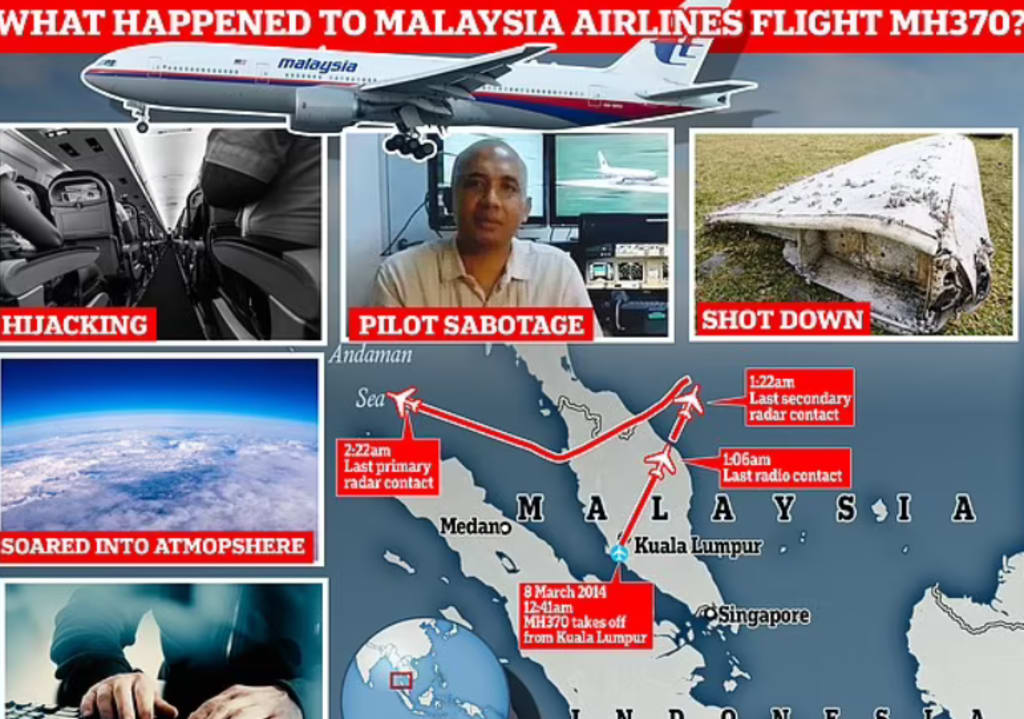
The disappearance of Malaysia Airlines Flight MH370 is one of the most enduring and perplexing mysteries in modern aviation. On March 8, 2014, the Boeing 777-200ER, carrying 239 people, vanished less than an hour after taking off from Kuala Lumpur, Malaysia, on its way to Beijing, China. Despite extensive search efforts, global media coverage, and countless theories, the flight’s final location remains unknown. This case has fascinated the public and captivated the world’s imagination, giving rise to numerous theories, investigations, and questions that remain unanswered. What exactly happened to Flight MH370?
Flight MH370’s Last Moments
Flight MH370 departed Kuala Lumpur International Airport at 12:41 AM local time on March 8, 2014. The aircraft was scheduled to fly to Beijing Capital International Airport, a flight that was routine for Malaysia Airlines, which had operated similar routes for years without incident. Among the 239 people on board, there were 227 passengers from various countries, including China, Malaysia, and Australia, as well as 12 crew members. The flight seemed ordinary—until it wasn’t.
At 1:19 AM, less than an hour after takeoff, the plane lost contact with air traffic control. Just 38 minutes after takeoff, the flight’s last known communication was a routine “Good night, Malaysian Three Seven Zero” from the cockpit, followed by silence. This was the last confirmed transmission from the plane.
At 1:21 AM, the plane’s transponder—an onboard device that transmits the aircraft’s position to radar—was turned off, effectively making the aircraft invisible to conventional radar. Shortly after, the aircraft took an unexpected and unexplained turn westward, deviating from its scheduled route. Initial efforts to locate the plane were focused on the South China Sea, but as investigations progressed, the evidence indicated the plane had continued flying for several hours. According to satellite data, the plane’s final “ping” to a satellite ground station was recorded at 8:19 AM, seven hours after the plane lost contact. The plane was still flying, but where?
The Search for MH370: A Global Effort
The immediate response to the disappearance of MH370 was a massive, international search effort. The first search area was the South China Sea, where the aircraft was last known to be, but as more information surfaced, the focus shifted to the southern Indian Ocean. Analysis of the satellite “handshakes”—signals sent between the plane and an Inmarsat satellite—revealed that the aircraft had veered far off course and was flying south over a remote stretch of the Indian Ocean. However, the area that needed to be searched was vast, and the plane’s final position remained elusive.
The search, which became one of the largest and most expensive in aviation history, was initially conducted in the search zone that extended across tens of thousands of square miles of open ocean. Despite this colossal effort, the search yielded only limited results. Some wreckage, including a flaperon (a piece of the wing) and a few other small items, was discovered washed up on the shores of several islands in the Indian Ocean. However, no wreckage or debris from the plane itself was found in the primary search zone.
By 2018, after four years of intensive searching and investigation, Australian authorities declared the official search for the plane’s wreckage suspended, with no definitive evidence having been found. The case remains unsolved, and the wreckage of MH370 has never been located.
Theories Surrounding the Disappearance
Given the lack of concrete evidence, a wide array of theories and speculations have emerged about what happened to MH370. Each theory attempts to explain the puzzling disappearance, but none have been proven conclusively. Some of the most prominent theories include:
1. Mechanical Failure or Catastrophic Event
One early theory was that the plane experienced a catastrophic failure, such as an electrical or mechanical malfunction, that incapacitated the crew or caused the plane to veer off course. Some speculated that an explosive decompression or sudden fire could have led to a situation where the crew was unable to respond. While there was no direct evidence supporting this theory, it raised questions about the safety systems in place to protect the passengers and crew. However, the absence of distress signals or any signs of a mechanical failure before the plane lost contact makes this theory less likely.
2. Hijacking or Terrorism
Another theory that gained traction in the early days of the investigation was that the plane had been hijacked. A number of people speculated that the aircraft had been taken by someone onboard, either to demand a ransom, make a political statement, or for some other reason. There was no definitive evidence of a hijacking, nor any credible terrorist claim of responsibility, but the possibility of foul play remained a point of concern. While this theory was not ruled out completely, investigators found no trace of a hijacker, and the passengers and crew members had no known connections to terrorist groups.
3. Pilot Involvement
One of the most controversial theories to emerge focused on the idea that the pilots may have been involved in the plane’s disappearance. Investigators examined the backgrounds of both Captain Zaharie Ahmad Shah and First Officer Fariq Abdul Hamid. Captain Zaharie’s flight simulator logs and personal life were scrutinized, with some suggesting that he may have deliberately caused the plane to crash. However, no evidence was found to suggest that Zaharie intentionally took the plane off course or crashed it. The lack of any premeditated plans or alarming behavior from the pilots led to this theory being met with skepticism.
4. Hypoxia and Loss of Consciousness
Another theory posits that the plane’s cabin suffered a sudden and severe loss of pressure, leading to hypoxia—a state of oxygen deprivation. This would have rendered the passengers and crew unconscious. According to this hypothesis, the plane continued flying on autopilot for several hours before running out of fuel and crashing into the Indian Ocean. This theory is supported by the fact that no distress signals were sent, and the last satellite ping indicated that the plane was flying at a constant altitude, which would be consistent with autopilot mode. While this theory remains plausible, no direct evidence links hypoxia to the plane’s disappearance.
5. Theories of Conspiracy and Cover-Ups
Over the years, numerous conspiracy theories have also emerged, many centered around the idea of a cover-up or a deliberate attempt to hide the true story. Some theorists believe that the plane was either secretly landed and hidden in a remote location or that the plane was shot down by military forces in a covert operation. These conspiracy theories gained traction due to the mysterious nature of the disappearance and the perceived lack of transparency in the investigation. However, no solid evidence has been presented to support these theories, and they remain speculative at best.
Investigative Challenges
The investigation into the disappearance of MH370 has been fraught with challenges. First and foremost, the vast expanse of the Indian Ocean, where the plane is believed to have crashed, made it incredibly difficult to pinpoint the exact location. Second, the inability to retrieve substantial wreckage or flight data from the plane only deepened the mystery.
The lack of real-time tracking of the plane, which became a major point of focus after the incident, has led to calls for more advanced tracking technology. In the years following MH370’s disappearance, aviation authorities worldwide introduced reforms to improve flight tracking, including real-time satellite data transmission, to prevent such incidents in the future. This technological shift was one of the few positive outcomes from an otherwise devastating situation.
The Families' Struggle for Answers
For the families of those on board, the disappearance of MH370 has been a deeply painful and unresolved tragedy. With no definitive answers, the families of the 239 passengers and crew have been left to endure the uncertainty of what happened to their loved ones. Many family members have been vocal in their demands for further investigations and greater transparency, emphasizing the need for closure. The lack of a definitive cause of the disappearance has led to frustration, and some family members have accused governments and aviation authorities of withholding crucial information.
The Legacy of MH370: A Haunting Mystery
As time passes, the disappearance of Malaysia Airlines Flight MH370 remains an unresolved enigma, one that continues to generate theories, debates, and documentaries. Despite the extensive search efforts, the wreckage of the plane remains unfound, and the reasons behind its disappearance remain speculative. The disappearance of MH370 has become an enduring part of modern aviation history, marked by unanswered questions and an unsolved mystery.
The case has underscored the complexities of modern air travel, highlighting the challenges that even the most advanced technology faces when it comes to tracking and locating aircraft. It has also sparked worldwide discussions about the future of aviation safety, with new measures being taken to ensure that no flight ever disappears without a trace again.
MH370 is a tragedy that continues to resonate, not only because of the loss of life but also because of the sheer uncertainty that surrounds it. The hope for answers still lingers, but as the years pass, the mystery of Flight MH370 may never be solved, leaving behind a dark and unanswered question in aviation history.
Conclusion: The Unsolved Enigma
The disappearance of Malaysia Airlines Flight MH370 remains one of the most profound and unresolved mysteries of the 21st century. Despite years of investigation, a massive international search, and countless theories, the exact fate of the plane and its passengers is still unknown. Whether caused by mechanical failure, a deliberate act, or some other factor, the disappearance of MH370 continues to haunt the world, leaving behind unanswered questions and an enduring sense of tragedy. In the absence of definitive evidence, Flight MH370 will forever be a symbol of aviation’s vulnerability and the limits of human knowledge in the face of such a mysterious disappearance.
About the Creator
Aslihan
Aspiring writer with a passion for researching diverse topics. I love sharing insights and connecting with others. Let’s embark on a journey of exploration and discover intriguing stories together
Javed Iqbal: The Monster Who Murdered 100 Boys in Six Months
Javed Iqbal Mughal stands as one of the most horrifying and prolific serial killers in modern history earning the grim distinction of being Pakistan's worst serial killer. Born around 1961 in Pakistan Iqbal came from a relatively affluent background. His family provided him with significant privileges early in life by his late teens his father had purchased a villa for him and gifted him a powerful 200cc motorbike. These luxuries would later become tools in his predatory schemes.In the early 1990s Iqbal's dark tendencies first came to light when he was arrested following allegations from one of his victims. He faced accusations of sexually abusing young boys luring them to his residence with promises of food money or shelter. However, the case did not result in lasting consequences—no formal charges stuck, and he was released. This brush with the law left a deep scar on Iqbal. He later claimed that the stress and humiliation his mother endured during his arrest and the surrounding scandal contributed to her suffering a fatal heart attack. Consumed by grief and rage Iqbal vowed revenge—not directly against the authorities, but against society itself. He declared his intention to inflict the same level of anguish on 100 other mothers by taking their sons' lives.
By Kure Garba6 days ago in Criminal
The Ken Childs Controversy: Inside a Private Investigator Scandal Involving Surveillance, Cybercrime Allegations
Los Angeles is a city built on stories. Some are scripted in movie studios. Others unfold quietly in courtrooms, investigative offices, and digital networks far from the spotlight.
By Shane Smith4 days ago in Criminal
Why Didn't Anyone Tell Us
Men, move along. This is not for you. This is for the women. I was forty-five when I began menopause. It is pretty young for that to be going on in a woman’s life, but I had undiagnosed PCOS, my entire life. Thank you to all the gynecologists I had seen my entire life. That in itself should encourage women to keep seeking second opinions, especially when you are not getting correct answers or any at all.
By Alexandra Grant6 days ago in Humans




Comments
There are no comments for this story
Be the first to respond and start the conversation.