
The Canadian Judicial System
legislative process and different levels of courts


Three branches of government work together to govern the country of Canada: the executive, legislative, and judiciary branches. The executive branch is the decision-making branch to which the Crown entrusts executive authority. The Head of State or the Monarch is represented in Canada by the Governor-General. The Prime Minister and members of the Cabinet aid the Governor-General by advising on governing the country. People appointed into the Senate and people elected to the House of Commons make up the legislative branch, the law-making branch. The Senate is composed of 105 senators appointed by the Governor-General on the advice of the Prime Minister. The senators represent Canada's regions, provinces, and territories. Canadians elect the members of the House of Commons to represent defined electoral districts. Currently, 338 seats in the House of Commons belong to different political parties. The number of seats that the party holds determines whether the House of Commons is a majority or minority government (HCC). The judiciary branch involves the Supreme Court of Canada, federal courts, and provincial courts of Canada. The Supreme Court of Canada is taken care of by nine judges appointed by the Governor-General (IRCC). Each provincial government appoints judges for provincial and territorial courts that it belongs to (DOJ).
The country of Canada is a federal state, a parliamentary democracy, and a constitutional monarchy. As a federal state, Canada's political ruling is between a central authority and various constituent units of the country (AEES). The federal government is responsible for defence, foreign policy, interprovincial trade and communications, currency, navigation, criminal law, and citizenship. At the same time, the provinces are responsible for concerns regarding municipal government, education, health, natural resources, property and civil rights, and highways. In addition, the federal and provincial governments share jurisdiction over agriculture and immigration (IRCC). As a constitutional monarchy and parliamentary democracy, the government of Canada acts in the name of the Crown. Still, the Canadian people have the authority to live under the Canadian Charter of Rights and Freedom (HCC). The Canadian people elect representatives to the House of Commons in Ottawa and the provincial and territorial legislatures. In addition, they will be responsible for passing laws, approving, monitoring expenditures, and keeping the government accountable (IRCC).
The Legislative Process
The Legislative process involves nine stages that start from a written notice of a bill up to its royal assent and coming into force by the governor's order in council. There are two main categories of bills initiated in Canada: public or government and private or private member's bills. Most of the bills considered by the House of Commons are public. Public bills are of national interest, while private bills grant special powers, benefits or exemptions to persons or corporations. First, a 48-hour written notice is required to create a print of any bill submitted for reading in the House of Commons. The bill's title appears on the Order Paper then introduced to the House. Second, a representative presents the Order Paper to the House of Commons during routine proceedings. The third stage involves a second reading of the bill and referral to a committee. In this stage, the bill is scrutinized on its general scope and principle and then referred to a committee for further discussion. In the fourth stage of the legislative process, a committee reviews the bill for approval or modification. In the process of scrutinization, the committee may invite witnesses to provide their views or answer questions that can help in the clause-by-clause consideration and amendment of the bill. After detailed consideration, the committee votes upon the bill with or without amendments. Then through a Chair, the bill is reported to the House.
The fifth stage is called the report stage, where motions to amend the bill's text are made. The Speaker chooses and groups amendments for debate when necessary. The debate only covers the amendment of texts within the bill and not the bill itself, as the committee has already considered it in the fourth stage. The sixth stage involves the third reading and adoption of the bill. The debate focuses on the bill's final form in the third reading. The final form is then adopted and sent to the Senate. In the seventh stage, the bill goes under the consideration of the Senate, which is like the legislative process followed by the House of Commons in stages four to six. If the Senate has suggested amendments, an agreement must be reached between the House of Commons and the Senate before the bill is passed for royal assent. If there are no suggested amendments, the House of Commons is notified, and the bill receives royal assent. The eight-stage is called royal assent. In the royal assent stage, the bill is approved by the Governor-General or another designated Crown representative. The bill then passes as a law by the Senate and House of Commons. The last stage of the legislative process is the bill's coming into force. Once granted royal assent, the bill becomes a law that comes into force on a pre-determined date or by order of the Governor in Council (HCC).
The Different Court Levels
The Canadian Judicial System is overseen by the federal, provincial, and territorial governments. The federal government appoints and pays judges in the superior or upper-level courts in the provinces. In addition, Parliament can establish a general court of appeal and other courts wherein exclusive authority over procedures that try criminal cases is practiced (DOJ). The Canadian court system follows a hierarchical structure. At the uppermost level is the Supreme Court of Canada. As a General Court of Appeal for Canada, the Supreme Court hears appeals from the federal and provincial court systems and functions as a national court of last resort (SCC). The Supreme Court serves two main functions: (1) hearing appeals from the Federal Court of Appeal and other courts of appeal in all provinces and territories and (2) deciding important questions about the Constitution and controversial or complicated areas of private and public law and sharing opinions on important legal questions (DOJ).
The tier under the Supreme Court consists of the Federal Court of Appeal, the Court Martial Appeal Court, and the provincial and territorial superior courts of general jurisdiction. Modelled under the English common law, courts in this tier have inherent jurisdiction in addition to the jurisdiction granted by federal and provincial statutes (SCC). Inherent jurisdiction means that courts within this tier do not derive their existence from legislation (Judges Library). Under the Federal Court of Appeal exists the Federal Court and the Tax Court of Canada. Under the Federal court, Federal Administrative Tribunals exist to deal with cases that do not need to be dealt with in court. Examples of such cases are entitlement to employment insurance or disability benefits, refugee claims, and human rights. The Federal Court of Appeal reviews the decisions made by the Federal Court and the Tax Court of Canada. While the Federal Court takes cases on intellectual property, maritime law, federal-provincial disputes, and civil cases related to terrorism. In comparison, the Tax Court of Canada specializes in cases involving tax assessments (DOJ).
The Court Martial Appeal Court has jurisdiction to hear appeals of decisions from Courts-Martial, which are military courts established under the National Defence Act. The Court Martial Appeal Court hears cases of those accused of violating the Code of Service Discipline set out in the National Defence Act. These individual cases are identified and escalated by Military Courts to be addressed in the Court Martial Appeal Court (CMACC).
Most provinces across Canada have three levels: (1) provincial and territorial, or lower, courts, (2) superior courts, and (3) appeal courts. An exemption is the Nunavut Court of Justice, that follows a single-level trial court. Provincial and territorial courts handle most cases that involve criminal offences, money matters and family matters. Superior courts handle cases that involve the most serious criminal and civil cases. The Superior courts also have the power to review the decisions of the provincial and territorial courts. Under the Superior Courts are trial-level court and Courts of Appeal. Trial-level courts deal with civil and criminal cases, while Courts of Appeal hear civil and criminal appeals from the trial-level courts (DOJ).
Works Cited
AEES. "What Is Federalism?" Atomic Energy Education Society, 2020.
CMACC. "Welcome to the Court Martial Appeal Court of Canada." Court Martial Appeal Court of Canada - Home, 2020, https://www.cmac-cacm.ca/en/home.
DOJ. "The Judicial Structure." Government of Canada, 1 Sept. 2021, www.justice.gc.ca/eng/csj-sjc/just/07.html#:~:text=The%20federal%20 and%20provincial%20and,of%20appeal%20and%20other%20courts.
HCC. "The Canadian Parliamentary System." House of Commons of Canada, 2022, www.ourcommons.ca/About/OurProcedure/ ParliamentaryFramework/ c_g_parliamentaryframework-e.htm.
HCC. "Legislative Process." House of Commons of Canada, 2022, www.ourcommons.ca/ About/OurProcedure/LegislativeProcess/c_g_legislativeprocess-e.htm
IRCC. "How Canadians Govern Themselves." Canada.ca, Government of Canada, 11 Apr. 2012, https://www.canada.ca/en/immigration-refugees-citizenship/corporate/ publications-manuals/discover-canada/read-online/how-canadians-govern-themselves.html.
Judges Library. "About the Court." Superior Court of Justice, 2022, www.ontariocourts.ca/scj/about/.
SCC. "The Canadian Judicial System." Supreme Court of Canada, Supreme Court of Canada, 15 Feb. 2018, www.scc-csc.ca/court-cour/sys-eng.aspx.
About the Creator
Maz
Mazenne Jane here. Navigating life through Spiritual compasses and rose-coloured lenses. Spare some time and read through my stories. I hope they bring comfort and good spirit to your day.
Boosie Badazz Will Not Go To Prison Over His Federal Gun Case
In 2023, law enforcement authorities sought to have Boosie Badazz locked down for gun charges. Because he is a convicted felon, he may not possess any firearms. At a traffic stop, officials found multiple guns following seeing a handgun in the waistline of Boosie’s trousers.
By Skyler Saunders7 days ago in Criminal
Inside the House of Skulls: The Full Timeline of the Jonathan Gerlach Case
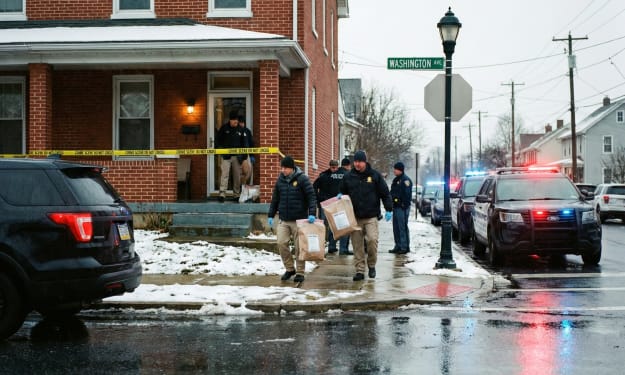
The Tuesday Morning Raid It started on Tuesday, January 6, 2026. Residents of Washington Avenue in Ephrata, Pennsylvania, are used to quiet mornings. But that day, the street was lined with unmarked cars. These weren't Ephrata police cruisers; they were detectives from the Yeadon Police Department in Delaware County, backed by state authorities.
By Sunshine Firecracker2 days ago in Criminal
So You Decided To Become a Nurse Practitioner:
So you decided to become an "Advanced Practice" nurse. Congratulations!... is what I would say if this was a good idea. Grad school? In this economy? What were you thinking? Likely it was something along the lines of either 1) “I've seen these other chucklefucks do it— Why can't I?” or even 2) “I've got a nice career, I should shake it up. I miss feeling like I have no clue what I'm doing.”
By Sandor Szaboabout 12 hours ago in Fiction



Comments
There are no comments for this story
Be the first to respond and start the conversation.