capital punishment
Weigh the pros, cons and controversies surrounding the grave issue of capital punishment; should the death penalty be allowed?
Reason First: William Kemmler’s Electric Ride
A hatchet sliced into Tillie Ziegler on March 29, 1889. The man holding the bloody murder weapon stood as William Kemmler. A jury found him guilty. A sentence stated that he should be put to death. As an uneducated swindler, Kemmler held onto bits and pieces of rage. For his crime, he would see that fury silenced as the first man to die from the electric chair.
By Skyler Saunders6 years ago in Criminal
Reason First: Bring back the Total Death Penalty in Delaware
A gurney with a body rolls into the forensics laboratory. It has only expired a few minutes ago. It is the corpse of a monster. A male convicted of multiple counts of rape perished behind prison walls. Good riddance. The evil man had died at the James T. Vaughn Correctional Center in Smyrna, Delaware. He succumbed due to his cancer. For the rapes, the state sentenced him to life in prison with an additional twenty years. Fortunately, science silenced this brute. It’s only right that he should die behind bars rather than reach a parole date which would have been extremely difficult with his sentence.
By Skyler Saunders6 years ago in Criminal
Unpopular Opinion:The Death Penalty Needs to be Suspended
What began as a public event soon became more private as executions were moved from outdoor gathering spaces to within prison walls. The death penalty has been in use in the United States since the mid-1600s. Early criminals were often put to death in front of jeering crowds who celebrated the act of execution. But the morbid desire to see people being killed was not diminished once executions were removed from public spaces. Crowds of people still clamored to gain entry to the exclusive events. The more publicized the crime, the more well-attended the execution.
By Lauryl Sandman6 years ago in Criminal
Delayed Death No More in Texas
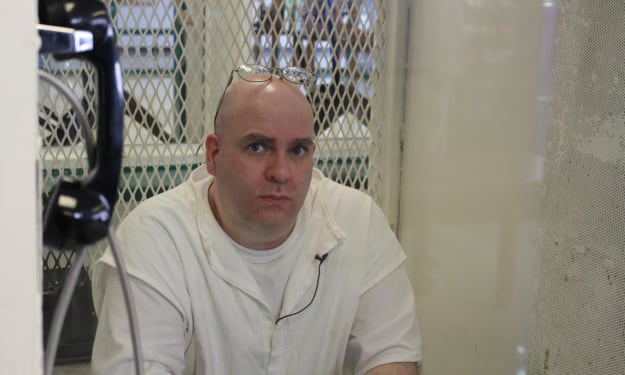
"Lord forgive them. They don't know what they are doing," those are the last words of convicted murderer Larry Swearingen. In July of 2000, a jury found Swearingen guilty of raping and murdering 19-year-old Melissa Trott. Crimes he adamantly denied committing, despite the "mountain of evidence" against him.
By Edward Anderson6 years ago in Criminal
Criminals & Society
Historically, society has attempted to discourage crime by making the punishment so horrible that nobody would want to take the risk of committing a crime. In an age where people aren’t afraid of death what can be done to scare them? What can we do in America where inmates consider lumpy potatoes to be "cruel and unusual punishment?"
By Joseline Burns7 years ago in Criminal
Waiting to Die
Dear Love, I’m not dead yet. It seems I’ve been waiting here forever just to die. I’m not all that surprised though; it doesn’t seem like anyone ever dies around here unless its from old age or a prison brawl. I heard one guy died here, after waiting forty years, from natural causes (“Nation’s Longest Serving Death Row Inmate Dies 40 Years After Conviction”). I hope I don’t do that. The anxiety of waiting would probably kill me first. I also heard that in the last forty years only thirteen people have been executed (Ron Briggs con 3). Thirteen! Can you believe that? Why bother putting us on death row if they aren’t even going to kill us? They might as well lock us up for life; it’s pretty much what they are doing anyways. Why do they want to kill us anyways? Do they find justice from it? Is killing me the only way they can feel at peace? Do they worry that I'll escape and cause more trouble? I don't want to live my life on the run. At least here I have food and shelter. There's no guarantee that I would get that out of here. Let me tell you, I thought killing that man who hurt me would give me peace, but it didn’t. It made everything worse. Do they think it will stop others? They obviously don’t know deterrence theory. I doubt they have even heard the term swiftness of punishment or certainty of punishment. It means that for a punishment to be a deterrence it has to happen soon after the sentencing and has to happen with certainty (Schram and Tibbetts 70 -71). Well, I’m still not dead and I’m not sure I ever will be killed. And if I hear one more time that killing me is the only way to keep me from killing again, I swear (George W. Bush pro 11). What about all the murders not on death row? The murders in prison are allowed to murder? What’s the point of regular prison if you really believe it won’t hold? Don’t even get me started on the brutalization effect. I still don’t understand how the death penalty isn’t just someone seeking revenge. Killing is killing, whether someone decides it's legal or not. Might as well let vigilantes do the work and save the police some time. Anyway, how are you? Did you fix your financial problem? You know it would be less of a problem if taxes weren’t so high. It costs you $384 million an execution to do it the ‘right way’ (con 3). Makes you wonder what a bullet would cost. But then again, it’s easier to say it’s not murder when nobody’s pulling the trigger. Plus, someone could miss with a bullet and fail the execution. Not that that ever happens with lethal injections or electrocutions. Oh wait, yeah it does. So who knows, maybe when they finally call my number I won’t die. I’ll just be a vegetable. There’s one guy in here that keeps getting his number called but keeps getting rescheduled (“Upcoming Executions”). Honestly, it seems like more people are getting rescheduled than executed. Anyways, I hope you’re doing well. I miss you, I love you. Hopefully this will all be over soon.
By Medea Walker7 years ago in Criminal
Why the Death Penalty Is 100% Justified, Forty-Nine Years After One of the Most Infamous Acts of Domestic Terrorism
When we think of the death penalty, there are only two types of opinions. The first type views capital punishment as hypocritical and inhumane, which is understandable. The second viewpoint is that punishment by death is justified and fair in cases of murder and terrorism. One case that got people talking about the death penalty was the infamous Manson Family case; this case is now considered an act of domestic terrorism. Do mass murder and domestic terrorism warrant capital punishment? Yes they do, as this can be seen as a justified punishment for crimes that are horrific beyond belief. Human life cannot be compensated for with money or other materialistic items. Nor will it ever be.
By Devin Louise7 years ago in Criminal
Make It Efficient, Practical, and Humane (**Essay**)
It was scheduled that inmate Ricky Gray is expected to be executed on March 16, 2016. But, what would happen to his conviction if the lethal injection was no longer an option? The theory of the electric chair is an open discussion, but some Congressmen will argue that it is in violation of the Constitution for being deemed a cruel and unusual of punishment. How can that be when even some of the most well-known states (such as, Arizona, California, and Oklahoma) still legalize demeaning gas chambers? The State of Virginia challenges that notion by proposing a death row bill that will promote the opportunity to explore other choices on how to bring justice when the court system convicts a person to die. The state is trying to get previous techniques re-approved for death row inmates in response to the now crisis of the insufficient stock of deadly chemicals. If the bill provides too much of a controversy, then the Virginian Correctional Facilities will be forced to look for alternative sedatives in order to create a completely new lethal drug formula. One problem still remains as a prominent factor with the passing of this bill is that humanity as a whole does not entirely agree with the Capital Punishment Law. The people would rather see the law be terminated permanently. Even though it may not be the most humane method, the State of Virginia proposes that electrocution can be more efficient and practical than the reliability of obtaining the drugs used for lethal injections.
By Robyn Welborne8 years ago in Criminal
Case Brief: ‘A Life for a Life?’
For money or for virtue? This is a question that many lawyers and politicians must make. For people in jobs like these, they are put in a position in which they are forced to decide either to do what they believe is right, or do what will guarantee them another paycheck. The case brief "A Life for a Life?" is about a House Member named Manny who needs to make a decision to vote for or against a bill that will get the death-penalty statute off the books in Florida (A Life for a Life). With second term elections coming up, and outside opinions clashing, Manny needs to make a firm decision. According to Virtue Ethics and Aristotle’s Philosophy, it would be unethical and, therefore, wrong for Manny to approve the bill that will get the death-penalty statute off the books in Florida because it would be going against key virtues in Manny’s life.
By Valerie Holt8 years ago in Criminal